
Tag Archives: canyon

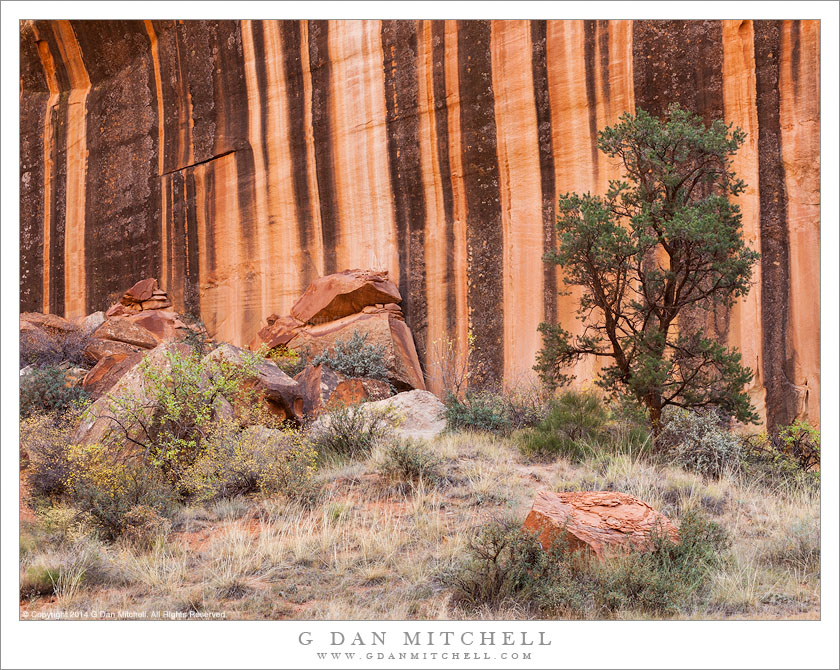
Sandstone Canyon Walls

Sandstone Canyon Walls
Detail of a fractured sandstone canyon walls at Capitol Reef National Park.

Sandstone Canyon Walls. Capitol Reef National Park, Utah. October 20, 2014. © Copyright 2014 G Dan Mitchell – all rights reserved.

Detail of a fractured sandstone cliff in a canyon at Capitol Reef National Park.

Over several years and several visits I began to understand Capitol Reef National Park a bit more. (Though it is a big and varied place, and true knowledge of the place — as is the case with any such landscape — comes from longer experience than I yet have.) Understanding comes partly from experiencing a wider range of the park’s geography than that in the most conveniently located places. Visiting during different parts of the year and in varied conditions helps — a sunny spring morning is very different from a freezing late October morning. Finding a few personal spots that feel like familiar friends is part of the process.

The sandstone-walled canyons are all over this part of the Southwest. I distinctly recall the first one I visited, walking into it in the morning, wading up canyon in the shallow stream, winding through its twists and turns as the canyon deepened. More visits taught me that each canyon has is own personality — yet some general features are shared by most of them. Unlike most of my Sierra Nevada world, where one often feels open to the entire sky, in the canyons the world shrinks to what you can see between two twists in the course of the stream that created the canyon. Views of the sky are extremely limited, and your focus soon turns almost exclusively to things that are nearby. There is little wind and usually the quiet is broken only by the sound of water, perhaps some birds, and your own passage. The light bounces among red rock walls and diffuses as it gently arrives from far above.


G Dan Mitchell is a California photographer and visual opportunist. His book, “California’s Fall Color: A Photographer’s Guide to Autumn in the Sierra” is available from Heyday Books and Amazon.
Blog | About | Flickr | Twitter | FacebookGoogle+ | LinkedIn | Email


All media © Copyright G Dan Mitchell and others as indicated. Any use requires advance permission from G Dan Mitchell.
Before The Dust Storm

Before The Dust Storm
Just after dawn, the precursors of a day of Death Valley dust storms

Before The Dust Storm. Death Valley National Park, California. April 28, 2016. © Copyright 2016 G Dan Mitchell – all rights reserved.

Just after dawn, the precursors of a day of Death Valley dust storms

I’ve been through a number of desert dust storms in and around Death Valley National Park — ranging from minor “dust blowing through the campsite” events to “damaging to my vehicle” events. (The latter was some years back as I left the park and headed out to highway 395 and, as I later found out, drove through record-breaking wind and driving dust and sand, to the permanent distress of my windshield.) It is fair to say that my feelings about such conditions are mixed. Frankly, they are very unpleasant — the dust gets into everything, from clothes to eyes to camera gear, and it is almost impossible to do much of anything if you are inside a really bad storm. In fact, near the end of the day on which I made this photograph we simply had to hunker down indoors for several hours and wait for it to stop. But there can be a kind of terrible beauty in these events as well, and if you are cautious you can photograph them.

I recall a day many years ago when I started to make sense of the antecedent conditions that lead to such storms. It was the final day of a Death Valley visit and I was down along the southeast part of the main valley, when I noticed a kind of fuzzy glow in the atmosphere. I made a few photographs and headed north to leave the park, and within an hour or so I was engulfed in a huge cloud of dust. On the day I made this photograph we went to a high overlook along the top of a mountain range to photograph dawn light. This time I recognized that strange, milky atmosphere, seen along and above the Black Mountains in the distance in the photograph. The morning was, indeed, quite beautiful. But it was only hours later that we began to see dust above us — even though we were thousands of feet up in the mountains — as a giant storm developed, and by the time we returned to the bottom of Death Valley in the mid-afternoon one of the biggest dust storms I have seen enveloped the area.


G Dan Mitchell is a California photographer and visual opportunist. His book, “California’s Fall Color: A Photographer’s Guide to Autumn in the Sierra” is available from Heyday Books and Amazon.
Blog | About | Flickr | Twitter | FacebookGoogle+ | LinkedIn | Email


All media © Copyright G Dan Mitchell and others as indicated. Any use requires advance permission from G Dan Mitchell.
Evening Shadows, Death Valley

Evening Shadows, Death Valley
The evening view down Trail Canyon, across Death Valley, and to the Black Mountains

Evening Shadows, Death Valley. Death Valley National Park, California. April 3, 2017. © Copyright 2017 G Dan Mitchell – all rights reserved.

The evening view down Trail Canyon, across Death Valley, and to the Black Mountains

The first day of any trip to Death Valley is often a long one for me. Typically it begins with a very early departure from the San Francisco Bay Area for the long drive down the Central Valley, east over Tehachapi Pass and then back to the north to reach the park. This year’s journey to the park was even longer since I took a first-day detour and briefly joined friends on the Carrizo Plain for an evening and a morning of wildflower photography. But the time I was on the road the second day it was mid-morning, and I arrived in Death Valley in the mid-afternoon to find winds and dust kicking up in the Valley. Not looking forward to camping in those conditions, I reconsidered and headed up to Wild Rose Canyon, where the mountains can provide some shelter.

I got there and found plenty of campsites. I grabbed one and just sat around for a while, recuperating from too much time behind the wheel. However, I knew that I wanted to do some photography on this first evening, so I worked up the energy to rise from my camp chair and head out to a favorite spot along the ridge of the Panamint Range. Often my Death Valley visits combine return visits to places I know well and want to continue to explore photographically with visits to places I haven’t been before. This spot is a very familiar one by now, and it seemed like and almost sure bet for this first evening. It was hazy — remember the wind and dust I just mentioned? — but as the color of the light warmed near the end of the day the landscape’s features became a bit more visible. This photograph looks across Trail Canyon in the foreground, with the late-day shadows already concealing the features of the ridge, toward the main portion of Death Valley, with its large salt flats. Beyond lie the Black Mountains and the southern boundary of the park, with further mountains just barely visible through the distant haze.


G Dan Mitchell is a California photographer and visual opportunist. His book, “California’s Fall Color: A Photographer’s Guide to Autumn in the Sierra” is available from Heyday Books and Amazon.
Blog | About | Flickr | Twitter | FacebookGoogle+ | LinkedIn | Email


All media © Copyright G Dan Mitchell and others as indicated. Any use requires advance permission from G Dan Mitchell.
Lenticular Clouds, Death Valley

Lenticular Clouds, Death Valley
Dawn lenticular clouds from above the Black Mountains and Death Valley

Lenticular Clouds, Death Valley. Death Valley National Park, California. April 7, 2017. © Copyright 2017 G Dan Mitchell – all rights reserved.

Dawn lenticular clouds from above the Black Mountains and Death Valley

After a cold and windy final night camping in the Panamint Mountains of Death Valley National Park this spring, I woke up early and headed to an overlook along the summit ridge for the range before dawn. The most typical experience here is to watch the sun rise into clear skies above the desert landscape, but this time a weather system was approaching. It was cold, extremely windy, and the sky was filled with dark clouds. The only sunrise color I saw was along a distant band of light at the horizon, produced by clearer skies far to the southeast.

I had seen the giant lenticular cloud forming the previous afternoon. These clouds are almost a part of the landscape at times, arising in predictable locations and formed by interactions between the atmosphere and features such as mountain ridges. Unlike other clouds, the lenticular can remain almost stationary for long periods of time — but this is the first time I’ve awakened to see clouds from the previous day still there. The choice to use a monochrome interpretation allowed me greater interpretative latitude in the final image, and this let me draw attention to certain shapes mirrored by the clouds and the geology in the scene.


G Dan Mitchell is a California photographer and visual opportunist. His book, “California’s Fall Color: A Photographer’s Guide to Autumn in the Sierra” is available from Heyday Books and Amazon.
Blog | About | Flickr | Twitter | FacebookGoogle+ | LinkedIn | Email


All media © Copyright G Dan Mitchell and others as indicated. Any use requires advance permission from G Dan Mitchell.