
Tag Archives: canyon

Plants, Canyon Wall

Plants, Canyon Wall
Plants, Canyon Wall

Plants, Canyon Wall. Death Valley National Park, California. April 1, 2014. © Copyright 2014 G Dan Mitchell – all rights reserved.

Plants grow from thin cracks in the rock wall of a desert canyon, Death Valley National Park

I found this little scene in a well-known Death Valley Canyon, where the walls become vertical, hundreds of feet high, and quite close together. Canyons like this are some strange combination of beautiful — with soft light, colorful rock, shade — and harsh — with the clear evidence of flooding that periodically sweeps through and rearranges everything, against a backdrop of more typical aridity, and a terrain almost entirely consisting of rock.

In these places I am always intrigued by where and how plant life manages to survive. This is nowhere more true than in such canyons in Death Valley National Park, where the usual challenges are made worse by extreme heat and dryness. Here two kinds of plants have managed to find a foothold, but in must be a very tenuous one. The grow from thin cracks in solid rock, a good distance above whatever water comes during the periodic flooding of the wash, in an environment in which the light is most often muted yet in which extreme temperatures are common for much of the year.

G Dan Mitchell is a California photographer and visual opportunist whose subjects include the Pacific coast, redwood forests, central California oak/grasslands, the Sierra Nevada, California deserts, urban landscapes, night photography, and more.
Blog | About | Flickr | Twitter | FacebookGoogle+ | 500px.com | LinkedIn | Email

Text, photographs, and other media are © Copyright G Dan Mitchell (or others when indicated) and are not in the public domain and may not be used on websites, blogs, or in other media without advance permission from G Dan Mitchell.
Rusting Building, Leadfield

Rusting Building, Leadfield

Rusting Building, Leadfield. Death Valley National Park, California. April 1, 2014. © Copyright 2014 G Dan Mitchell – all rights reserved.

A rusting corrugated building, one of the few remaining structures at the ghost town of Leadfield, California

This is one of the few standing structures remaining from the boom town of Leadfield, in the backcountry of Death Valley National Park, in the Grapevine Mountains more or less midway between the Beatty, Nevada area and the main Death Valley. The standard story is that this town was the result of one of the biggest swindles and scams in the mining history of the area, and the story is often told of the main promoter salting the mine with ore brought in from other locations and producing brochures featuring boats on the Amargosa River… which is typically completely dry. In the process of preparing this photograph to share I did a bit of reading, and it seems like the story might not be quite so simple nor so dramatic. Apparently there was a history of prospecting and mining in this area before the town was created in the mid-1920s, and lead and perhaps silver were actually mined from the place. A range of problems led to its downfall—the distance the ore needed to be transported, problems with the sale of shares in the mines—but it may not be true that the mine itself was essentially just a scam.

This building is well-known to those who have visited the place, as it is one of two buildings that still stand. Both are located near the entrance to one of the mine shafts, and it seems likely that this was not a residence but rather some building related to mine operations. Today it is a mere shell, but I find it amazing that it still stands nearly 90 years after the “town” (which apparently consisted largely of tents) was abandoned. Even more amazing is to stand at this spot and look out at the surrounding landscape—a rugged and uncompromising mountainous desert terrain—and imagine what it must have been like to live and work in such a place.

G Dan Mitchell is a California photographer and visual opportunist whose subjects include the Pacific coast, redwood forests, central California oak/grasslands, the Sierra Nevada, California deserts, urban landscapes, night photography, and more.
Blog | About | Flickr | Twitter | FacebookGoogle+ | 500px.com | LinkedIn | Email

Text, photographs, and other media are © Copyright G Dan Mitchell (or others when indicated) and are not in the public domain and may not be used on websites, blogs, or in other media without advance permission from G Dan Mitchell.
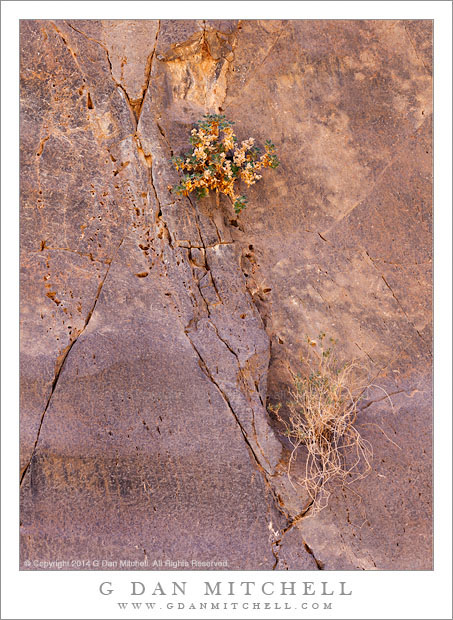
Curves, Desert Canyon

Curves, Desert Canyon

Curves, Desert Canyon. Death Valley National Park. April 1, 2014. © Copyright 2014 G Dan Mitchell – all rights reserved.

Small dry plants grow in a curving crack in a two-toned desert canyon, Death Valley National Park

Passing through this deep and narrow canyon, I always watch the rock walls for little odds and ends of shape and form and color and occasional surprising bits of vegetation. If you had asked me about this section of canyon after my first passage some years ago, I might well have mentioned how narrow and deep it is and perhaps how dusty. I might have commented on the way the bottom remains in shade even in the midday heat. But repeated visits have shown me that there is much more to see, and the fact that I still see new things on every visit tells me that there is far more yet to be discovered.

On one hand this is a pretty plain photograph of some rocks with cracks running through them. On the other hand, I think there are some stories behind the scent that are interesting to contemplate. At least I think so! If you look closely you will see some very dry plants that have grown in this curving crack. It is hard to imagine a more inhospitable place for a plant to grow—perhaps a dozen feet up the nearly solid rock wall of an arid and hot desert canyon. Yet somehow these plants found a way, as did and do many other plants throughout this desert landscape. Behind the small, delicate, and even intimate element of these plants is the backdrop of a small section of a massive rock wall that towers out of sight above the frame of the photograph. Here is a boundary between two sorts of rock—I’m not enough to a geologist to make technical observations, but I do note that the upper layer is darker and more solid while the lower is lighter and has more cracks in its surface. From the upper left a crack follows the junction of the two rock layers, but for some reason the crack leaves the junction and curves back upwards into the darker rock, and it is in this surprising bit of geological dissonance that the small plants took root.

G Dan Mitchell is a California photographer and visual opportunist whose subjects include the Pacific coast, redwood forests, central California oak/grasslands, the Sierra Nevada, California deserts, urban landscapes, night photography, and more.
Blog | About | Flickr | Twitter | FacebookGoogle+ | 500px.com | LinkedIn | Email

Text, photographs, and other media are © Copyright G Dan Mitchell (or others when indicated) and are not in the public domain and may not be used on websites, blogs, or in other media without advance permission from G Dan Mitchell.

Desert Holly, Black Formation

Desert Holly, Black Formation

Desert Holly, Black Formation. Death Valley National Park, California. April 3, 2014. © Copyright 2014 G Dan Mitchell – all rights reserved.

Desert Holly plants grow on a black formation, Death Valley National Park

This area of Death Valley National Park, not far from the popular Zabriskie Point overlook, shares some of the same geology with that often crowded location. However, you don’t have to go too far from that parking lot to find locations where you can be almost alone, especially early in the morning. This area is one such spot—easily accessible but not marked in any sort of obvious way. Yet it is a great place to spend hours looking at geological forms, sparse plants, and spare effects of light and color.

The desert holly plants grow in some of the most arid locations, and often appear to be the only plants that are able to survive where it grows. You might find a plant or two in a rocky wash, growing out of a crack in a rock wall, or on this dark (volcanic?) material. One can only imagine how hot this black earth must get in the heat of the Death Valley summer! Besides often being the only visible living thing in some very stark areas, desert holly also can change its appearance depending upon how the leaves are doing and on where the light comes from. Light from behind the plant can make it take on an almost golden glow.

G Dan Mitchell is a California photographer and visual opportunist whose subjects include the Pacific coast, redwood forests, central California oak/grasslands, the Sierra Nevada, California deserts, urban landscapes, night photography, and more.
Blog | About | Flickr | Twitter | FacebookGoogle+ | 500px.com | LinkedIn | Email

Text, photographs, and other media are © Copyright G Dan Mitchell (or others when indicated) and are not in the public domain and may not be used on websites, blogs, or in other media without advance permission from G Dan Mitchell.