
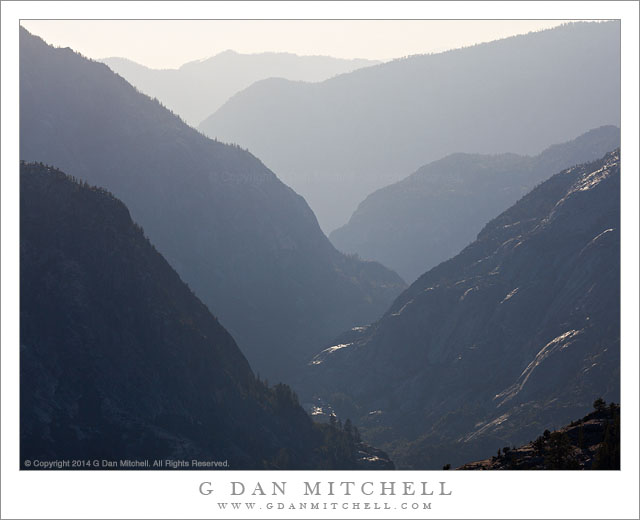
Tag Archives: canyon

Rusting Building, Leadfield

Rusting Building, Leadfield

Rusting Building, Leadfield. Death Valley National Park, California. April 1, 2014. © Copyright 2014 G Dan Mitchell – all rights reserved.

A rusting corrugated building, one of the few remaining structures at the ghost town of Leadfield, California

This is one of the few standing structures remaining from the boom town of Leadfield, in the backcountry of Death Valley National Park, in the Grapevine Mountains more or less midway between the Beatty, Nevada area and the main Death Valley. The standard story is that this town was the result of one of the biggest swindles and scams in the mining history of the area, and the story is often told of the main promoter salting the mine with ore brought in from other locations and producing brochures featuring boats on the Amargosa River… which is typically completely dry. In the process of preparing this photograph to share I did a bit of reading, and it seems like the story might not be quite so simple nor so dramatic. Apparently there was a history of prospecting and mining in this area before the town was created in the mid-1920s, and lead and perhaps silver were actually mined from the place. A range of problems led to its downfall—the distance the ore needed to be transported, problems with the sale of shares in the mines—but it may not be true that the mine itself was essentially just a scam.

This building is well-known to those who have visited the place, as it is one of two buildings that still stand. Both are located near the entrance to one of the mine shafts, and it seems likely that this was not a residence but rather some building related to mine operations. Today it is a mere shell, but I find it amazing that it still stands nearly 90 years after the “town” (which apparently consisted largely of tents) was abandoned. Even more amazing is to stand at this spot and look out at the surrounding landscape—a rugged and uncompromising mountainous desert terrain—and imagine what it must have been like to live and work in such a place.

G Dan Mitchell is a California photographer and visual opportunist whose subjects include the Pacific coast, redwood forests, central California oak/grasslands, the Sierra Nevada, California deserts, urban landscapes, night photography, and more.
Blog | About | Flickr | Twitter | FacebookGoogle+ | 500px.com | LinkedIn | Email

Text, photographs, and other media are © Copyright G Dan Mitchell (or others when indicated) and are not in the public domain and may not be used on websites, blogs, or in other media without advance permission from G Dan Mitchell.
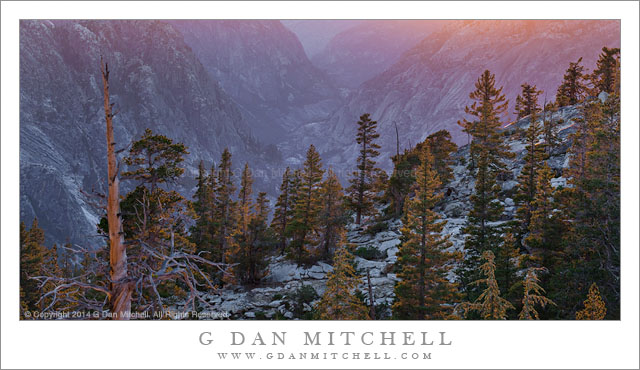
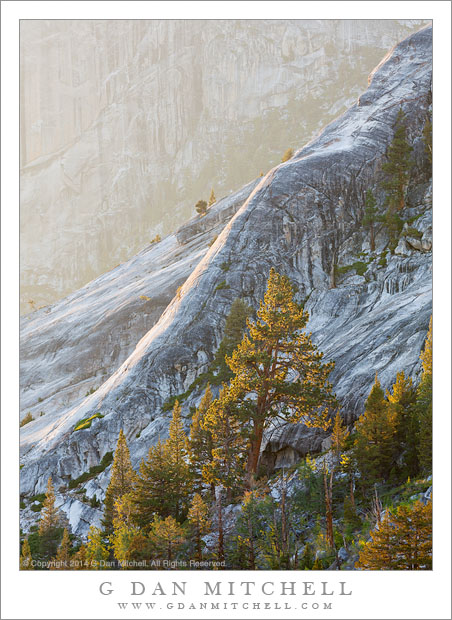
Curves, Desert Canyon

Curves, Desert Canyon

Curves, Desert Canyon. Death Valley National Park. April 1, 2014. © Copyright 2014 G Dan Mitchell – all rights reserved.

Small dry plants grow in a curving crack in a two-toned desert canyon, Death Valley National Park

Passing through this deep and narrow canyon, I always watch the rock walls for little odds and ends of shape and form and color and occasional surprising bits of vegetation. If you had asked me about this section of canyon after my first passage some years ago, I might well have mentioned how narrow and deep it is and perhaps how dusty. I might have commented on the way the bottom remains in shade even in the midday heat. But repeated visits have shown me that there is much more to see, and the fact that I still see new things on every visit tells me that there is far more yet to be discovered.

On one hand this is a pretty plain photograph of some rocks with cracks running through them. On the other hand, I think there are some stories behind the scent that are interesting to contemplate. At least I think so! If you look closely you will see some very dry plants that have grown in this curving crack. It is hard to imagine a more inhospitable place for a plant to grow—perhaps a dozen feet up the nearly solid rock wall of an arid and hot desert canyon. Yet somehow these plants found a way, as did and do many other plants throughout this desert landscape. Behind the small, delicate, and even intimate element of these plants is the backdrop of a small section of a massive rock wall that towers out of sight above the frame of the photograph. Here is a boundary between two sorts of rock—I’m not enough to a geologist to make technical observations, but I do note that the upper layer is darker and more solid while the lower is lighter and has more cracks in its surface. From the upper left a crack follows the junction of the two rock layers, but for some reason the crack leaves the junction and curves back upwards into the darker rock, and it is in this surprising bit of geological dissonance that the small plants took root.

G Dan Mitchell is a California photographer and visual opportunist whose subjects include the Pacific coast, redwood forests, central California oak/grasslands, the Sierra Nevada, California deserts, urban landscapes, night photography, and more.
Blog | About | Flickr | Twitter | FacebookGoogle+ | 500px.com | LinkedIn | Email

Text, photographs, and other media are © Copyright G Dan Mitchell (or others when indicated) and are not in the public domain and may not be used on websites, blogs, or in other media without advance permission from G Dan Mitchell.
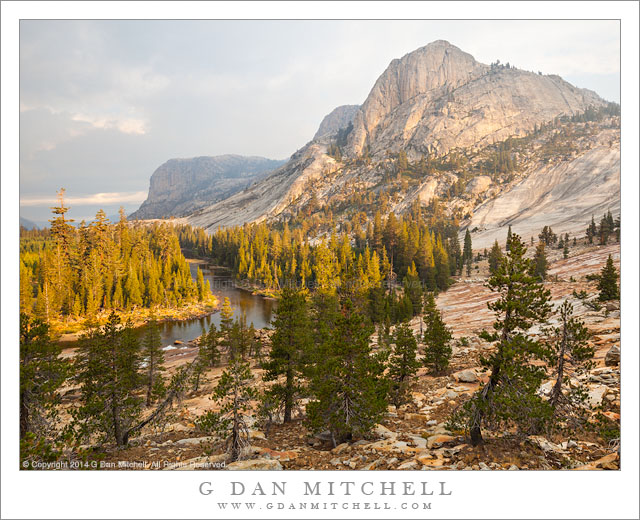
Desert Holly, Black Formation

Desert Holly, Black Formation

Desert Holly, Black Formation. Death Valley National Park, California. April 3, 2014. © Copyright 2014 G Dan Mitchell – all rights reserved.

Desert Holly plants grow on a black formation, Death Valley National Park

This area of Death Valley National Park, not far from the popular Zabriskie Point overlook, shares some of the same geology with that often crowded location. However, you don’t have to go too far from that parking lot to find locations where you can be almost alone, especially early in the morning. This area is one such spot—easily accessible but not marked in any sort of obvious way. Yet it is a great place to spend hours looking at geological forms, sparse plants, and spare effects of light and color.

The desert holly plants grow in some of the most arid locations, and often appear to be the only plants that are able to survive where it grows. You might find a plant or two in a rocky wash, growing out of a crack in a rock wall, or on this dark (volcanic?) material. One can only imagine how hot this black earth must get in the heat of the Death Valley summer! Besides often being the only visible living thing in some very stark areas, desert holly also can change its appearance depending upon how the leaves are doing and on where the light comes from. Light from behind the plant can make it take on an almost golden glow.

G Dan Mitchell is a California photographer and visual opportunist whose subjects include the Pacific coast, redwood forests, central California oak/grasslands, the Sierra Nevada, California deserts, urban landscapes, night photography, and more.
Blog | About | Flickr | Twitter | FacebookGoogle+ | 500px.com | LinkedIn | Email

Text, photographs, and other media are © Copyright G Dan Mitchell (or others when indicated) and are not in the public domain and may not be used on websites, blogs, or in other media without advance permission from G Dan Mitchell.

A Reprise: “Fractured Granite, Reflections”

Fractured Granite, Reflection, Sequoia-Kings Canyon National Parks
“Fractured Granite, Reflection” — The base of a rugged granite wall reflected in the still surface of a sub-alpine Sierra Nevada lake

Today I am reprising a photograph that I shared previously since it is part of the Yosemite Renaissance XXIX exhibit opening this weekend in the Yosemite Museum Gallery in The Valley. 

An exhibition of contemporary art of Yosemite and the Sierra
Saturday, March 1 to Sunday, May 11, 2014
Yosemite Museum Gallery, Yosemite National Park

The first event of the show is tonight

The public is invited to the
Awards Reception, Friday, February 28 from 5:30 to 7:30 PM

Perhaps I’ll see you there!

Now, to the text of the original post, plus a more recent addition…

Fractured Granite, Reflections. Kings Canyon National Park, California. September 15, 2013. © Copyright 2013 G Dan Mitchell – all rights reserved.

The base of a rugged granite wall reflected in the still surface of a sub-alpine Sierra Nevada lake

A few days ago I returned from a 9-day trip into the back-country of Kings Canyon National Park. I was one of a group of four photographers who traveled to a remote location at about 11,000′, where we remained for more than five days, photographing the surrounding terrain morning and evening. We followed the common routine of such work – up before dawn and off to investigate and photograph some valley or lake, back by mid or late morning for breakfast, generally hanging out and doing camp chores during the midday period when the light is often less exciting, then back out in the late afternoon for a few more hours of exploration and photography before returning to camp for a post-sunset dinner. Unlike a typical backpack trip, where one rarely stays in the same place for long, we remained in the same camp for six nights, allowing us to really get to know the surrounding area very well.

With so much time, we were frequently able to return to places that we had already visited – perhaps coming back in the evening after a morning visit, returning to try again to catch a subject that didn’t have the right light the first time, or shooting the subject in various conditions ranging from clear skies to rain. This bit of interesting rock was next to a lake that I walked to on a number of occasions, and on this morning I arrived when the lake was still in shadow but illuminated by light reflected from nearby rock faces. Because it was so early the air was very still, allowing me to photograph this very sharp reflection of the fractured granite cliff where it entered the water. A bit of vegetation just above the waterline has taken on early fall colors.

Addendum: It occurred to me last week that there is a (perhaps tenuous?) connection between this photograph – with its theme of a vertical rock face above placid water – and this one by Ansel Adams that I had an early connection to: http://www.christies.com/lotfinder/photographs/ansel-adams-lake-precipice-frozen-lake-and-5056399-details.aspx – I have a personal connection to the place, which I wrote about here: https://gdanmitchell.com/2010/01/14/a-photograph-exposed-submerged-boulders-precipice-lake


G Dan Mitchell is a California photographer and visual opportunist. His book, “California’s Fall Color: A Photographer’s Guide to Autumn in the Sierra” (Heyday Books) is available directly from him.

G Dan Mitchell: Blog | Bluesky | Mastodon | Substack Notes | Flickr | Email


All media © Copyright G Dan Mitchell and others as indicated. Any use requires advance permission from G Dan Mitchell.