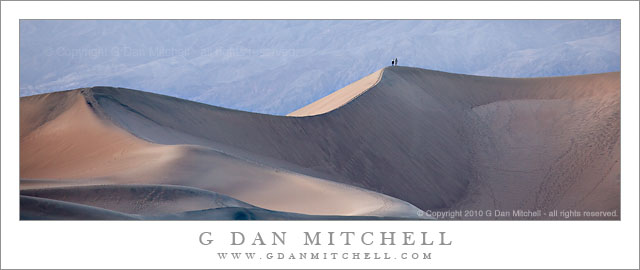
Two hikers take in the evening landscape of Death Valley National Park from the Summit of the dunes.
Many times I might have been disappointed to have two hikers enter “my” scene in such beautiful dusk light, but here I feel like they crystalize the scene. In a larger version of the photograph the two of them seem to stand silently facing the rugged vastness of Death Valley – and I think their presence invites us to think of ourselves in the scene and to imagine our own reaction to it.
My favorite time to photograph these iconic dunes near Stovepipe Wells is in the evening during a brief interval right around sunset and lasting a while after the sun drops behind the peaks to the west. The light softens, especially if there is a bit of haze in the sky, and the dunes that are so bright and harsh at other times of day take on a smoother and softer quality and their subtle colors become visible.
This photograph is not in the public domain and may not be used on websites, blogs, or in other media without advance permission from G Dan Mitchell.
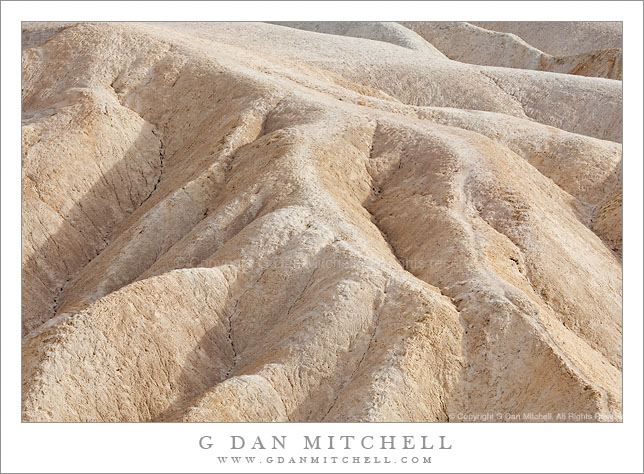
Slightly overcast afternoon light on erosion patterns in the Gower Gulch area of Zabriskie Point, Death Valley National Park, California.
After posting such a long string of close views of the hills at Zabriskie Point… it is starting to become difficult to say much original and new about the photographs in this series! This one was made rather late in the afternoon – about 4:00 p.m. – when the light is usually still too harsh and bright for most photography here. Fortunately, some high and thin clouds diffused the light a bit – but still didn’t take the light too far in the soft direction.
It perhaps goes without saying that this another in my series of long-lens studies of small elements of the large and iconic scene at this location. I’ve photographed this particular bit of folded geology before, and I’m still interested in the combination of soft, almost organic shapes and the crazy patterns of lines and shapes heading every which way. From lower left to upper right the lines shift almost completely.
This photograph is not in the public domain and may not be used on websites, blogs, or in other media without advance permission from G Dan Mitchell.
Technical Data:
Canon EOS 5D Mark II
Canon EF 100-400mm f/4.5-5.6 L IS USM at 200mm
ISO 100, f/16, 1/60 second
keywords: gower, gulch, zabriskie, point, erosion, gully, ridge, hill, crack, dirt, curve, fold, geology, shadow, light, afternoon, overcast, diffuse, death valley, national, park, california, usa, north america, landscape, nature, scenic, travel, detail, stock
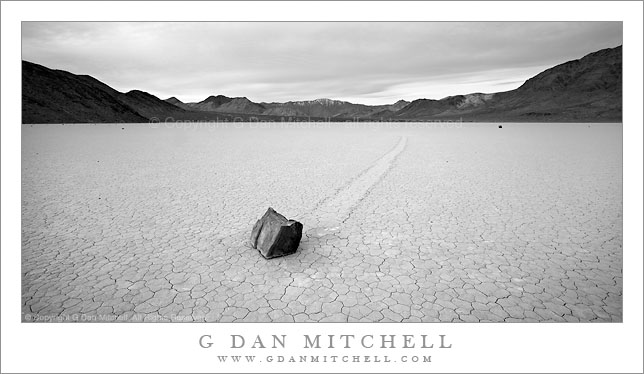
Black and white panoramic format photograph of a moving rock at Racetrack Playa, Death Valley National Park, California.
This photograph probably belongs in the “trying to turn lemons into lemonade” file. I’ve had wonderful luck with great light on all of my previous visits to the remote Racetrack Playa in Death Valley, the site of the “moving rocks” that have left tracks in their wake across the playa surface. However, my string luck seemed to run out on this late March visit. Earlier in the day as I contemplated whether or not to head out there I noticed some budding lenticular clouds to the north and made the decision to go. My preference is to have some clouds at the Racetrack, as perfectly clear sky isn’t as interesting in my view. Plus I always have in mind a particular previous visit when I photographed the playa at dawn with beautiful lenticulars building over the mountains to the north of the playa, and I think I’m always hoping for similar conditions again.
The plan on this visit was to arrive in the mid-afternoon to shoot the Grandstand, a formation near where the road first arrives at the playa, and to then photograph the beautiful evening light, the full moon (in the evening and then again before dawn) and finally the dawn light. The conditions continued to look great as I did the long washboard drive to the playa, and I arrived and photographed the Grandstand as planned. However, as I finished up here a high band of clouds moved across the sky and flattened out the light. As evening came on I was out on the playa, but the clouds remained and the light was not remarkable. I finally wandered back off the playa after dark, hoping that the clouds would clear and allow full moon photography. This never happened, and when I returned to the playa early in the morning the overcast was still present, with only a thin area of blue sky far to the west.
But I photographed anyway. Softer, overcast light has its potential, and since I was there I was certainly not going to waste the opportunity. In the end, I wasn’t thrilled with what I brought back for the most part, though I do like the effect of the overcast and the softer light on this black and white photograph of one of the more recognizable rocks. (By the way, the rest of my Death Valley visit went much better than this one night!)
This photograph is not in the public domain and may not be used on websites, blogs, or in other media without advance permission from G Dan Mitchell.
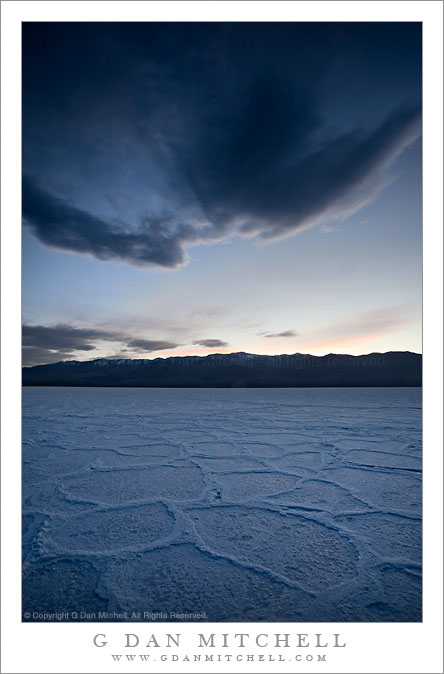
Last light of the day over the Panamint Range casts its glow on Badwater Basin salt flats and clouds.
In what may be the last gasp of my obvious attempt to extract as many photographs as possible from this late March evening in Badwater Basin, here is yet another. This one was photographed well after the sun had set, and I had turned my camera away from the expansive view north into Death Valley and to the east towards the Panamint Range and Telescope Peak over which I saw this wing-shaped cloud. While there was a thin band of relatively bright sky above the Panamint Range, everything else was heading quickly toward twilight. (The longer exposures listed in the “technical data” below will confirm the light levels.)
I’ve previously mentioned the subjective issue of how to handle the very blue tone of the “white” salt formations here. The salt is, no doubt, really white – but after the sun dips below the Panamint Range the only light is that of the very blue sky, and the salt picks this up. If you think about it you can see it on the scene, but when you look at the photographs later it is absolutely clear. I’ve been thinking for several weeks about how I’d handle this one, and I decided over a week ago that I’d “go for the blue” with this rendition.
This photograph is not in the public domain and may not be used on websites, blogs, or in other media without advance permission from G Dan Mitchell.
Technical Data:
Canon EOS 5D Mark II
Canon EF 17-40mm f/4 L USM at 17mm
ISO 100, f/16, composite of .8 second and 1.3 second exposures
keywords: panamint, mountain, range, badwater, basin, salt, flats, polygons, desert, death valley, national, park, california, usa, north america, landscape, travel, scenic, dusk, twilight, sunset, cloud, large, dark, sky, nature, blue, evening, pink, stock, pattern
Photographer and visual opportunist. Daily photos since 2005, plus articles, reviews, news, and ideas.
Manage Consent
To provide the best experiences, we use technologies like cookies to store and/or access device information. Consenting to these technologies will allow us to process data such as browsing behavior or unique IDs on this site. Not consenting or withdrawing consent, may adversely affect certain features and functions.
Functional
Always active
The technical storage or access is strictly necessary for the legitimate purpose of enabling the use of a specific service explicitly requested by the subscriber or user, or for the sole purpose of carrying out the transmission of a communication over an electronic communications network.
Preferences
The technical storage or access is necessary for the legitimate purpose of storing preferences that are not requested by the subscriber or user.
Statistics
The technical storage or access that is used exclusively for statistical purposes.The technical storage or access that is used exclusively for anonymous statistical purposes. Without a subpoena, voluntary compliance on the part of your Internet Service Provider, or additional records from a third party, information stored or retrieved for this purpose alone cannot usually be used to identify you.
Marketing
The technical storage or access is required to create user profiles to send advertising, or to track the user on a website or across several websites for similar marketing purposes.