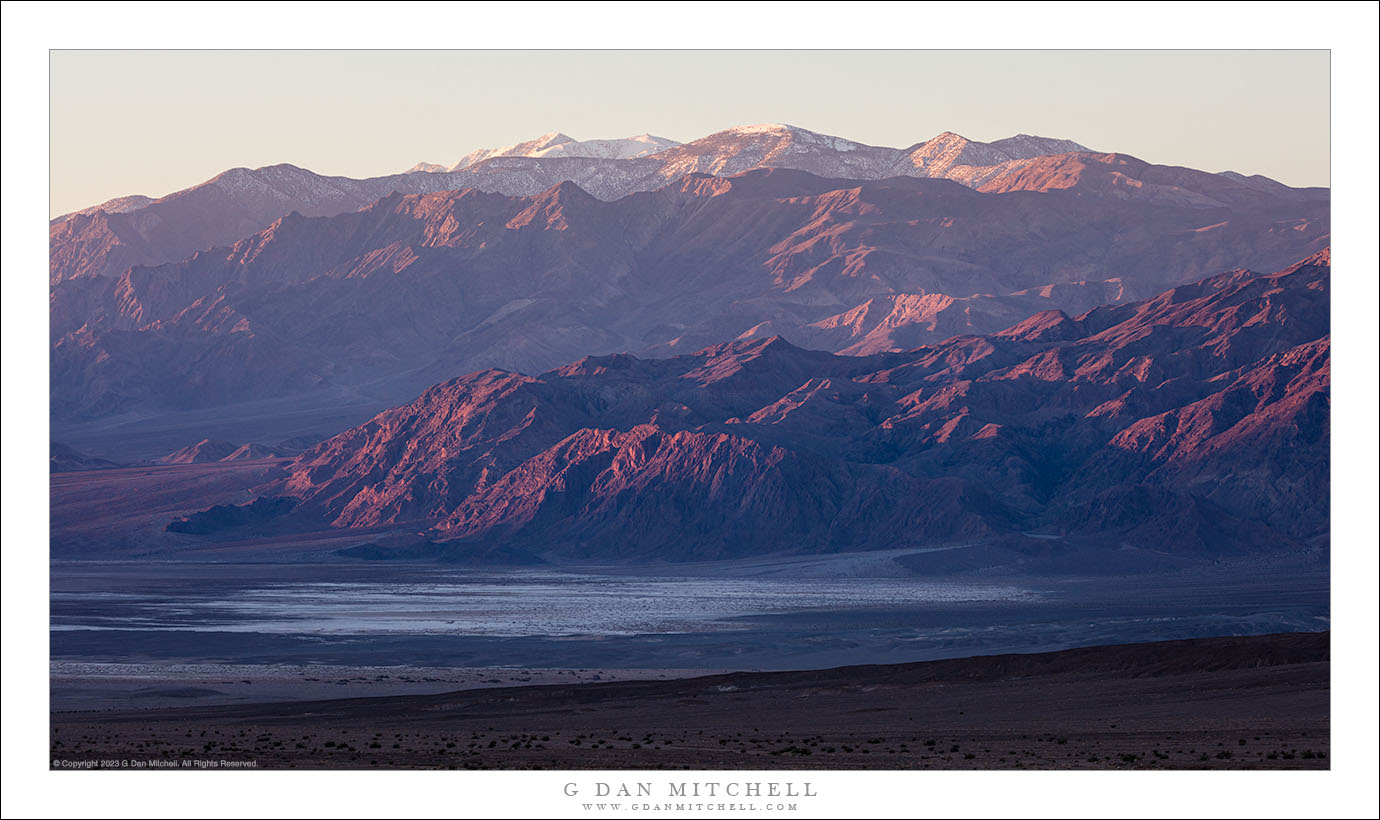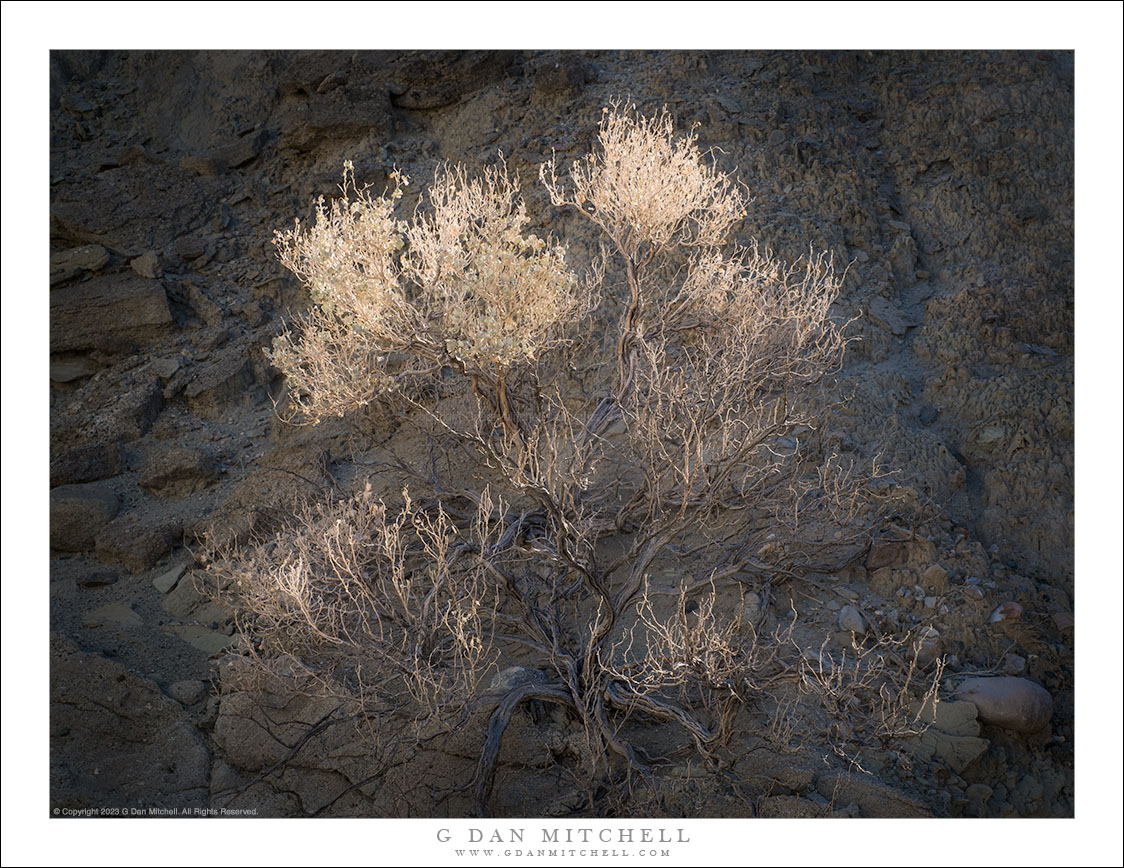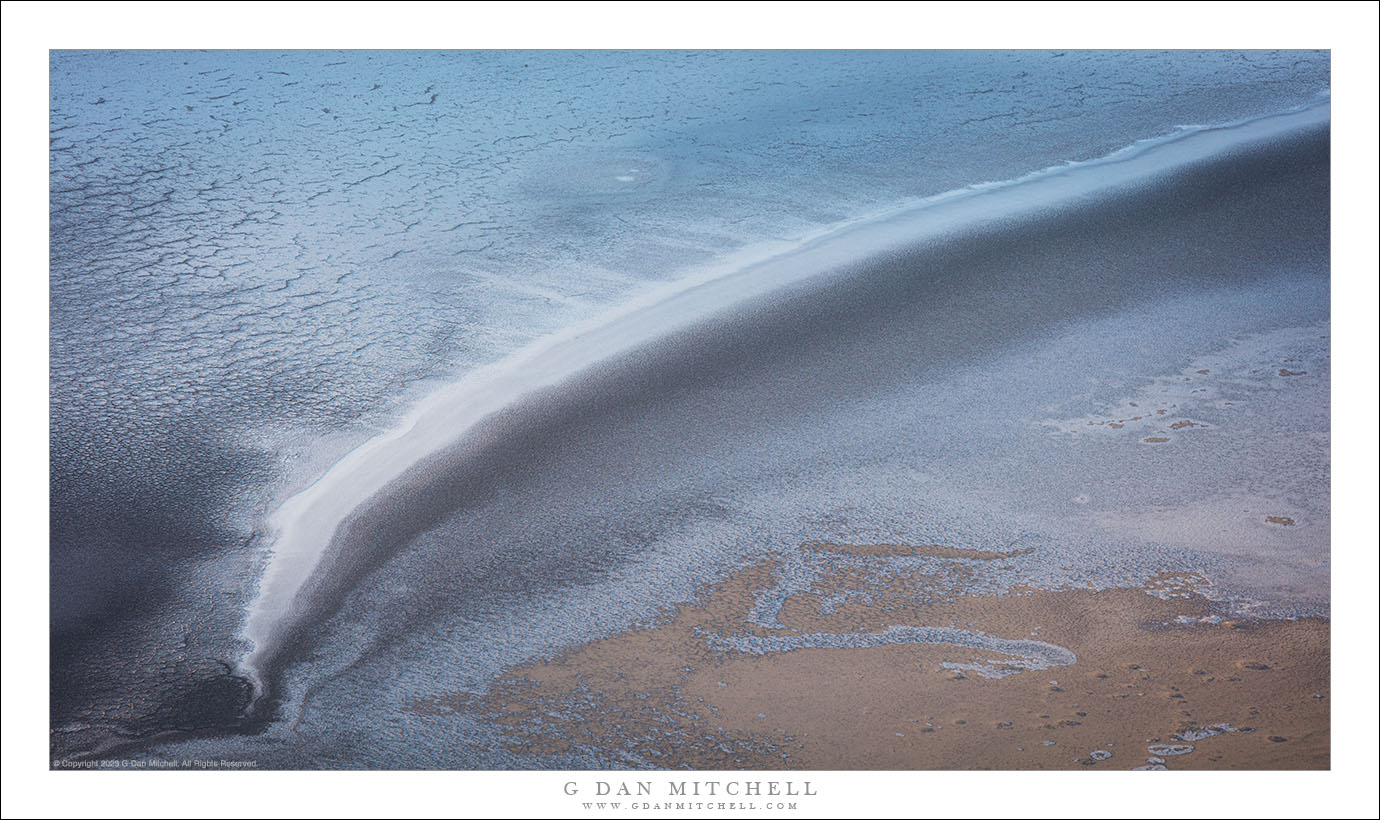
I’m excited to announce that ELEMENTS Magazine has published my article on “Death Valley National Park: Photographing the Desert Landscape” in their August 2022 issue. It is an honor to have my photography and writing appear in the company of work by photographers I admire.
Morning light creates stark contrasts between ridges and shadows on Death Valley badlands landscape.
Believe it or not, I’m still not quite done with this year’s Death Valley photographs. I’ve been sitting on this one for a week or two, pondering several things about it, but now I think I’m done with it. It may be the final one from this year’s very productive visits to the park. We’ll see! (Looking ahead, there’s a good chance that a year from now I’ll review the files and find at least one more.)
This is perhaps the place to again mention the typical cycle I go through when I return with photographs from a location. I open up the collection, and a few typically jump out at me immediately. These will not necessarily be “the best” of the group, but they are photographs that are fairly straightforward to process and work more or less as I expected when I exposed them. Then I go back through the files and begin to work on likely prospects that will require more thought. (Often the best work comes from this pass.) But this isn’t the end of it, and next I look again, this time trying to see the work with a different perspective. Here I often “discover” how to “see” photographs that did not initially seem like they would work. Finally (or maybe not?) I make one more serious traverse of the work to see what I might have missed. And with that — at least until I come back to the files in a year or so — it is on to new projects!
G Dan Mitchell is a California photographer and visual opportunist. His book, “California’s Fall Color: A Photographer’s Guide to Autumn in the Sierra” is available from Heyday Books, Amazon, and directly from G Dan Mitchell.
Varied sand patterns on a fold in dunes at Death Valley National Park.
One of the myths about sand dunes is that their features are in motion, being blown across the landscape by winds. The fact that so many features — ripples, waves — remind us of water reinforces the illusion. But here the fluidity is of a largely static sort, and these features tend to remain in much the same place over long periods of time.
The reasons that dunes come into existence begin to be obvious when ou get to know them. They tend to be in windy places where natural features obstruct, divert, and slow the winds, causing them to drop their load of airborne dust and sand. While these broad features are easy to understand, I remain mystified by the smaller scale features like those seen in this “intimate landscape” photograph — the waves, ridges, valleys, drop-offs that also tend to remain fixed.
G Dan Mitchell is a California photographer and visual opportunist. His book, “California’s Fall Color: A Photographer’s Guide to Autumn in the Sierra” is available from Heyday Books, Amazon, and directly from G Dan Mitchell.
Soft early-evening light on sand dunes as the last sun strikes distant desert mountains.
Photographers (and other creatives) understand that their perspective on their own work will always differ from those of others. It cannot be any other way. Only the photographer — that’s me! — knows the circumstances and experiences of making the image. No one else can ever see the photograph the way I do or know all of the associations it evokes. Perhaps this is a reason that we tell stories about photographs. We hope to fill in some of what the photograph alone cannot tell.
So, some backstory: This was the first time I visited at this semi-remote desert location. I planned to photograph in the evening, camp nearby that night, and photograph again in the morning. My camp was a bit more than a half hour walk from the location, and this was the very last photograph I made that evening. Astute observers (and fellow photographers) may wonder: “Why did you stop when that light was still on the mountains?” Well… I was there to photograph the dunes. It was extremely windy and the low light was becoming more of a problem. The light on the mountains was beautiful, but there wasn’t a photograph there. And I had a long walk back to my camp, alone and across terrain that I had not visited before.
G Dan Mitchell is a California photographer and visual opportunist. His book, “California’s Fall Color: A Photographer’s Guide to Autumn in the Sierra” is available from Heyday Books, Amazon, and directly from G Dan Mitchell.
Photographer and visual opportunist. Daily photos since 2005, plus articles, reviews, news, and ideas.
Manage Consent
To provide the best experiences, we use technologies like cookies to store and/or access device information. Consenting to these technologies will allow us to process data such as browsing behavior or unique IDs on this site. Not consenting or withdrawing consent, may adversely affect certain features and functions.
Functional
Always active
The technical storage or access is strictly necessary for the legitimate purpose of enabling the use of a specific service explicitly requested by the subscriber or user, or for the sole purpose of carrying out the transmission of a communication over an electronic communications network.
Preferences
The technical storage or access is necessary for the legitimate purpose of storing preferences that are not requested by the subscriber or user.
Statistics
The technical storage or access that is used exclusively for statistical purposes.The technical storage or access that is used exclusively for anonymous statistical purposes. Without a subpoena, voluntary compliance on the part of your Internet Service Provider, or additional records from a third party, information stored or retrieved for this purpose alone cannot usually be used to identify you.
Marketing
The technical storage or access is required to create user profiles to send advertising, or to track the user on a website or across several websites for similar marketing purposes.