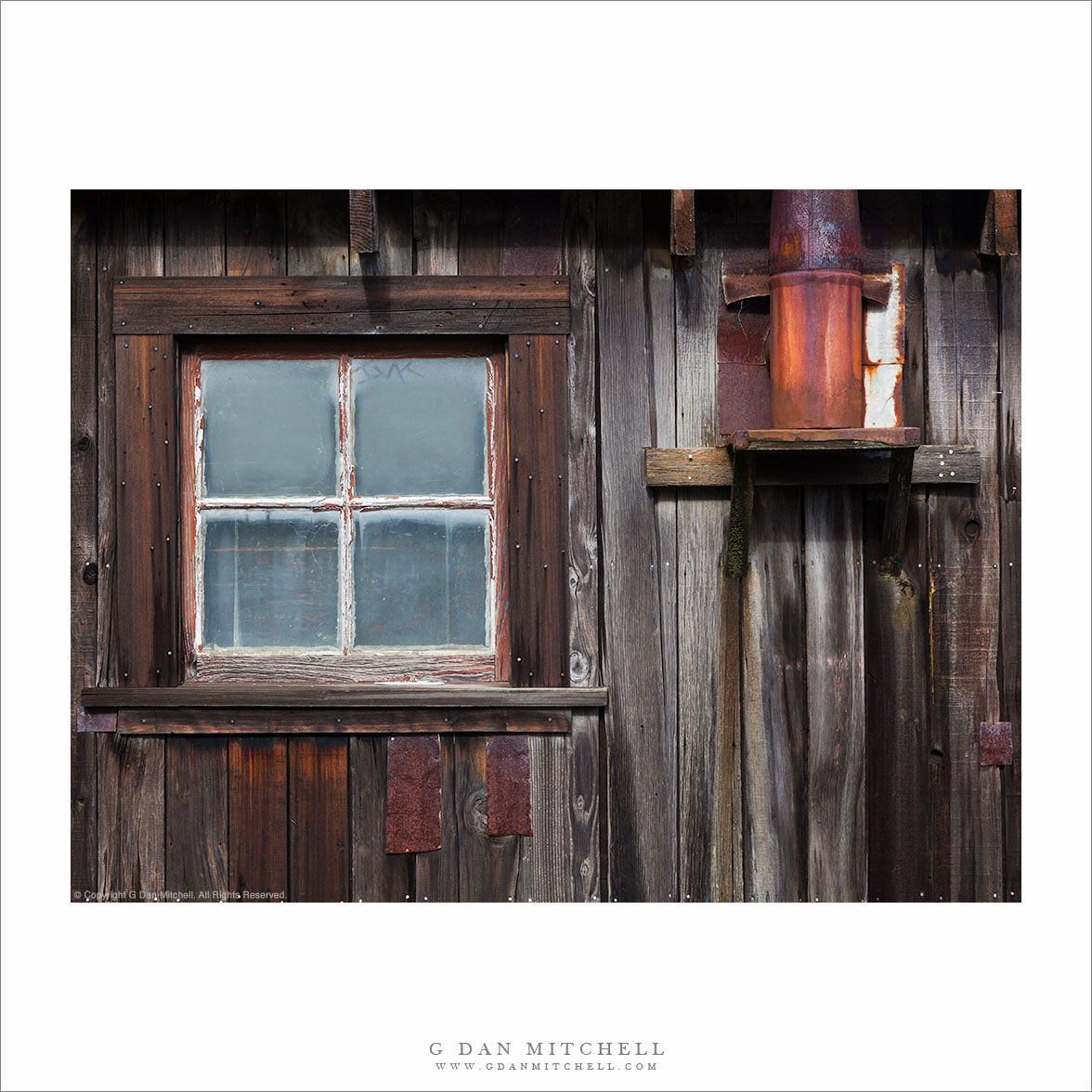
“Window and Rusted Chimney”Detail of the outside wall of a dilapidated wooden building with a window and a rusted metal chimney, China Camp, California
During the first weekend of 2013 I joined a bunch of Bay Area photographers who were taking part in a “long exposure photo walk,” shooting with this group at dawn near the Golden Gate Bridge and then later in the morning at this historic location. China Camp was, as I understand it, a shrimp fishing village established on the shoreline of the northern San Francisco Bay in the 1800s by immigrants from China. It has long since been abandoned and now is part of a California state park. It seems mostly like a place of quiet and solitude these days, and the most common sounds during my visit were the cries of shore birds.
A few buildings, some apparently reconstructed or restored, remain from the original village. They sit right along the shoreline in a shallow cove with an open view across the northern bay. I had beautiful soft light on this visit, as a Pacific winter storm was just beginning to clear, leaving it its wake plenty of atmospheric moisture and cloudiness. I photographed the very weathered side of this building as that light vacillated between cloudy gray and nearly full sun, catching this shot as some sun shone through, though softened a bit by the clouds.
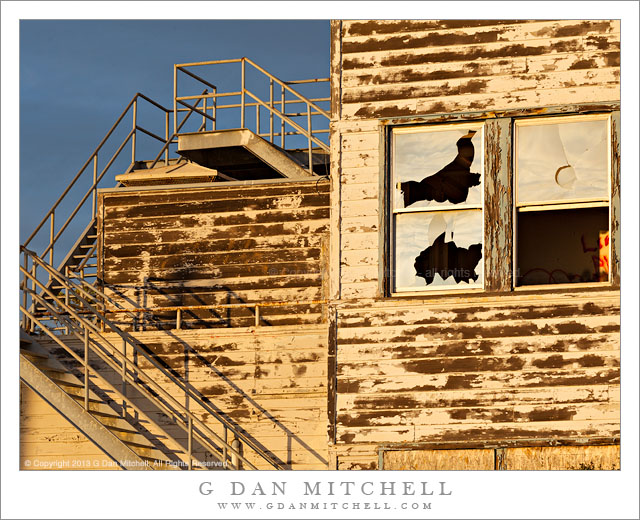
Exterior staircase, broken windows, and peeling paint on the wooden side panels of an abandoned building near Vallejo, California
I had joined up with a group of night photographers that I often shoot with on this evening, and we were sitting around in the late afternoon hours sharing pizza when someone made the radical suggestion of going out to shoot before darkness arrived! In the past, this has been just about the only group of photographers I’ve ever met who would stay inside during a San Francisco Bay area golden hour and sunset period, anxious for the light to go away so that shooting could begin! But on this evening, the radical concept of shooting in the daylight must have seemed so innovative that quite a few of us headed out to find either landscape-style shots over the San Francisco Bay or else abandoned and dilapidated industrial subjects nearby. I opted for the latter, and hoping to cover a bit more ground before dark, rather than walking nearby I drove, trying to figure out where I wanted to be in the fading light.
I ended up near this lonely, abandoned and partially destroyed building that has been left to vandals, who seem to be doing their best to accelerate the natural destructive forces that eventually take such buildings. Many windows are broken, there is spray paint in many places, and the exterior of the building is tremendously weathered and worn. Just a few minutes before sunset I made a series of exposures of this building, using a long lens to isolate smaller sections of the building. The sunset light turned the otherwise-dull building a much more intense shade of brown/yellow, and the brighter sky and clouds over San Francisco Bay are reflected in the broken windows. Soon after I finished shooting, the sun set, and I headed back to where my nocturnal friends awaited, and we headed out to photograph in the night.
G Dan Mitchell is a California photographer and visual opportunist whose subjects include the Pacific coast, redwood forests, central California oak/grasslands, the Sierra Nevada, California deserts, urban landscapes, night photography, and more. Blog | About | Flickr | Twitter | Facebook | Google+ | 500px.com | LinkedIn | Email
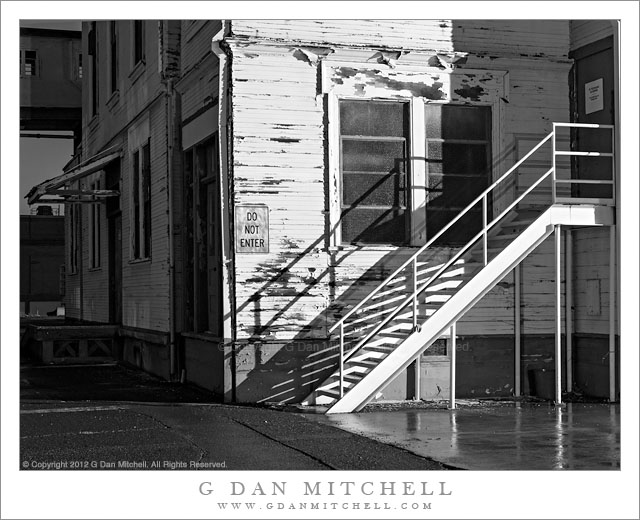
Black and white photograph of a stairway and a portion of a front wall of a building on a rainy evening at the historic Mare Island Naval Ship Yard, Vallejo, California
Black and white photograph of a stairway and a portion of a front wall of Building 45 on a rainy evening at the historic Mare Island Naval Ship Yard, Vallejo, California
I interrupt the almost-steady stream of landscape photographs from the American Southwest (of which there are many more to come) to share a photograph of night photography at the historic Mare Island Naval Ship Yard near Vallejo, California. Depending upon where you see/read this, you may not know that I have been photographing this place at night for a half-dozen years or more, joining a large number of other night photographers who continue to be fascinated by the place. The San Francisco Bay Area group known as The Nocturnes has been instrumental in uncovering the photographic potential of this wonderful location and in ensuring its respectful treatment by photographers, and I was there with them again this week. I’m certain that many people who drive past and see “Mare Island” signs have no idea of how long this place has existed (well back into the 1800s) nor of its historic importance (the first US west coast major ship yard) or some of its “issues,” including the transition from the military to civilian uses and all of the things that this entails.
The whole area, but especially that around the “historic core,” is quite an amazing photographic resource, especially for those who have worked to “see” it at night. There are a number of obvious, impressive, and iconic features – the gantry structures, the power plant, many old buildings, dry docks, and more – yet return visits begin to reveal smaller and subtler features that you could miss on a single visit. There was one wrinkle in this week’s shoot – RAIN! When we assembled there before sunset – for photograph sharing and talk – we knew that a weather front was headed our way, but we hoped that it might hold off long enough to let us complete some shooting first. I wasn’t so sure. (The weather radar app showed a front very close to us!) As soon as it was dark enough, I quickly went to work at this building that I had seen earlier in the day when I arrived. It was already beginning to sprinkle when I got there, and soon the rain increased to the point where I had to work under an umbrella as I completed some relatively long exposures. (For real fun, try juggling camera, lenses, bags, tripod, and an umbrella… in increasing wind… and rain… while trying to attach camera to said tripod and compose and focus!) I had time to make five or six photographs at this location before I had to seek shelter along with my Nocturnes colleagues on the front porch of one of the old officers’ mansions.
G Dan Mitchell is a California photographer whose subjects include the Pacific coast, redwood forests, central California oak/grasslands, the Sierra Nevada, California deserts, urban landscapes, night photography, and more. Blog | About | Flickr | Twitter | Facebook | Google+ | 500px.com | LinkedIn | Email
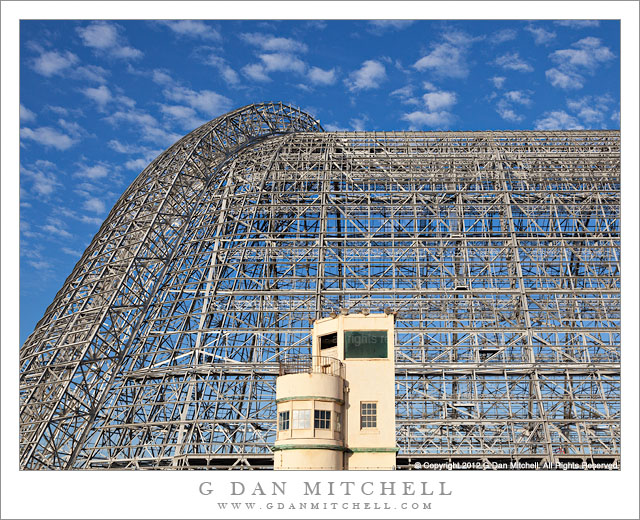
An abandoned control tower in front of the skeleton of historic Hangar One, stripped of its outer skin, at the NASA/Ames Research Center Moffett Airfield.
An abandoned control tower in front of the skeleton of historic Hangar One, stripped of its outer skin, at the NASA/Ames Research Center Moffett Airfield.
Moffett Field (now officially called “Moffett Federal Airfield”) is an iconic landmark in the southern San Francisco Bay Area. Located along highway 101, in sight of thousands of drivers who pass every day, the most obvious features are the three very large hangars that were once built to house lighter-than-air craft. The largest is the so-called “Hangar One,” which is shown in this photograph. When I was a child, my family used to go to Moffett Field (then “Moffett Naval Air Station,” if I recall correctly) on “Armed Forces Day” (which seemed to be a big deal back then) to see the annual air shows, often featuring the Blue Angels and more. Visiting Hangar One was always a high point. The thing is huge! The wikipedia entry reports, among other things, that it is large enough to hold six football fields.
In the 1990s the airfield was decommissioned and then turned over the NASA Ames Research Center. Not long after that it was discovered that the lead paint used in the structure and perhaps other elements, too, were polluting the waters of the San Francisco Bay, which lie at the end of the runway. To make a long story short, the steel panels that formed the outer shell of the hangar were stripped off as part of the work to fix this problem. I’m unaware of the ultimate plan, if there is one, for the hangar, though its historic status creates some hope that it might be refitted at some point. I made this photograph on September 21, 2012 while waiting for the flyover of the Endeavor on its flight to Los Angeles. Even without the skin, the massive skeletal structure is quite a sight.
G Dan Mitchell is a California photographer whose subjects include the Pacific coast, redwood forests, central California oak/grasslands, the Sierra Nevada, California deserts, urban landscapes, night photography, and more. Blog | About | Flickr | Twitter | Facebook | Google+ | 500px.com | LinkedIn | Email
Photographer and visual opportunist. Daily photos since 2005, plus articles, reviews, news, and ideas.
Manage Consent
To provide the best experiences, we use technologies like cookies to store and/or access device information. Consenting to these technologies will allow us to process data such as browsing behavior or unique IDs on this site. Not consenting or withdrawing consent, may adversely affect certain features and functions.
Functional
Always active
The technical storage or access is strictly necessary for the legitimate purpose of enabling the use of a specific service explicitly requested by the subscriber or user, or for the sole purpose of carrying out the transmission of a communication over an electronic communications network.
Preferences
The technical storage or access is necessary for the legitimate purpose of storing preferences that are not requested by the subscriber or user.
Statistics
The technical storage or access that is used exclusively for statistical purposes.The technical storage or access that is used exclusively for anonymous statistical purposes. Without a subpoena, voluntary compliance on the part of your Internet Service Provider, or additional records from a third party, information stored or retrieved for this purpose alone cannot usually be used to identify you.
Marketing
The technical storage or access is required to create user profiles to send advertising, or to track the user on a website or across several websites for similar marketing purposes.