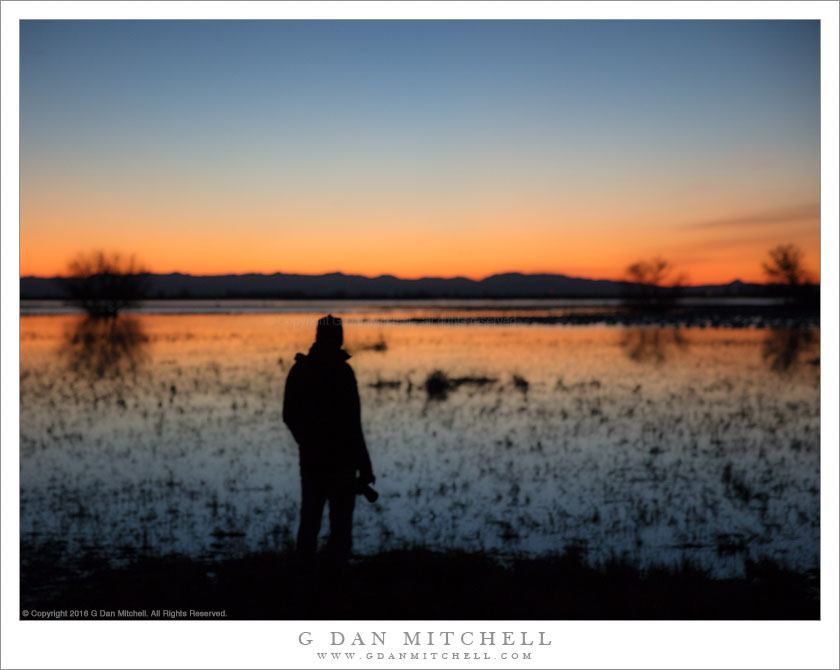
Photographer Michael Frye silhouetted against the fading light of winter San Joaquin Valley dusk sky.
Earlier this week I spent the day out in the San Joaquin Valley, photographing birds and this expansive landscape of water and sky and a few trees. (I also made a quick midday run up to the Sierra foothills on business, and it was wonderful to see the evidence of a relatively normal looking winter in California — water pooling in flats and snow on the peaks!) It was quiet in the morning when I arrived, and there were few others there at dawn. But shortly, as I was stopped photographing sandhill cranes, a car drove up and it was my friends Michael and Claudia — what a wonderful surprise!
These are long days, beginning with a 3:30 wake-up alarm, a two-hour pre-dawn drive in darkness, and arrival at my destination by perhaps 6:30 AM or so. I photograph for a few hours, take a midday break, and then return in the afternoon to photograph until the light is gone. The cycle of the afternoon photography is striking. I begin in good light, watching for the golden hour light to begin. Soon it arrives, and it goes quickly. On this evening it was hard to figure out where the birds would be, so we finally just decided to pick a spot and see what would happen. As the sun set, geese and cranes began to arrive — cranes flying past, mostly, and some geese landing in the ponds in front of us. We continue to find ways to photograph as the light fades — switching from long lenses to wide-angle, working with rather than against the blur of lower shutter speeds. But eventually it just plain becomes too dark and we stop photographing. And this, in many ways, is the most beautiful moment of the entire day — we lower our cameras and simply stand and look, on the best days standing with a small group of friends as the day ends.
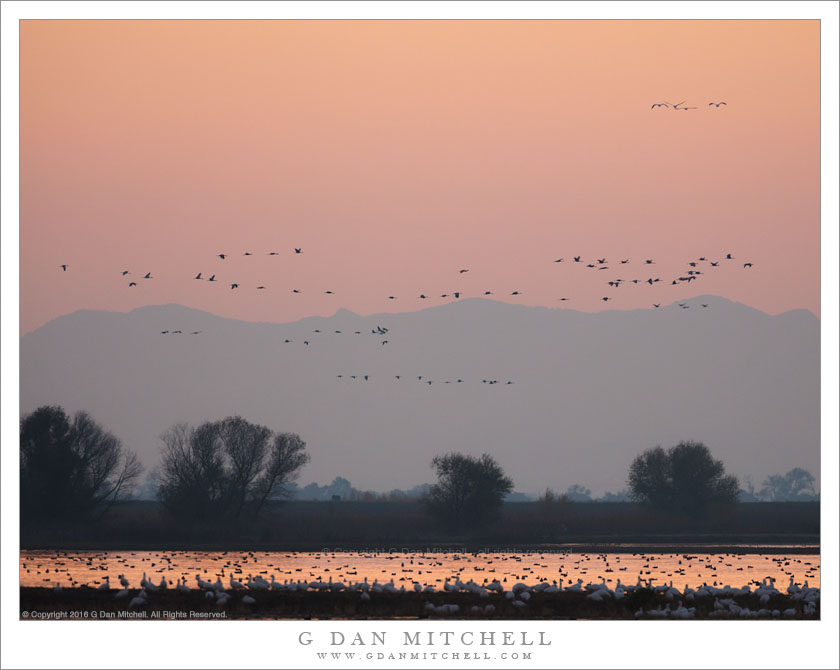
Lesser sandhill cranes return to wetland marshes in fading dusk light
There is a natural cycle to the day during the winter at these San Joaquin Valley wetland marshes — actually there are multiple cycles. One is the cycle of the animals themselves, responding to the dawn, moving to daytime activities, coming and going, then settling in once again for the night. Another is the cycle of the photographer or viewer of this wildlife, whose own patterns are inextricably linked to those of the birds and the light, but who also may sometimes choose when and where to focus efforts.
The midday and early afternoon hours are, at least most of the time, relatively quiet and slow. It makes sense that during the times of day when conditions are the most stable that the birds would also be more settled. (There are seasonal exceptions, including the late winter time when the winter residence of many birds is coming to an end and another migration cycle is about to begin.) The evening brings another transition, and one of the final and most impressive moments often comes after sunset with the dusk fly-in of the sandhill cranes. Long strings of these birds appear (usually from the south in this place), flying low and straight paths toward the places where they will land and spend the night.
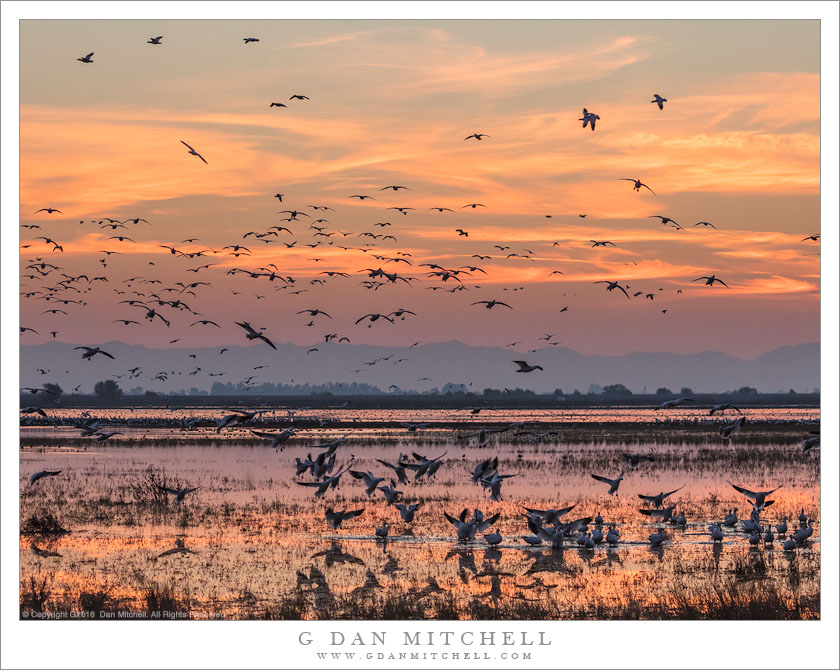
In an earlier post I alluded to my occasional good fortune in being the recipient of unanticipated events while out photographing, in this case the unexpected arrival of a dusk flock of geese right in front of the spot where I was standing and quietly watching the dusk light fade, thinking that I had finished my photography for the day. In that last moment, a flock took to the air a good distance away across wetland ponds, expanded the circle of its flight, and without warning began to land in the pond next to my position.
The relationships between luck and skill and preparation are complex, but there is no denying that luck plays a role in photographing the natural world. While I could tell that the sky was becoming beautiful, and while I am prepared to make technical and esthetic decision about how to photograph things as they happen, the fact that this flock took off in the dusk light and then landed perhaps fifty feet from my position is certainly nothing for which I can take credit. It does pay to be prepared, to have done this enough times to have a good chance of making the right decisions quickly when the opportunity arrives and, perhaps most of all, to be out there in the field as much as possible. One moment like this one makes it worthwhile.
Photographer and visual opportunist. Daily photos since 2005, plus articles, reviews, news, and ideas.
Manage Consent
To provide the best experiences, we use technologies like cookies to store and/or access device information. Consenting to these technologies will allow us to process data such as browsing behavior or unique IDs on this site. Not consenting or withdrawing consent, may adversely affect certain features and functions.
Functional
Always active
The technical storage or access is strictly necessary for the legitimate purpose of enabling the use of a specific service explicitly requested by the subscriber or user, or for the sole purpose of carrying out the transmission of a communication over an electronic communications network.
Preferences
The technical storage or access is necessary for the legitimate purpose of storing preferences that are not requested by the subscriber or user.
Statistics
The technical storage or access that is used exclusively for statistical purposes.The technical storage or access that is used exclusively for anonymous statistical purposes. Without a subpoena, voluntary compliance on the part of your Internet Service Provider, or additional records from a third party, information stored or retrieved for this purpose alone cannot usually be used to identify you.
Marketing
The technical storage or access is required to create user profiles to send advertising, or to track the user on a website or across several websites for similar marketing purposes.

 G Dan Mitchell is a California photographer and visual opportunist. His book, “California’s Fall Color: A Photographer’s Guide to Autumn in the Sierra” is available from Heyday Books and Amazon.