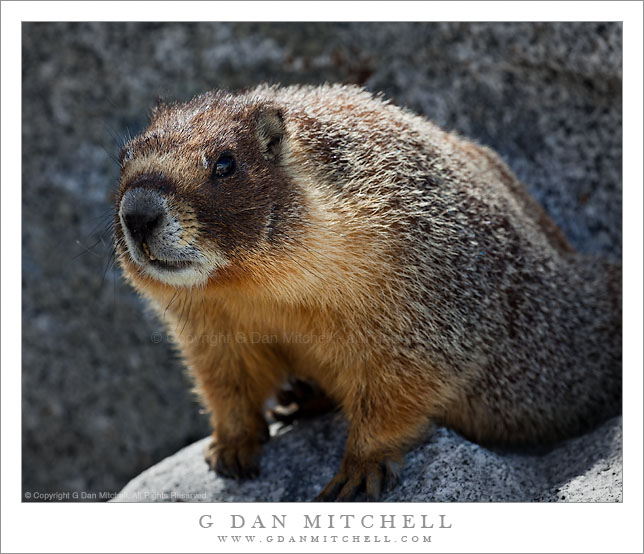
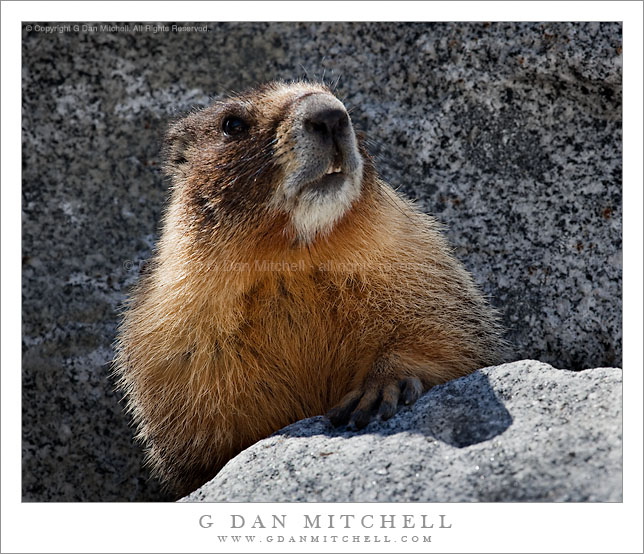
A marmot emerges from rocks near Olmsted Point in Yosemite National Park, California.
I’m going for two in a row of the furry animal shots. This marmot is among those who live in the rocks at Olmsted Point, the iconic roadside viewpoint just before Tenaya Lake along the Tioga Pass Road. I may have had my very first “marmot experience” at this very spot many years ago when my father took me and my brother camping at Tuolumne Meadows. After many intervening decades of real back-country travel, I might be a bit jaded about roadside marmots… but it was a kick to have a chance to photograph this marmot and its partner as they ducked in and out of the rocks below the parking lot.
This photograph is not in the public domain and may not be used on websites, blogs, or in other media without advance permission from G Dan Mitchell.
A marmot emerges from winter conditions along the Tioga Pass Road, Yosemite National Park, California.
Sometimes this is just a bit too easy. Almost anyone who has driven over Tioga Pass Road through the high country of Yosemite National Park has stopped at the famous overlook at Olmsted Point. From here you can look one direction and see the “back side” of Half Dome or look the other way and see Tenaya Lake and the procession of domes, ridges, and peaks beyond. But you can also see marmots up close. They hang out in the rocks right below the parking area and are less fearful of people than are normal high-country marmots. (I’m more familiar with the latter. Getting a good photograph of them is possible but very challenging.)
I stopped here on my drive over the pass on the first day it was open this year, and two marmots were active near where steps lead down toward a nearby dome. I simply sat down near by, kept very still, and then waited for them to appear where I could photograph them. They were very cooperative – and there will be more photographs of these “guys” to come.
This photograph is not in the public domain and may not be used on websites, blogs, or in other media without advance permission from G Dan Mitchell.
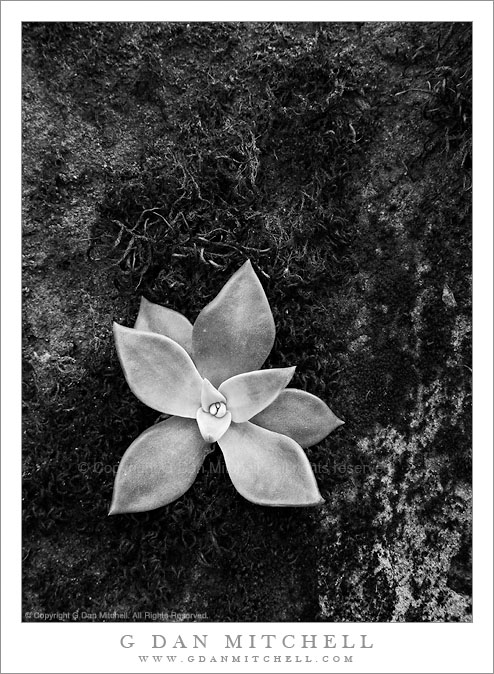
Black and white photograph of a single succulent plant growing on an almost barren rock face at Castle Rock State Park, California.
I wish I had a better title for this photograph, but I’m afraid that I am not expert at plant identification. (Yes, I’m hoping that someone who knows about these things will offer an identification – I’ll change the title to reflect this. Thanks in advance!)
(Update: “Thank you!” to Gena and Guy who suggest that it is a type of stonecrop. That makes sense to me.)
On this warm spring-like morning I hiked at Castle Rock State Park along the summit ridge of the Santa Cruz Mountains – this was my first hike of the season on which it actually felt like spring rather than winter. (It has been a wet winter here in the San Francisco Bay Area.) As I passed over a rocky section of the trail to Goat Rock I paused to think about photographing some ferns and wildflowers that were growing against the base of a small rock face. I didn’t find anything along those lines worth photographing, but I did spot this single specimen of some sort of small succulent plant growing out of seemingly nothing in the middle of the rock face. The plant’s location was so improbable that I stopped and looked around for another of the same type, but this seemed to be the only one.
This photograph is not in the public domain and may not be used on websites, blogs, or in other media without advance permission from G Dan Mitchell.
Technical Data:
Canon EOS 5D Mark II
Canon EF 24-105mm f/4 L IS USM at 105mm
ISO 100, f/16, 2 seconds
keywords: black and white, monochrome, single, succulent, plant, leaf, pointed, spring, season, cliff, wall, moss, lichen, trail, hike, castle rock, state, park, california, usa, north america, nature, flora, vegetation, barren, face, stock
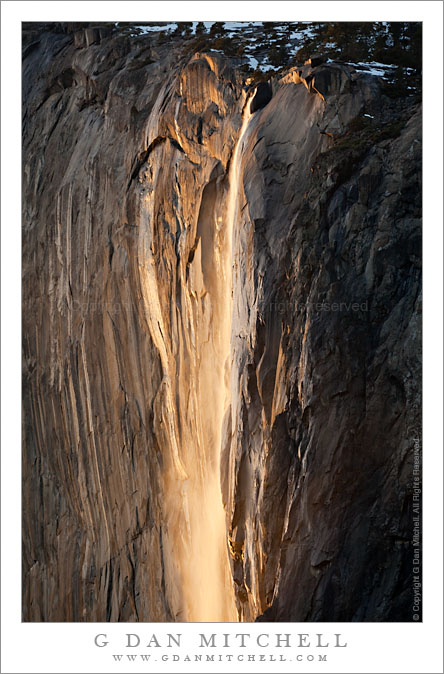
Photograph of Horsetail Fall – the “natural firefall” – along the eastern end of the face of El Capitan, Yosemite Valley, California.
I made this photograph from “the other” vantage point for viewing the winter Horsetail Fall light show. I’ve shot this subject a few times in the past, but always from the general area of the picnic area at base of the east end of El Capitan. Since I thought the light might be good on this evening I decided to try the location along Southside Drive at a point between the crossover road near El Capitan and the start of the Four Mile Trail where many people photograph this scene. Yeah, it is an icon. What can I say? (Well, I can say that my favorite photograph from this particular trip to the Valley is actually a black and white image of a couple branches of a dormant fern plant – but that’s a different photo and a different story.)
This location – I’ll call it the “Merced River location” – is popular among Horsetail Fall photographers for several reason. For one it is very accessible. To be blunt, you can find a shot within a few seconds walk from your car! (Unless you arrive late and all the parking is gone, a distinct possibility in such a popular spot, especially if you go on a weekend when the sunset light hits the fall.) It also provides a different sort of view of the fall. While the view from right beneath El Capitan tends to provide a slightly wider and closer view of the upper fall, this one provides a clear view of a greater portion of the fall along with the little valley above the fall. And because it is a bit further east, you are looking at the fall more from the side. This means that when things work out just right the brilliantly lit fall becomes a very thin stream against the much darker background rock.
The light on this evening was perhaps not quite “classic” Horsetail light. There was some nice color, but the light faded before it became brilliantly colorful. It seemed like perhaps the sun (which is itself not visible to photographers from here) might have passed behind some distant clouds in the west just before reaching the horizon. The development of the brilliant sunset color was somewhat muted when this happened.
This photograph is not in the public domain and may not be used on websites, blogs, or in other media without advance permission from G Dan Mitchell.
Technical Data:
Canon EOS 5D Mark II
Canon EF 100-400mm f/4.5-5.6 L IS USM at 360mm
ISO 200, f/11, 1/50 second
keywords: yosemite, national, park, valley, california, usa, north america, nature, winter, horsetail, fall, waterfall, water, gold, molten, light, sunset, dusk, glow, fire, firefall, cliff, el, capitan, cap, face, crack, water, spray, mist, sierra, nevada, mountain, range, february, stock
Photographer and visual opportunist. Daily photos since 2005, plus articles, reviews, news, and ideas.
Manage Consent
To provide the best experiences, we use technologies like cookies to store and/or access device information. Consenting to these technologies will allow us to process data such as browsing behavior or unique IDs on this site. Not consenting or withdrawing consent, may adversely affect certain features and functions.
Functional
Always active
The technical storage or access is strictly necessary for the legitimate purpose of enabling the use of a specific service explicitly requested by the subscriber or user, or for the sole purpose of carrying out the transmission of a communication over an electronic communications network.
Preferences
The technical storage or access is necessary for the legitimate purpose of storing preferences that are not requested by the subscriber or user.
Statistics
The technical storage or access that is used exclusively for statistical purposes.The technical storage or access that is used exclusively for anonymous statistical purposes. Without a subpoena, voluntary compliance on the part of your Internet Service Provider, or additional records from a third party, information stored or retrieved for this purpose alone cannot usually be used to identify you.
Marketing
The technical storage or access is required to create user profiles to send advertising, or to track the user on a website or across several websites for similar marketing purposes.