
Tag Archives: grass

Red-Wing Blackbird

Red-Wing Blackbird
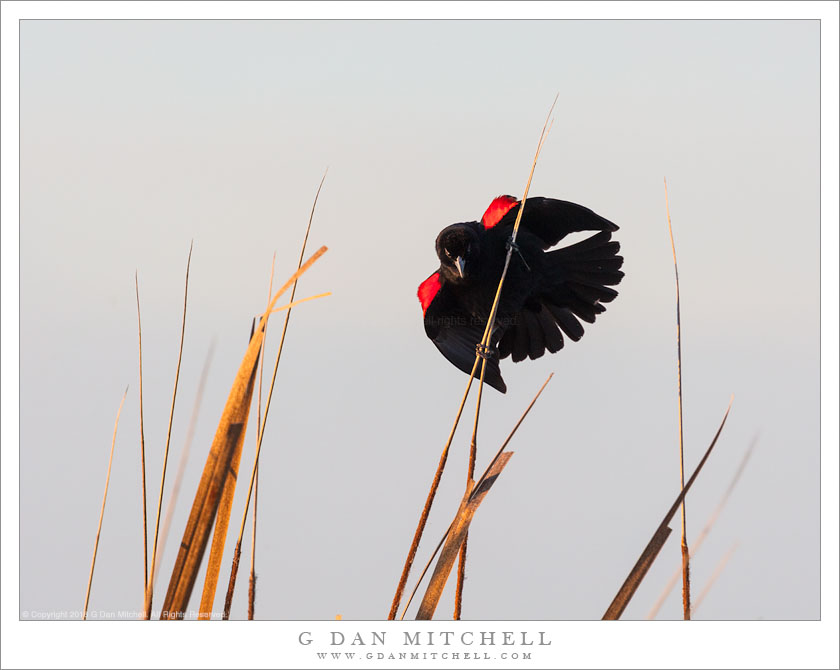
A red-wing blackbird perched among wetland plants

Red-Wing Blackbird. © Copyright 2018 G Dan Mitchell – all rights reserved.

A red-wing blackbird perched among grasses

The red-wing blackbird (and the similar tri-color blackbird) are among those birds that are found all over the place here in California. I’ve encountered them in agricultural areas and on trails in coastal hills parks, in huge groups or as solitary individuals. They often perch, and they aren’t too hard to photograph with a long lens, though their very dark feathers can provide some exposure challenges. When they take to the air they often move quickly and can be hard to track.

The red patches are not always visible. In fact, when I first saw this individual I did not see them. But the bird seemed content to remain in one spot for a while, so I settled in with the bird in the viewfinder and waited. Typically the first thing I’ll do is to try to grab an initial photograph that is at least usable. But they I wait and watch for something beyond that, something that might show the animal in a special way. As I watched this bird, all of a sudden it puffed out its feathers and exposed those brilliant red patches for a few seconds.


G Dan Mitchell is a California photographer and visual opportunist. His book, “California’s Fall Color: A Photographer’s Guide to Autumn in the Sierra” is available from Heyday Books and Amazon.
Blog | About | Flickr | Twitter | FacebookGoogle+ | LinkedIn | Email


All media © Copyright G Dan Mitchell and others as indicated. Any use requires advance permission from G Dan Mitchell.
Two Geese Landing

Two Geese Landing
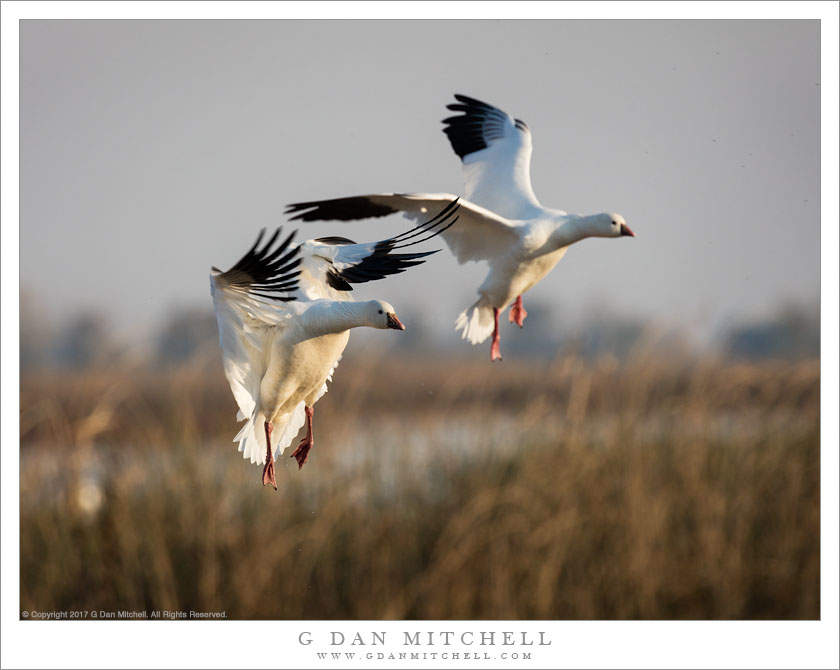
Two geese descend to land in a wetland pond

Two Geese Landing. © Copyright 2017 G Dan Mitchell – all rights reserved.

Two geese descend to land in a wetland pond

Since we’re well into my “bird season,” focused on migratory and other birds, I’ll stick with that theme a bit longer. I photographed this pair of geese (I’m pretty sure they are Ross’s geese) back at the beginning of December. Near the end of the day I moved to where the light would come in from the right, highlighting light and shadow and the textures of the birds features. Not too long before sunset, geese began to arrive and land in the pond, and I was able to photograph their descent.

I often marvel at the contortions of these birds during the final instants of their flights. In the air they are often graceful, but the landings vacillate between that grace and nearly-out-of-control clumsiness as they transform from creatures of the to earthbound animals. They glide in, instinctively facing into the breeze, and can sometimes then seem to almost drop right out of the sky. Wings go upwards, feet extend down, and necks stretch forward, and quickly they are on the ground.


G Dan Mitchell is a California photographer and visual opportunist. His book, “California’s Fall Color: A Photographer’s Guide to Autumn in the Sierra” is available from Heyday Books and Amazon.
Blog | About | Flickr | Twitter | FacebookGoogle+ | LinkedIn | Email


All media © Copyright G Dan Mitchell and others as indicated. Any use requires advance permission from G Dan Mitchell.
Island With Trees, Thinning Fog

Island With Trees, Thinning Fog
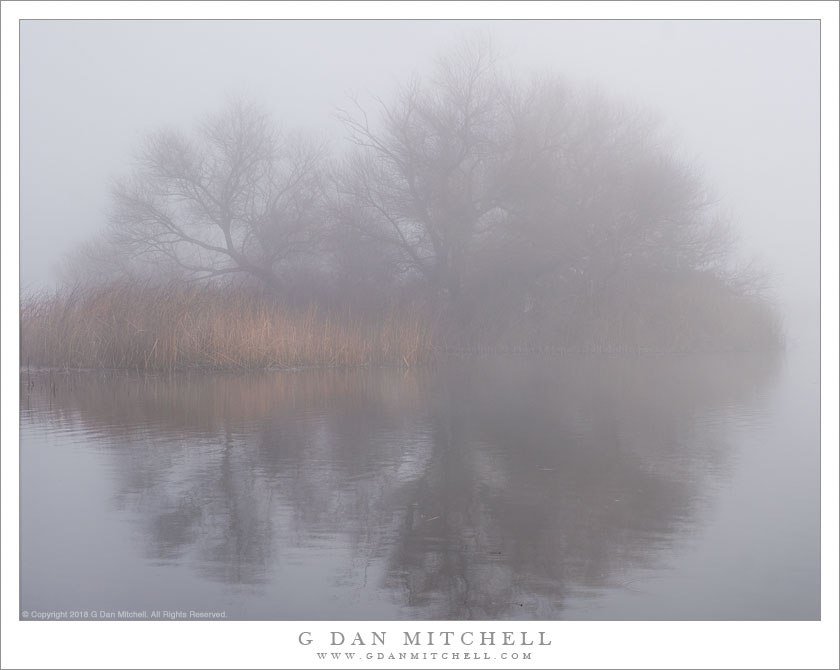
Sunlight begins to illuminate a small wetland island as San Joaquin Valley tule fog thins

Island With Trees, Thinning Fog. © Copyright 2018 G Dan Mitchell – all rights reserved.

Sunlight begins to illuminate a small wetland island as San Joaquin Valley tule fog thins

We all know that (apparently false) story about the number of words that Inuit people have for the myriad types of snow. I suspect that it would be possible to have a similarly diverse vocabulary of descriptions for fog, dependent upon its thickness, temperature, quality and color of light, tendency to move, effect on sound, time of day, season, persistence, and much more. Photographing in California is something of a laboratory in the nature of fog, in that we have so many types. Living in the San Francisco Bay Area I am very familiar with the type of fog created by the marine influence — often cold and gray and damp, and frequently a feature of the late-spring and summer months. Photographing Central Valley birds (and driving across the great valley while traveling to and from the Sierra Nevada) has given me ample opportunities to know the tule fog, mostly a winter phenomenon caused by cool and damp conditions over land.

On winter days when I photograph in the valley I experience transitions though many different types of fog and fog-light. I often start before dawn, when the fog and darkness can close the world down to what I can (barely) see in my headlights, or by the glow of commercial signs and streetlights as I pass through towns. Before sunrise the fog can glow in colors ranging from sky blue to the gaudy reds, oranges, yellows, and purples of first light on clouds above the fog. Eventually that color dissipates and the fog can simply become gray. Then, as it things (often from the top down), and light begins to filter down to the ground level, the colors of grasses and trees and water being to appear faintly.


G Dan Mitchell is a California photographer and visual opportunist. His book, “California’s Fall Color: A Photographer’s Guide to Autumn in the Sierra” is available from Heyday Books and Amazon.
Blog | About | Flickr | Twitter | FacebookGoogle+ | LinkedIn | Email


All media © Copyright G Dan Mitchell and others as indicated. Any use requires advance permission from G Dan Mitchell.
Wetlands Evening

Wetlands Evening
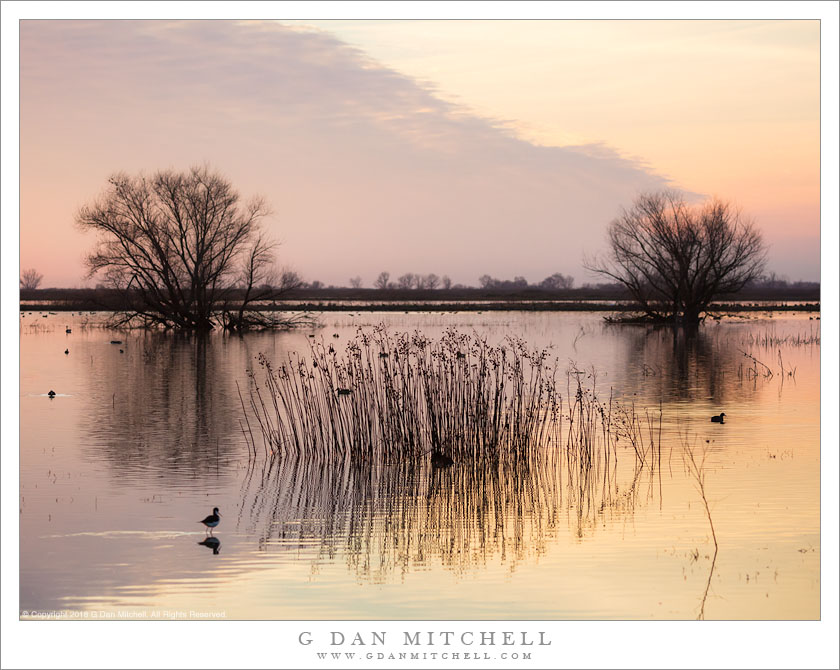
Trees, plants, and a few birds under a bank of clouds above San Joaquin Valley wetlands

Wetlands Evening. © Copyright 2018 G Dan Mitchell – all rights reserved.

Trees, plants, and a few birds under a bank of clouds above wetlands

The process of bird-photography, at least as I know it, is perhaps not quite what people who don’t photograph this subject might imagine. The actual practice and experience varies from photographer to photographer and, no doubt, from place to place. However, I’d be willing to bet that many people would be surprised at how much not-photographing goes on! There are amazing moments when we come upon a special scene, when a huge flock of geese lifts off, when we get close to a raptor, when the light and sky do something astonishing. Then there are all the other moments, and they form the majority of the experience. The birds are somewhere else. They are just a bit too far away. The light goes flat. It rains. And so on.

The fact of the matter is that in order to photograph those periodic extraordinary moments, you have to spend a lot of time just being there. If really special stuff happens, say 1% of the time, you’ll increase your odds of experiencing it if your base is 100 hours rather and one. Of course, that also means that you’ll increase the number of slow hours when not much happens. Be ready. Bring a book. Take a nap. Wander a bit. And sometimes take a look at other subjects, like the still and quiet grasses growing in a shallow pond beneath winter skies, even though there aren’t a whole lot of birds there.


G Dan Mitchell is a California photographer and visual opportunist. His book, “California’s Fall Color: A Photographer’s Guide to Autumn in the Sierra” is available from Heyday Books and Amazon.
Blog | About | Flickr | Twitter | FacebookGoogle+ | LinkedIn | Email


All media © Copyright G Dan Mitchell and others as indicated. Any use requires advance permission from G Dan Mitchell.