Tag Archives: high

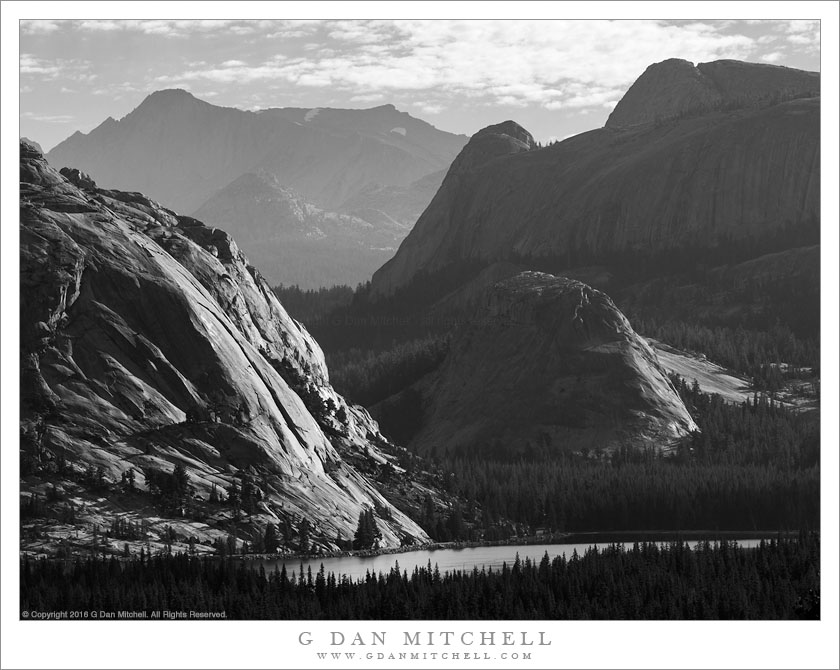
Morning Light, Domes, Lake

Morning Light, Domes, Lake
Morning light on Tenaya Lake, granite domes, and Mount Conness

Morning Light, Domes, Lake. Yosemite National Park. July 16, 2016. © Copyright 2016 G Dan Mitchell – all rights reserved.

Morning light on Tenaya Lake, granite domes, and Mount Conness

I have been in a bit of a black and white mood recently. Although most of my photographs today are color photographs, my roots are in black and white. Many years ago that is what I learned to develop and print, all the way back to when my father took me into his home darkroom when I was a very young kid. Until I began to use slide film, virtually everything I shot was in black and white, and so many of my early photographic heroes also worked almost exclusively in monochrome.

I order to render the conjunction of shapes and masses, curves and textures in this complex scene of the Sierra Nevada landscape rising from Tenaya Lake, it seemed to me that black and white was the right choice. I made the photograph in the morning — not “crack of dawn” early, but a bit later, when the sun’s rays were clearing the higher ridge to the right and illuminating elements of the scene right down to the lake itself. The distant mass of Mount Conness is slightly obscured by haze, and a thin layer of bright clouds pass overhead.


G Dan Mitchell is a California photographer and visual opportunist. His book, “California’s Fall Color: A Photographer’s Guide to Autumn in the Sierra” is available from Heyday Books and Amazon.
Blog | About | Flickr | Twitter | FacebookGoogle+ | LinkedIn | Email


All media © Copyright G Dan Mitchell and others as indicated. Any use requires advance permission from G Dan Mitchell.
Cathedral Range, Meadows, Evening

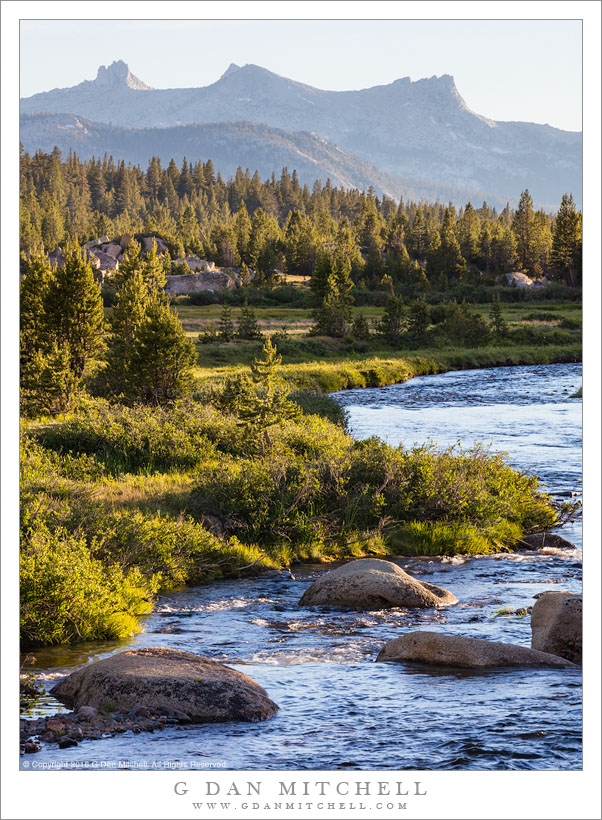
Cathedral Range, Meadows, Evening
Cathedral range and early evening in the Yosemite High Sierra.

Cathedral Range, Meadows, Evening. Yosemite National Park, California. July 15, 2016. © Copyright 2016 G Dan Mitchell – all rights reserved.

Cathedral range and early evening in the Yosemite High Sierra.

For me, this is a quintessential Sierra Nevada scene, and memories such places and sensations go back almost to my first knowledge of the range. One touchstone was many years ago when my father took me up to Tuolumne Meadows (if my hazy memory is accurate) and we passed through such country. I have a very particular memory of stopping at a waterfall alongside the road, where I looked up the stream above that cascade and wondered, without quite understanding what I was asking, what might lie above and beyond my field of vision. Perhaps at about this time I discovered some of my father’s books, including one that was (again, if memory is correct) about a passage along the backcountry spine of the range. The photograph I remember most from that book, a photograph that is still one of my mental models for seeing these mountains, featured a deeply grooved trail heading across a high country meadow toward a distant ridge. Some things never change!

This spot is one that I know well — and it is also easily accessible. But it could be any of thousands of places where water runs between meadow banks and past forests with rocky peaks in the distance, the sum of which draw me back to these mountains every year. There is still a lot of snow on the ground in this and similar places right now, and the water is running much higher. But in a month or two this brief period of abundant green will come to the high country, and you’ll find me there again.


G Dan Mitchell is a California photographer and visual opportunist. His book, “California’s Fall Color: A Photographer’s Guide to Autumn in the Sierra” is available from Heyday Books and Amazon.
Blog | About | Flickr | Twitter | FacebookGoogle+ | LinkedIn | Email


All media © Copyright G Dan Mitchell and others as indicated. Any use requires advance permission from G Dan Mitchell.
Abandoned Stamp Mill

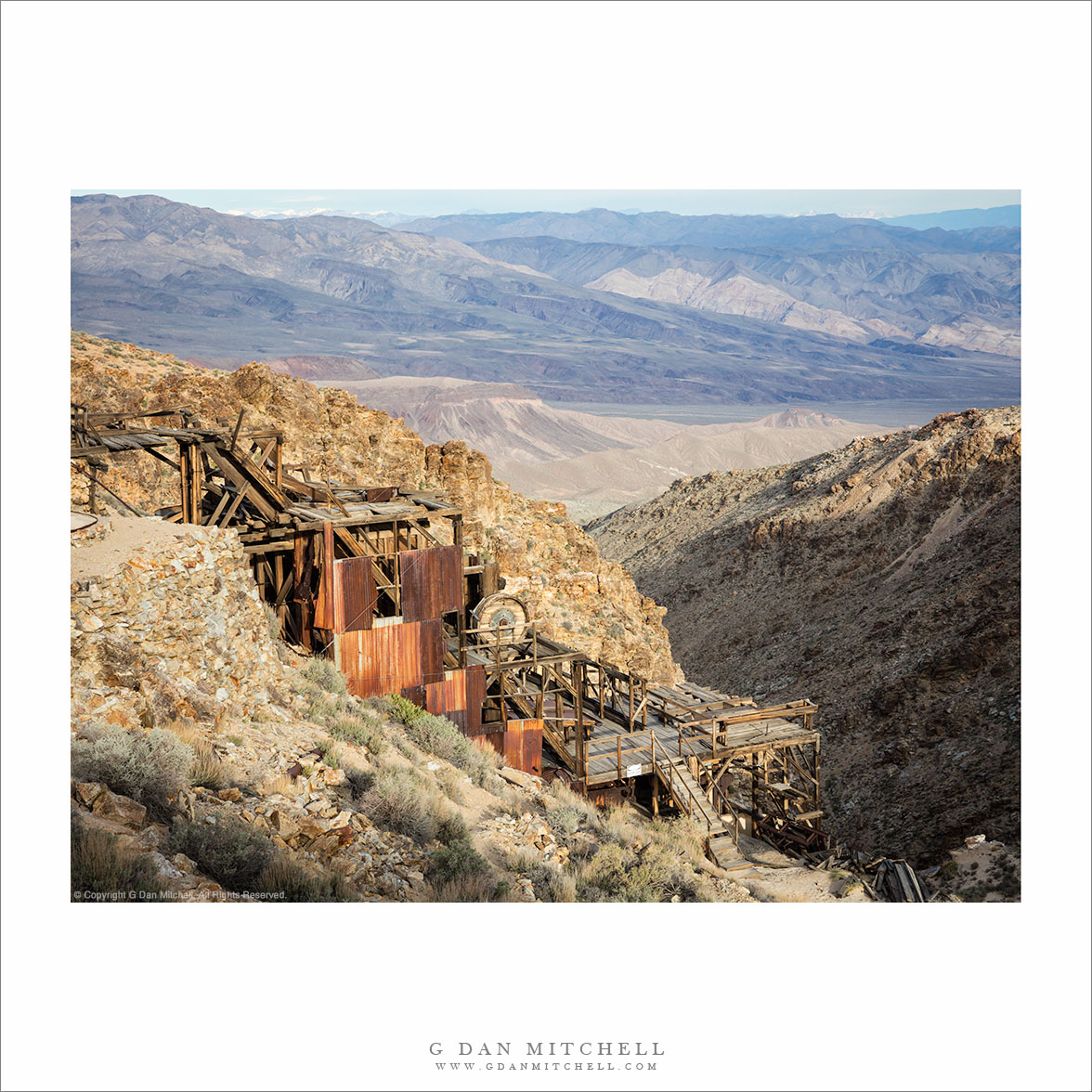
Abandoned Stamp Mill
“Abandoned Stamp Mill” — An abandoned water-powered stamp mill high in the Panamint Range, Death Valley National Park

It seems that every national park or monument has both a natural and a human hisstory, or perhaps a story about the relationship between the two. While the power of natural forces (heat, water, geology, and more) is abundantly obvious in the huge, austere landscape of Death Valley National Park, the human history of the place is rarely far from view. It begins with the evidence of people who lived here long before European-origin settlers came, evidence that can be seen in rock art scattered throughout the park, in the recognition that many settlements (current and now-abandoned) have a very much longer history than we may think, and in the native people who still occupy and identify with this landscape.

Perhaps more obvious is the more recent history of those who came to look for mining success. (There are places in the park where extraction still takes place.) Some examples are obvious to the casual visitor, but the more time you spend in the back-country of the park the more you understand that this particular history is everywhere — though not usually as obvious as this example. This stamp mill, built to crush gold ore, is amazing in multiple ways. Perched at the end of high ridge in very remote location, it was powered in the most unlikely manner… by water piped in from a spring over twenty miles away. The location is stupendous, and it is easy to think that practical issues may not have been the only considerations in choosing the site. From here one can look down thousands of feet to broad alluvial slopes leading towards Death Valley, but one can also look further into the distance and see the snow-covered peaks of the Sierra Nevada.


Leave a comment or question using the form. (Click the title to see the full article and to comment if you are viewing it on the home page.)

G Dan Mitchell is a California photographer and visual opportunist. His book, “California’s Fall Color: A Photographer’s Guide to Autumn in the Sierra” (Heyday Books) is available directly from him. Blog | Bluesky | Mastodon | Substack Notes | Flickr | Email

All media © Copyright G Dan Mitchell and others.

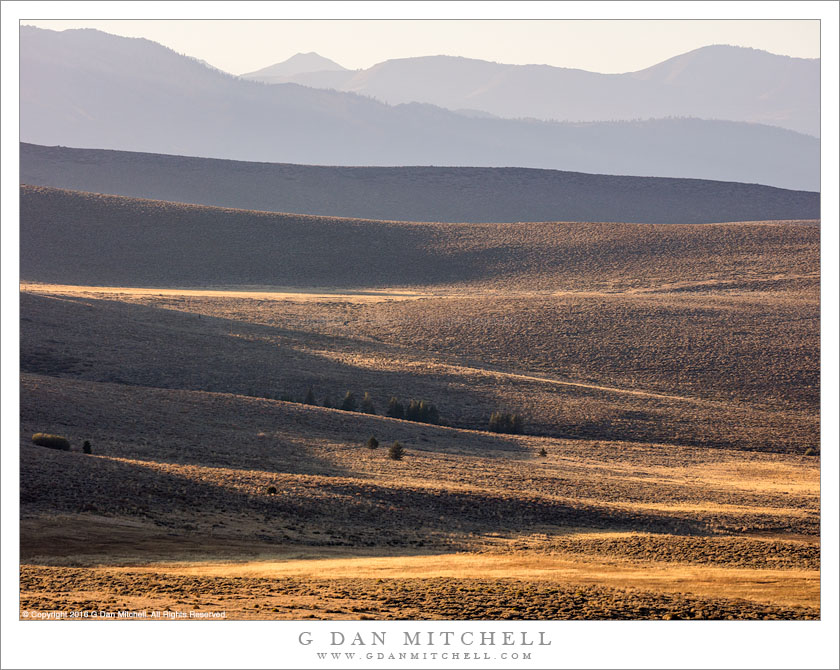
Eastern Sierra Ridges

Eastern Sierra Ridges
A seemingly endless series of ridges rises toward the crest of the Sierra Nevada in early evening light

Eastern Sierra Ridges. Near Mono Lake, California. October 1, 2016. © Copyright 2016 G Dan Mitchell – all rights reserved.

A seemingly endless series of ridges rises toward the crest of the Sierra Nevada in early evening light

The east side of the Sierra Nevada — the “eastern escarpment” — provides an often impressive and quite varied landscape. In places the terrain at the base of the mountains may be in the 4000′ elevation range, which in others the “lowlands” to the east may lie at 8000′ or higher. The mountains may erupt from this lower landscape in a sudden upward burst of granite and cliffs, or they may rise more gradually along mountain valleys that extend well into the range. In places the summit peaks are visible, while in some areas they are hidden behind lower peaks east of the crest. In one spot in the middle of the range the crest is actually lower than peaks to the west.

In this area along the western boundary of Yosemite the Sierra rises somewhat gradually from the high desert sagebrush country. The emptiness of this high desert gives way to a band of coniferous forest and is then replaced by the rugged granite high country. Here the sagebrush highlands rise, ridge upon ridge, toward the peaks of the crest, with the golden colors of early fall becoming muted by atmospheric haze in the distance.


G Dan Mitchell is a California photographer and visual opportunist. His book, “California’s Fall Color: A Photographer’s Guide to Autumn in the Sierra” is available from Heyday Books and Amazon.
Blog | About | Flickr | Twitter | FacebookGoogle+ | LinkedIn | Email


All media © Copyright G Dan Mitchell and others as indicated. Any use requires advance permission from G Dan Mitchell.