
Tag Archives: Mountain

Bishop Aspen Creek Conditions – 10/3/09

(Since posting this message I posted a later update on conditions during this period: “More Eastern Sierra Aspen Color Conditions“.)

I’m currently down in Bishop “doing email” at Starbucks for an hour or so during the harsh light time of the day, so I though I’d post a quick report on conditions in the Bishop Creek area today – along with some (semi-) educated guesses about what lies ahead.

I was up way before dawn this morning and heading up 168 well before the sun came up – there was a bit of light in the sky. My plan was to do “the aspen thing” very early, but as I drove I saw that the clouds were likely to light up in interesting fashion and that it looked like there was some light precipitation on the highest peaks that would soon be illuminated by the sun. So I took a detour out into the Buttermilks on Starlite Road, found a spot looking at Mt. Emerson (?), set up my shot, and waited. I figured that an almost sure thing here was worth a slightly later arrival at the aspens.

The clouds and the wind suggested that the weather forecast of, uh, clouds and wind was probably accurate… I soon finished shooting here and headed up 168. The wind strengthened, at some points blowing hard enough to raise dust clouds on the surrounding slopes. After passing through Aspendell, where the trees are still completely green, I began to see some color just above here. I’d say that it more or less begins above the Cardinal Resort, though the real color starts a bit higher.

I decided more or less spontaneously to try North Lake. I had heard that the “river of color” above the lake had mostly passed its prime and was partially brown, and I knew that the wind would interfere with photographs of the lake, but I also figured that some close-up photographs of sheltered trees might work. There was a fair amount of color along the first part of this road – I came back later and spent some time shooting there as the sun/shadow line approached – and again after the exposed section overlooking Aspendell. Clearly the trees that were further along in the color transitions have taken a bit of a beating from the wind, though there are still quite a few green trees and enough color among the others to make the trip worthwhile. (I also like shooting bare or nearly bare aspen trunks…)

I drove up toward Sabrina but did not stay, instead deciding that the road to South Lake might be more promising. I returned through Aspendell an then turned right to head toward South Lake. The trees before the small village a ways up the road are almost all completely green. Above this village some color starts, and eventually there were some very nice sections. While the conditions ranged from green to yellow to “leaves all gone” and included some brown leaves, there were still plenty of shooting opportunities. I eventually ran out of “good light” as the morning wore on, but I’ll likely had back up that way this afternoon and evening since I located several promising locations.

My general sense of the conditions is that they are a bit unusual. It seems to me that the elevation where the trees start to change color is a bit higher still than I would have expected – it surprised me a bit to see no color at Aspendell, for example. On the other hand, the color started fairly quickly above this level as I ascended. Yes, there are some brown leaves (though these, too, can be interesting photographic subjects) and yes, the wind is blowing down a lot of leaves. But even up high and close to the areas where the leaves have blown down I could find other sheltered groves with excellent color.

So, what now? The weather report still calls for much colder conditions tonight along with the possibility of snow flurries. I think that the aspen conditions in the higher areas are likely to deteriorate somewhat quickly if this holds. On the other hand, there is still a lot of green! The middle and lower elevations have largely not changed yet. Perhaps the change to colder conditions will trigger a change there – and those who are coming up in the next week will find great color.

On another topic: For the past few years Vern Clevenger has had a gallery a couple doors down from the Bishop Starbucks. This morning I saw that Vern is no longer there. I just checked his web site and see that his gallery has moved to Mammoth at 220 Sierra Manor Road #4. I guess that Bishop’s loss is Mammoth’s gain!
More Links to Current Eastern Sierra Fall Aspen Color Reports

I’m catching up on some online reading this evening, and thought I’d share a list of some reports on eastern Sierra fall color that I’ve come across. In no particular order:

  • A quick eastern Sierra fall color update from Greg Russell/Alpenglow Images – Greg’s brief report mentions visiting the Bishop Creek area on Saturday along with visits to Rock Creek and June Lakes Loop.
  • Richard Wong offers a brief report on Bishop Creek Canyon Fall Color at the California Nature Photographers blog. (Yes, my report from this weekend is posted there, too.) Richard covers several areas in the Bishop Creek and North/South/Sabrina Lakes area.
  • The Eastern Sierra Fall Color group on Flickr includes a lot of recent on-the-scene photographs (you may be able to use them to make some decisions about your destination) and the discussion forum includes a lot of posts by those who are there and have been there recently. There is also an interesting thread on the all-important question of where to eat in the eastern Sierra! (Discussion forums only open to group members.)
  • Elizabeth Carmel’s Landscape Photography blog points out a Sacramento Bee Interactive Guide to Fall Colors. (The guide has some interesting and useful information – perhaps most importantly a map with many great aspen locations identified. However, the interactive part of the guide would be even more useful if the information was a bit more up-to-date. I wonder if they might think about building something like this with input from a larger group of photographers who are on the scene?)
  • Journal of My Travels for the Perfect Photo, Inge Fernau’s photography blog, has lots of good advice and reports on photographing Sierra aspens.
  • It looks like Carol Leigh may be updating her Fall Color in California page once again. This is one of the “classic” sites for locating information about this topic, and typically includes lots of reports from those in the field. (I’m wondering though, if it is a bit less current than in the past. (I recently sent an update last week and it never appeared on the page…)
  • Greg A. Lato has posted a sequence of three posts about his visit to the eastern Sierra. Visit his latoga Photography site and then look for the “recent blog posts” section lower on the page.
  • Leon Turnbull reports on a visit to the giant aspen groves at the top of Monitor Pass and a perhaps unfortunate abundance of certain other travelers while he was there. (The groves atop Monitor Pass are huge, and seem to me to be a bit less well-known than some of the areas further south. I was a bit surprised at his report that many of the trees had not yet changed colors, since I frequently find that they change here just a bit earlier than in some other locations on my circuit. A good aspen route is to go up over Carson Pass and then over Monitor to highway 395.)
  • The Life on the Eastern Slope blog mentions conditions in Lundy Canyon, Tioga Pass, and other nearby areas. (I drove past but did not enter Lundy Canyon on Sunday – I could see colors up high above Lundy, but cannot offer first-hand info on conditions down in the canyon. I also went over Tioga Pass twice and saw some pretty good colors just east of the pass, though colors down in Lee Vining Canyon have not changed yet.)
  • I mentioned it earlier, but it is worth mentioning that Michael Frye posted a bit of a guide to photographing fall colors in Yosemite. (For the record, if you are looking for great aspen photography opportunities, Yosemite is not your best choice. But there are other types of fall color in Yosemite that bring me back every year.)
  • Greg Boyer has posted his Fall Color Update #8 from Bishop. His view is that this coming weekend will likely be the prime time to shoot – which is pretty much in line with what I’m thinking. I would not be surprised to find that some areas in the upper Bishop Creek drainage will have lost leaves by then, but there are tons of trees a bit lower… and many other eastern Sierra areas should be in great shape. (But watch the weather – there is a chance of a change this weekend.) Other entries at Greg’s One Horse Studio blog also offer good information and perspectives on fall color.

Whew! I’m sure I’ve missed some other useful resources – feel free to share via a comment.

Eastern Sierra Aspen Color Reports Starting (9/24/09)

If you are really trying to follow the evolution of eastern Sierra fall color – most aspens – your best bet is to find some of the primary sources yourself and start following them. However, I’m going to continue to post a few here from time to time – and before long I should be able to start posting some of my own reports.

  • Inge Fernau posted an extensive description of her one-day marathon trip to Bishop Creek, including some photographs that will help those who know the areas already extrapolate a bit. Inge’s site is always worth a visit, and few post more thoroughly on the aspens.
  • The calphoto site is typically a great source of current information about the fall color in the eastern Sierra… but this season there doesn’t seem to be much info there yet. I’m hopeful that this many change in the next few days.
  • The Eastern Sierra Fall Color group at Flickr has a lot of information, both in the form of text and in images that will give you some answers to the “where?” and “when?” questions.
  • Greg Boyer’s One Horse Studio site is featuring frequent updates including one from the middle of the current week that sounds somewhat optimistic.

Remember a few things about finding and shooting aspens:

  • Conditions can vary a lot as you travel north/south and low/high. If you hear a poor report about one spot, you cannot necessarily extrapolate that to the whole range. Be prepared to move if your “perfect spot” isn’t in condition.
  • How you shoot the trees matters a lot. Sometimes a grove that seems to be almost green will appear to be quite yellow/gold if you go around to the other side for some backlight.
  • Time of day matters a lot #1. It is really tough to shoot them effectively in harsh, midday sun on a cloudless day. Early and late are often better, and shooting on the sun/shade boundary is often very interesting – though you’ll have to be prepared and work quickly.
  • Time of day matters a lot #2. A spot that is flat and boring in the morning may shine in the evening, and vice versa.
  • Time of day matters a lot #3. Shooting in shady conditions is sometimes very effective. You can get past the problems with black shadows and blown highlights and get a very wonderful soft effect – though you’ll likely have to do some color balancing in post.
  • If you show up and there is a crowd in the spot you were heading towards – yes, it happens! – look around. There is often something slightly different nearby and shooting something other than “the obvious thing” often leads to more interesting shots. (One morning I arrived at North Lake intending to do the iconic “across the lake towards Piute Peak” shot only to find a few dozen photographers lined up tripod to tripod in “the spot.” I went a few hundred yards away… and came back with one of my very favorite aspen photos.
  • Think small. Big groves are spectacular, but sometimes one perfect leaf can make a better photograph.
  • Think beyond the trees. Part of the experience includes other trees, rocks, moving or still water, clouds, grass, etc.

Happy aspen hunting!

UPDATE: 9:00 p.m. – Sierra Impressions points out that there is a probability of a change in the weather pattern next week – in the direction of true fall-like weather. That could mean cooler temperatures (a possible hard freeze is mentioned), perhaps wind, and (outside chance) some precipitation. It is always good to keep an eye on this stuff, for a whole bunch or reasons:

  • light snow can create some really wonderful photographic opportunities, but
  • it can also temporarily close passes, and
  • challenge your adaptability to and knowledge of more challenging conditions.
  • wind can quickly bring down some aspen leaves. (One morning I arrived before dawn at North Lake to find beautiful leaves. A squall swept in and it blew and snowed lightly for about an hour. At the end of that hour the large grove across the lake had lost half of its leaves!)

Besides following the official weather service reports – I like to read the “weather discussion” pages for more details – it also can be fun and informative to follow the Mammoth Dweeb Report. Not only does this site include some interesting local information and a lot of background stuff, but you can have fun following the speculation about longer term patterns.


G Dan Mitchell is a California photographer and visual opportunist. His book, “California’s Fall Color: A Photographer’s Guide to Autumn in the Sierra” (Heyday Books) is available directly from him.

G Dan Mitchell: Blog | Bluesky | Mastodon | Substack Notes | Flickr | Email


All media © Copyright G Dan Mitchell and others as indicated. Any use requires advance permission from G Dan Mitchell.

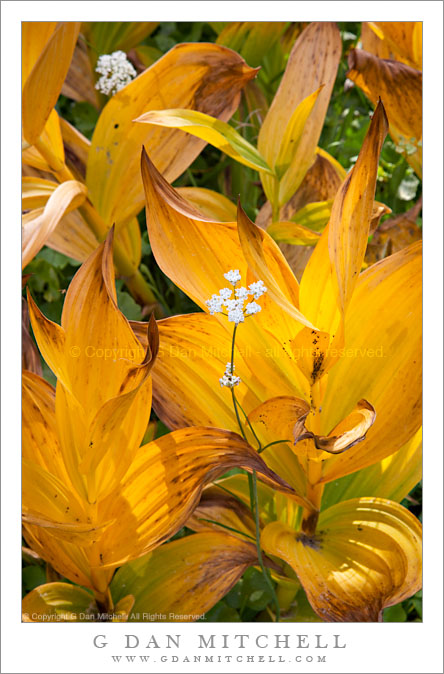
Late-Season Corn Lilies and White Flowers

Late-Season Corn Lilies

Late-Season Corn Lilies and White Flowers. Yosemite National Park, California. August 24, 2009. © Copyright G Dan Mitchell – all rights reserved.

Golden late-season corn lily plants at Half Moon Meadow, Yosemite National Park, California.

The summer goes so quickly in the High Sierra! It was barely a month ago that I was in the Young Lakes region for a few days and the wildflowers were just starting to come into form, and only a couple weeks ago when I encountered peak condition wildflowers above 10,000′ in the upper Sabrina Basin. While you can still find wildflowers – including in this photograph! – if you know where to look in the Sierra, the signs of the coming autumn are beginning to appear throughout the high country, as they do every year at about this time.

Every year, there seems to be a day during the second half of August when I’m in the Sierra and I get a very clear and distinct impression of a change. In many cases I’m hard pressed to identify exactly what it is, but I know it is there. It might be something about the changing angle and quality of the light. Sometimes I think changing air movement and wind patterns may play a part. Perhaps it is the end of the lush moisture from melting snow. In other cases it is more obvious – like when I begin to see these late-season corn lily plants begin their transition: first they are thick and green; then a bit of  brown begins to appear at the tips of the leaves; soon the veined pattern of the leaves begins to pick up brown and yellow streaks; before long some of the plants turn wild yellow and gold colors and their stems begin to weaken; and in a short time they fall over and taken on the texture and color of old corn stalks.

I photographed these brightly colored leaves at the edge of Half Moon Meadow in Yosemite during the last week of August while on a three-day pack trip into the Ten Lakes Basin.

(If anyone can identify the small white flowers in this photo I would be very grateful. And, no, the flowers are not growing from the bright yellow corn lily plants! 10/11/09 – I think we have  a winner. It looks like it might be a plant called gray’s lovage.)


G Dan Mitchell is a California photographer and visual opportunist. His book, “California’s Fall Color: A Photographer’s Guide to Autumn in the Sierra” (Heyday Books) is available directly from him.

G Dan Mitchell: Blog | Bluesky | Mastodon | Substack Notes | Flickr | Email


All media © Copyright G Dan Mitchell and others as indicated. Any use requires advance permission from G Dan Mitchell.