Tag Archives: mountains

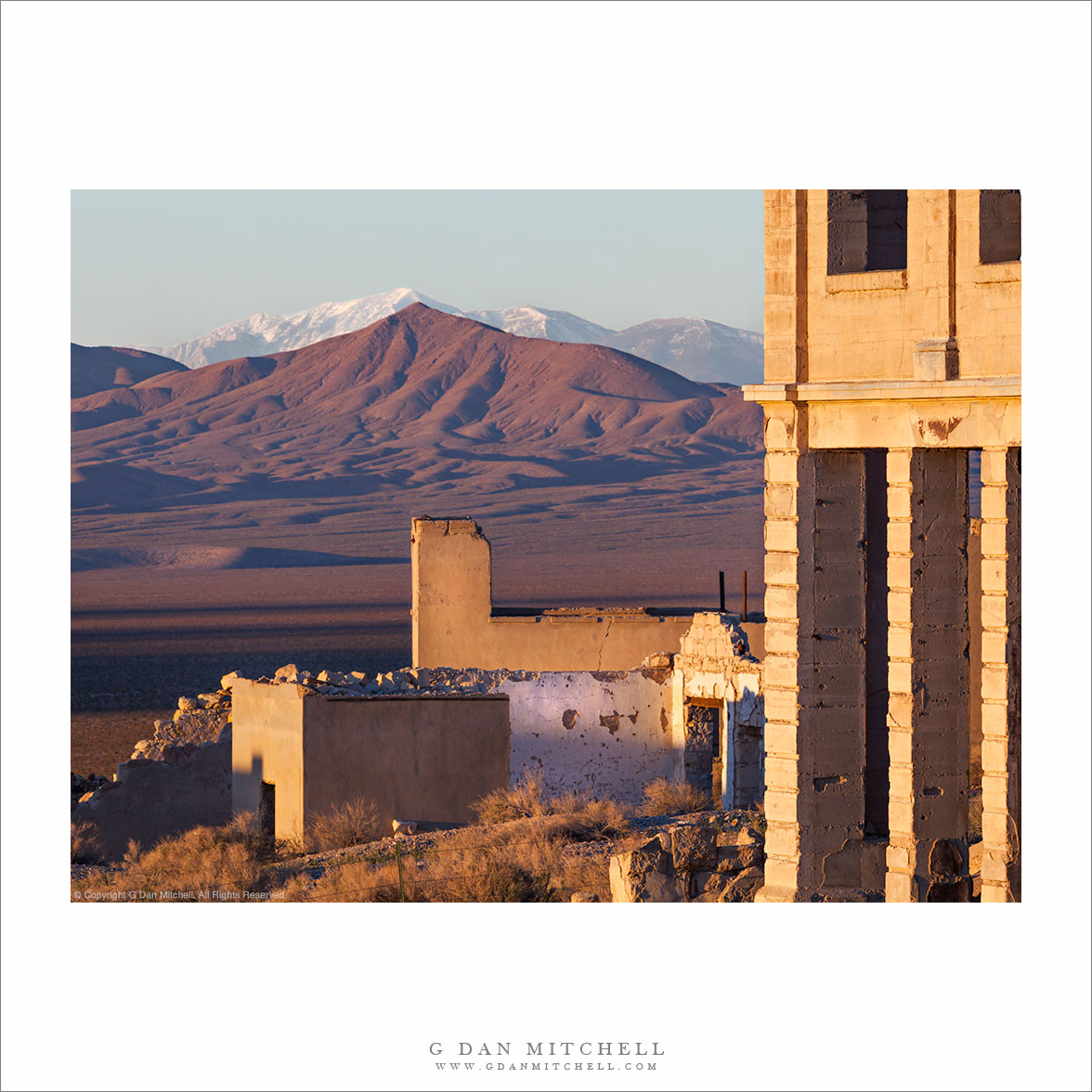
Rhyolite, Amargosa Valley, Telescope Peak

Rhyolite, Amargosa Valley, Telescope Peak
“Rhyolite, Amargosa Valley, Telescope Peak” — Telescope Peak, the Amargosa Mountains, and the Amargosa Valley seen beyond the ghost town of Rhyolite Nevada

I first visited the fabled ghost town of Rhyolite, Nevada perhaps a decade ago. I lies outside of Death Valley National Park, not too far from Beatty, Nevada. The place has existed in a state of mostly natural decay in the decades since it was abandoned. The story is that it was once a very successful and busy mining town, but as happens to virtually all such places, the mines played out and the town died. Not a lot is left at this point, though there are a few very interesting structures. Their size gives evidence of what the town must have been: a railroad station, a crumbling bank building, the remains of a large schoolhouse, and more.

When I first visited Rhyolite the place was pretty much what it was, and you could go just about anywhere you wanted to go. Within a few years fencing began to appear around some of the more dangerous structures—tall ruins of stone walls that are eventually going to fall. As time passed more and more fences were erected, and today many of the old buildings are off-limits. In a way this disappoints me, but given the increasing number of visitors and the increasingly fragile state of the town and its structures, I’m will to accept these limitations as a way to slow the eventual decay of the place. I’ve photographed at various times of day and in a range of conditions, but I still like dawn the best here. When the conditions are right, the sun comes up over a low ridge to the east and its light strikes the old bank building and other structures in the town just after it reaches the Amargosa Range and the summit of distant Telescope Peak, the highest point in Death Valley National Park.


Leave a comment or question using the form. (Click the title to see the full article and to comment if you are viewing it on the home page.)

G Dan Mitchell is a California photographer and visual opportunist. His book, “California’s Fall Color: A Photographer’s Guide to Autumn in the Sierra” (Heyday Books) is available directly from him. Blog | Bluesky | Mastodon | Substack Notes | Flickr | Email

All media © Copyright G Dan Mitchell and others.
Clearing Storm, Panamint Range

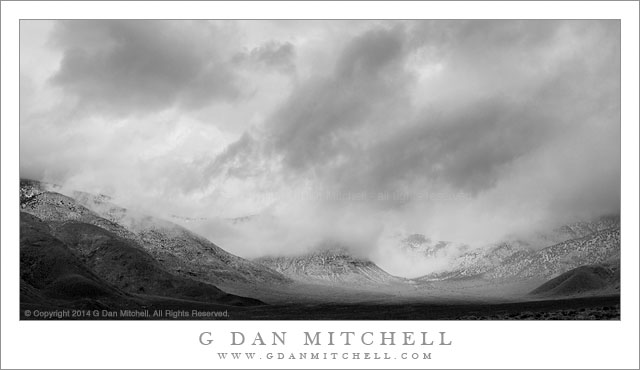
Clearing Storm, Panamint Range

Clearing Storm, Panamint Range. Death Valley National Park, California. April 2, 2014. © Copyright 2014 G Dan Mitchell – all rights reserved.

A clearing snow storm in the Panamint Mountains above Wildrose Canyon, Death Valley National Park

I seem to have a knack for encountering “interesting” weather in Death Valley. The first time I visited the park, on an early April trip back in the late 1990s, I encountered light snow at Scotty’s Castle, an extremely cold wind storm that forced a retreat from the back-country near Teakettle Junction, and a big dust storm at Stovepipe Wells. Since then I’ve experienced a number of dust storms, heavy rain, sub-freezing temperatures, more snow, and plenty of wind. If you are hoping to visit the park for its more typical hot weather, you might want to avoid times when I’m there! Of course, I often visit around the beginning of April, and this seems to be a time of wildly varied conditions in this park—the time of wind storms, and a season when you might see the last Pacific winter storms or the first really warm weather.

On this year’s early April visit things leaned more in the direction of winter-like conditions. As a series of welcome Pacific storms came through there were plenty of clouds, cooler temperatures, strong winds, and some precipitation. The plan on this morning was to start at a very high overlook in the Panamint Range, from which expansive morning vistas are often possible. We were there before sunrise… but it was cloudy and becoming cloudier. There was enough light for some photography, but we also became aware that snow was starting to fall on some of the higher peaks. After an hour or so at this location we retreated to a high, broad, sage-filled valley and continued to watch the clouds close in and the snow spread along other nearby ridges. Not wanting to miss the unusual conditions we headed up into Wildrose Canyon, getting as far as the charcoal kilns before the falling snow convinced me that we shouldn’t go any further. We worked our way back down the canyon where the storm began to temporarily clear from the ridge of the Panamint Mountains.

G Dan Mitchell is a California photographer and visual opportunist whose subjects include the Pacific coast, redwood forests, central California oak/grasslands, the Sierra Nevada, California deserts, urban landscapes, night photography, and more.
Blog | About | Flickr | Twitter | FacebookGoogle+ | 500px.com | LinkedIn | Email

Text, photographs, and other media are © Copyright G Dan Mitchell (or others when indicated) and are not in the public domain and may not be used on websites, blogs, or in other media without advance permission from G Dan Mitchell.

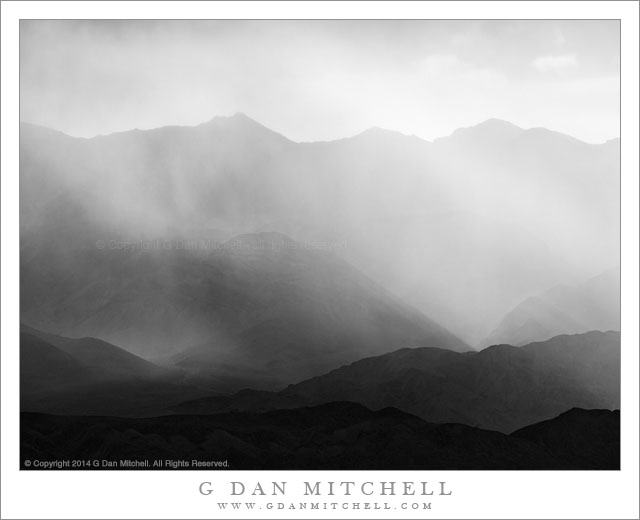
Desert Mountains, Rain

Desert Mountains, Rain

Desert Mountains, Rain. Death Valley National Park, California. April 2, 2014. © Copyright 2014 G Dan Mitchell – all rights reserved.

Rain falling from a dissipating afternoon storm is backlit above desert mountains, Death Valley National Park

This was anything but an ordinary Death Valley day—though I’m not sure that any Death Valley day is likely to be ordinary. We began very early, awakening a couple of hours before dawn. The plan was to be far up in the Panamint Mountains before sunrise, in the hope of photographing the first light over the Valley from a high and wild place. I try to assess the weather conditions in the dark in any way that I can—checking wind, looking to see if stars are visible, and so forth. In the darkness I could tell that only a few stars were visible and that their light was muted, all of which suggested cloudiness. This was, of course, in line with a weather forecast that mentioned things like showers and snow flurries and clouds. However, you can’t tell what will happen until you go out there and watch it happen, so we headed up into the mountains.

Most of the story of this day will wait for photographs of that early morning and the rest of the day in the Panamint range that followed. However, for now I will mention that it was cloudy, it was cold, and it snowed. Later in the day the weather began to clear and we saw some sun before we came back down from the mountains, with plans for an evening shoot in a different location on our minds. As we descended we noticed precipitation in the mountains to our north and west—more or less in the Cottonwood Mountains. We stopped and photographed this weather before heading down into the Valley. Our plans were changing with the weather, and we ended up heading to a high place with a good open view of much of the Valley, figuring that the changing light from the clouds might present quickly changing opportunities. Sure enough, as soon as we arrived at our location we could see that the clouds over the Cottonwood range were quickly thinning, and that backlight was illuminating the last rain falling over the receding ridges of this range, creating a very bright and constantly changing effect.

G Dan Mitchell is a California photographer and visual opportunist whose subjects include the Pacific coast, redwood forests, central California oak/grasslands, the Sierra Nevada, California deserts, urban landscapes, night photography, and more.
Blog | About | Flickr | Twitter | FacebookGoogle+ | 500px.com | LinkedIn | Email

Text, photographs, and other media are © Copyright G Dan Mitchell (or others when indicated) and are not in the public domain and may not be used on websites, blogs, or in other media without advance permission from G Dan Mitchell.

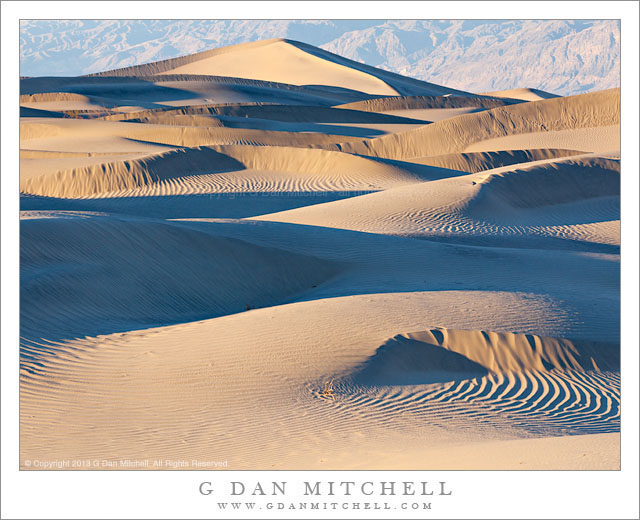
Dunes, Evening

Dunes, Evening
Dunes, Evening

Dunes, Evening. Death Valley National Park, California. December 11, 2013. © Copyright 2014 G Dan Mitchell – all rights reserved.

Receding layers of sand dunes in evening light, Death Valley National Park

After a very long day spent driving a lengthy backcountry gravel road through mountainous terrain, I headed back to my camp at Furnace Creek to take care of camp business and grab something to eat. As I usually do in Death Valley, I scheduled my day around a morning subject and an evening subject. Since the morning work had lasted so long, I was thinking of something closer for the evening and, besides, by the time I was ready to shoot it was probably too late to travel very far in the remaining light before the early sunset of this December day. So I decided to travel up the valley a bit to well-known dunes, where I can almost always find something interesting to photograph if I just go looking.

I stopped some distance from the “usual location,” loaded up some basic equipment, and wandered out into a likely looking section of the terrain that would probably not seem all that special to those seeing the area for the first time. (That’s easy to understand, when the impressive and large sand dunes tower above everything else not far from here!) But I know there is a wealth of interesting things to be found even in what appears to be the plainest of the dunes – conjunctions of light and shadow, textures of sand, tracks of small creatures, plants poking through the sand, and more. When I arrived the low sunlight was just about to leave this area, so I worked quickly, trying to take advantage of fleeting moments of shadow and light. As I came to the top of a low dune I saw this complex terrain of dunes and shadows stretching in front of me.

G Dan Mitchell is a California photographer and visual opportunist whose subjects include the Pacific coast, redwood forests, central California oak/grasslands, the Sierra Nevada, California deserts, urban landscapes, night photography, and more.
Blog | About | Flickr | Twitter | FacebookGoogle+ | 500px.com | LinkedIn | Email

Text, photographs, and other media are © Copyright G Dan Mitchell (or others when indicated) and are not in the public domain and may not be used on websites, blogs, or in other media without advance permission from G Dan Mitchell.