
Tag Archives: national

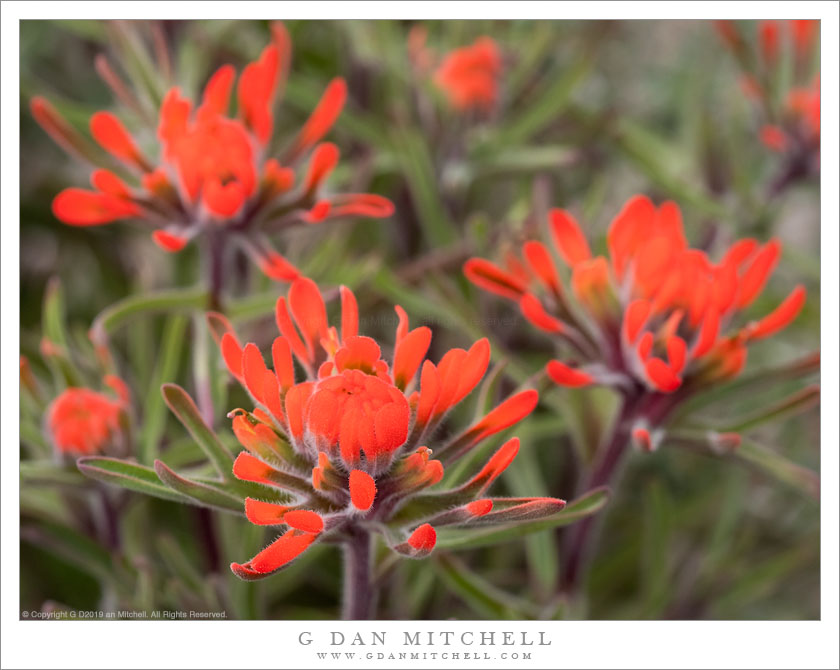
Desert Indian Paintbrush

Desert Indian Paintbrush
Indian paintbrush flowers in a canyon at Death Valley National Park

Desert Indian Paintbrush. © Copyright 2019 G Dan Mitchell – all rights reserved.

Indian paintbrush flowers in a canyon at Death Valley National Park.

This impressive — and very red! — flower and its neighbors were photographed in Death Valley National Park in early April, as this year’s spring bloom seemed to be getting underway in earnest. Predicting desert wildflower bloom timing is a tricky thing. This year a lot of folks were saying that there wouldn’t be that much of a bloom since the early season had been rather dry. However, very heavy rains swept through Southern California, including Death Valley, in early 2019. An atmospheric river situation developed near the start of March and there was enough rain to flood washes, fill desert playas, and damage many roads. I had an idea that there might be a good bloom this year, but that it might be a bit later than usual. Judging what I saw on my two visits — one in early March and other at the start of April — that is what happened, and a lot of flowers were emerging near the end of that second visit.

I’m going to use the second part of this post to share a little technical consideration to be aware of when photographing intensely colorful subjects, especially those that are yellow, orange, red, purple, or similar colors. It has to do with exposure. Most digital cameras meter the overall light, but they assume that the colors will be roughly balanced. In scenes with extremely intense colors — like those seen on the paintbrush flowers — the camera’s metering system can over-expose a color channel, often the red channel, even when it seems like the exposure is right. Often the safest thing to do when photographing such a subject (flowers, brilliant sunsets, autumn leaves) is to under-expose by about 1/3 to 2/3 stops so that you’ll retain some highlight detail in the intensely colorful subject.


G Dan Mitchell is a California photographer and visual opportunist. His book, “California’s Fall Color: A Photographer’s Guide to Autumn in the Sierra” is available from Heyday Books and Amazon.

Blog | About | Flickr | Facebook | Email

Links to Articles, Sales and Licensing, my Sierra Nevada Fall Color book, Contact Information.


All media © Copyright G Dan Mitchell and others as indicated. Any use requires advance permission from G Dan Mitchell.
First Light, Dunes and Creosote

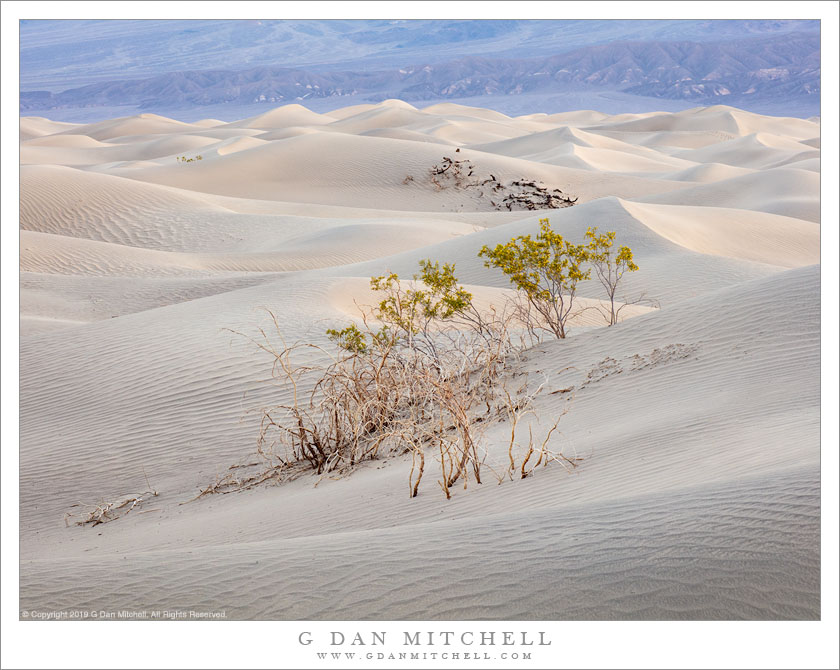
First Light, Dunes and Creosote
Blossoming spring creosote plants among the sand dunes at first light.

First Light, Dunes and Creosote. © Copyright 2019 G Dan Mitchell – all rights reserved.

Blossoming spring creosote plants among the sand dunes at first light.

I love early morning in the sand dunes. When photographing there I typically arrive well before sunrise, when there is just a hint of light in the sky. In Death Valley this is mostly a very quiet time of the day, often with few other visitors, when the winds have died down yet the temperatures are still comfortable. The ideal morning is preceded by a windy afternoon the day before and into the evening, which may wipe away many of the footprints from the previous day’s visitors. However, walking into the dunes I always find new “footprints” — of mice and reptiles and other desert residents.

The transition of morning dusk light to full sunlight always amazes me, even after experiencing it many times. At first things move slowly though inexorably as the overall sky begins to gradually lighten. Well before actual sunrise there is quite a bit of light, but it is soft and gentle light, generally with a blue tint from the pre-sunrise sky. (I made this photograph at just about this point.) Then the pace accelerates as the first direct sunlight strikes some high point, generally to my west, and the light begins to transition to the saturated reddish colors of sunrise and work its way to lower elevations. By this time I’m engaged in photographing and usually working fast as the light changes very quickly. As the sun rises above the horizon or a mountain ridge a brief moment of soft, direct light begins, but the light quickly becomes intense and the difference between shadow and highlights becomes very large. Before long the coloration of this intense light diminishes and conditions move toward “just plain daylight.” I photograph a bit longer… and then it is time for a break!


G Dan Mitchell is a California photographer and visual opportunist. His book, “California’s Fall Color: A Photographer’s Guide to Autumn in the Sierra” is available from Heyday Books and Amazon.

Blog | About | Flickr | Facebook | Email

Links to Articles, Sales and Licensing, my Sierra Nevada Fall Color book, Contact Information.


All media © Copyright G Dan Mitchell and others as indicated. Any use requires advance permission from G Dan Mitchell.
Hills and Wash

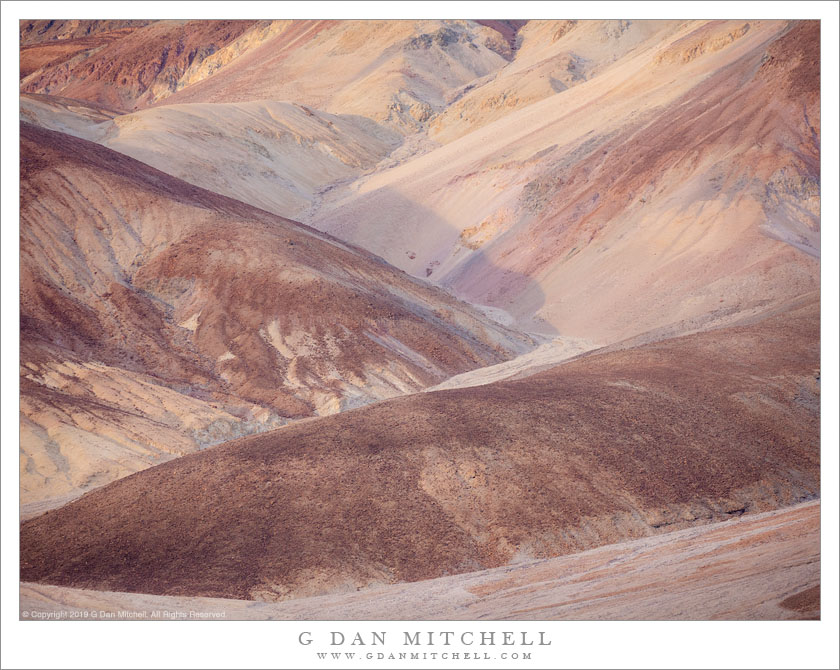
Hills and Wash
A desert wash winds through colorful hills at the base of the Black Mountains in soft evening light.

Hills and Wash. © Copyright 2019 G Dan Mitchell – all rights reserved.

A desert wash winds through colorful hills at the base of the Black Mountains in soft evening light.

I am a bit surprised that I never really noticed this feature before. This wash twists its way up through a series of very colorful hills that are plainly visible from a road that I have travelled many times. I suppose that the explanation may be that I have often passed by on my way to some other specific location, and thus my attention hasn’t been on my immediate surroundings as much as it should have been.

This was a very cloudy evening, but there were brief intervals of light, often filtered by high clouds and in gaps between thicker clouds and a high mountain ridge to the west. It was extremely windy and the light was in a constant state of flux, so when I saw this scene I worked very quickly, deciding that using a tripod wouldn’t help much in the strong gusty winds and that getting the photograph quickly before the light changed was the most important thing. Sure enough, within seconds after making a small number of exposures this light was gone.


G Dan Mitchell is a California photographer and visual opportunist. His book, “California’s Fall Color: A Photographer’s Guide to Autumn in the Sierra” is available from Heyday Books and Amazon.

Blog | About | Flickr | Facebook | Email

Links to Articles, Sales and Licensing, my Sierra Nevada Fall Color book, Contact Information.


All media © Copyright G Dan Mitchell and others as indicated. Any use requires advance permission from G Dan Mitchell.
Sand Storm Clouds

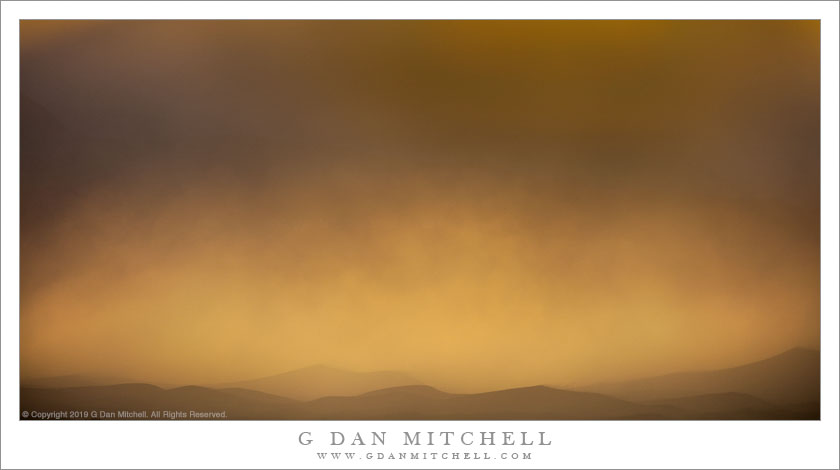
Sand Storm Clouds
Sand storm clouds narly obliterate the llight above dones and mountains

Sand Storm Clouds. © Copyright 2019 G Dan Mitchell – all rights reserved.

Sand storm clouds nearly obliterate the light above dunes and mountains.

Desert sand (or dust) storms are complicated things, bringing extraordinarily difficult conditions but also sometimes amazing visual opportunities. Operating within the worst of them is almost impossible, especially for a photographer trying to manage sensitive equipment and lenses… and manage to see and breathe. It can be done, but most people should not try. (I once read a semi-official description of Death Valley sand storm conditions on the dunes, in which the writer basically said, in no uncertain terms, “Don’t even try.” And then followed up with a description of the steps necessary to function in the storm… which would likely dissuade any sane person.) I’ve been caught in these storms more than once, even camping in a couple of them. I can assure you that it was not at all pleasant.

Yet these storms are also powerful and awe-inspiring events. (“Awesome” in the original sense of provoking awe.) I recall once a couple of years ago driving down into another such storm — much worse than this one — and listening to the sound of sand hitting the vehicle… and then the sound of small pebbles falling from the sky. That got my attention. To make this photograph I stopped along the edge of the storm, where the winds were very strong but had not yet picked up much sand and dust. Working handheld, since no tripod would stabilize a camera in these conditions, I stood in the lee of my vehicle for a few minutes and photographed across the blowing dust and the dunes toward the setting sun, whose light was a barely visible through the clouds.


G Dan Mitchell is a California photographer and visual opportunist. His book, “California’s Fall Color: A Photographer’s Guide to Autumn in the Sierra” is available from Heyday Books and Amazon.

Blog | About | Flickr | Facebook | Email

Links to Articles, Sales and Licensing, my Sierra Nevada Fall Color book, Contact Information.


All media © Copyright G Dan Mitchell and others as indicated. Any use requires advance permission from G Dan Mitchell.