Silhouetted figures, windows, and beams of light, Metropolitan Museum
This is a second “take” on a location I photographed between Christmas and New Year’s Day last year, when we spent a week in New York. It was an exceptionally cold week, and on a few days we decided that we really needed to find indoor activities. (On other days we defied the cold and wind and walked all over Manhattan anyway.) One of the reliable options is a visit to a museum, so we headed to the Metropolitan, where we wanted to see the David Hockney show. You can’t see it in this photograph, but the museum was packed with other visitors who were also looking for a warm, indoor option.
We passed through this room twice, on our way to and from a section of the museum with relatively modern art that we wanted to view. This space is really essentially a very wide walkway, though I suspect that it could also be used for exhibits at times. The row of tall windows along the southern wall opened to Central Park and, further away, the Manhattan skyline. Lots of people took advantage of the wide window sills as a place to sit. The resulting effects of light were intriguing — backlit people in a variety of poses, the faint image of the park and city outside, and the alternative effects of shadows and reflections from the bright light streaming through the windows.
UPDATE: As of 2020 I am no longer posting annual updates concerning this subject — and I am editing older posts on the subject in light of the need to be more responsible about not encouraging the onslaught. I also no longer recommend going to the Valley to see it. Unfortunately, too much exposure (yes, I played a part in it, unfortunately) has led to absurd crowds, traffic jams, littering, destruction of areas in the Valley where too many people go to see it… and the park has increasingly — and appropriately — cracked down. Parking options have been eliminated, at least one viewing location has been closed. Good news! The rest of Yosemite Valley is still there and often exceptionally beautiful at this time of year.
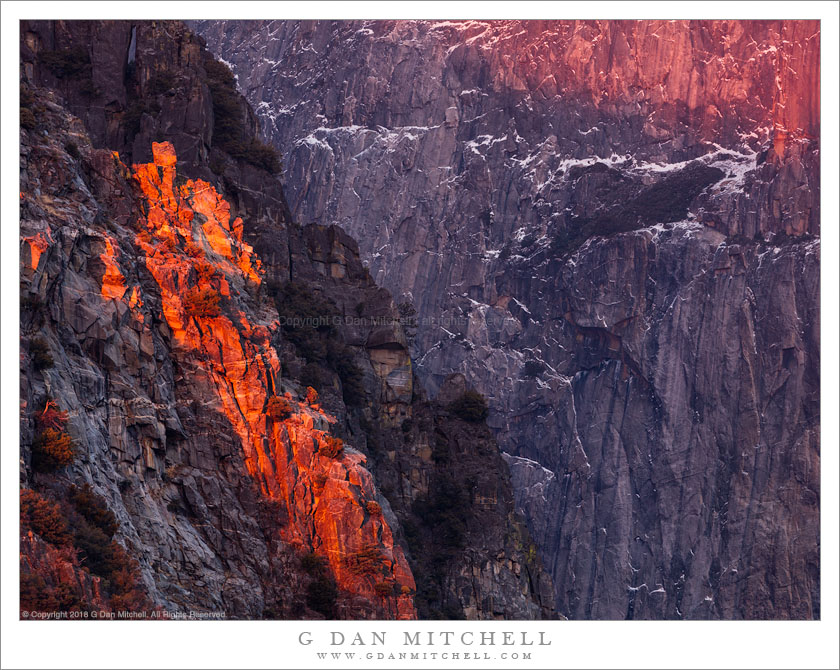
Horsetail Fall, Early Evening
Every winter, for roughly a week or so starting just after mid-February, the sun and various geological features line up so that sunset light falls on the seasonal and ephemeral Horsetail Fall near the east end of the face of El Capitan. Sometimes the light of the setting sun may illuminate this waterfall from behind and briefly make the waterfall and its misty spray glow in sunset colors.
Since it is that time of year again, I’m going to briefly share a few bits of information and perspective about Yosemite Valley’s Horsetail Fall. For more, see an earlier article.
But before you get too excited…
This is another extremely dry winter in California, with Sierra snowpack far below normal. There is very little snow in the drainage the feeds the fall, and forecasts suggest that it will remain dry. In other words, there probably won’t be enough water to start the fall.
The “event” has gotten out of control as thousands of people showed, parking everywhere and trampling through forests. The park service decided that something has to change. This year access to the typical viewpoints will be more difficult, with extremely limited parking (by advance permit only), and roads near the viewing area will be closed to parking or shut down completely. If you don’t have one of those permits, you have a long walk ahead of you… and probably a long return walk in the dark.
Third, what you see in photographs (including my own) is not what you are likely to see in person.
My best advice this year? Probably don’t bother. Between the uncooperative weather and the access restrictions, you are perhaps more likely to experience a #HorseFailFall than Horsetail Fall.
Also, while seeing this phenomenon can be special, it is but one of many, many special experiences to be found in the Sierra. Too often these days, social media convinces use that such experiences are Super Mega Peak Astonishing Ultra Wonders. This poses some dangers, and you should consider resisting. It falsely transforms quiet, contemplative experiences into the equivalent of a sports event, unfortunately creating greater distance between observers and the experience they crave. It also brings crowd that threaten the very places that they come to see.
Perhaps consider something else?
Fortunately, winter in Yosemite Valley has a whole lot to offer besides this event. Fog often forms in quiet meadows at dawn, clouds frequently float among cliffs and peaks, you might get lucky and see some snow, some wildlife is much easier to see in winter, the crowds are generally a lot smaller, and some interesting events take place, such as the Yosemite Renaissance Exhibit opening near the end of the month in the Visitor Center Museum Gallery. (I’ll be in the park during this period as a Yosemite Renaissance “artist in residence,” photographing and attending the opening of the exhibit.)
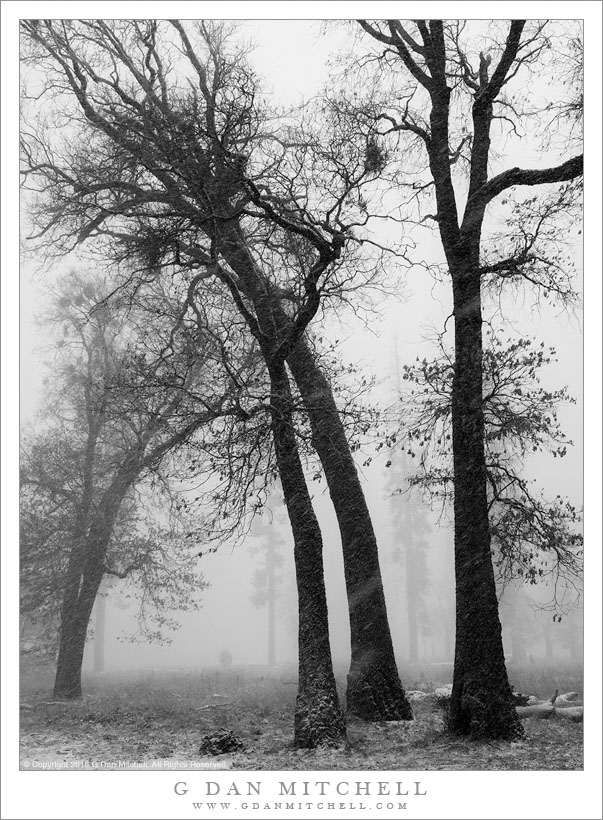
On Sunday there was ground fog all over the San Francisco Bay Area, and I had a few free hours, so I headed out to see what I could find. I went to a place that is very familiar to me, a local haunt where I have hiked and photographed for decades. I had not been there in perhaps a year, so it was good to reestablish my relationship with the location and note a few changes. The little trip also reminded me that it isn’t necessary to travel long distances to find photographic subjects — quite often a closer look at nearby places will reveal worthy subjects.
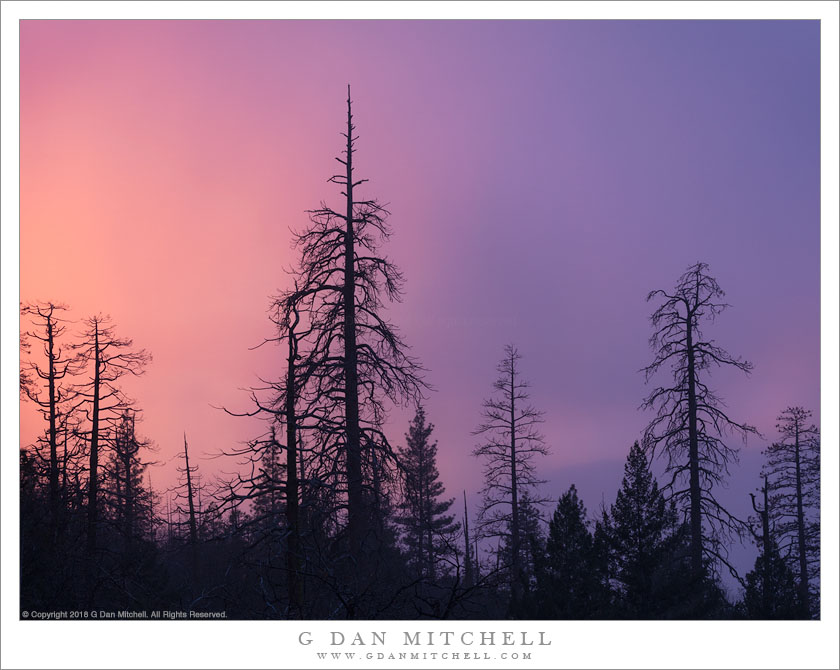
The idea here was to arrive before the fog cleared, photograph in the thick fog for a while, and then be ready to photograph the brief transition period as it thinned, a time when brilliant and stunning but ephemeral light may appear. During my short drive to this location the fog remained thick, but just before reaching my destination it began to clear, likely because ground fog doesn’t stick around as long in the hills. As I parked and loaded up a light load (my lightweight trail photography setup) there were still some pockets of fog clinging to the hillsides, but in most places there was instead a sort of haze that glowed when I photographed in the direction of the sun. I’m very fond of this kind of light, so I quickly looked for subjects that I could use to advantage, and I soon found this tree standing on a grassy hillside and silhouetted against the glowing atmosphere beyond.
Visitors sit in a Metropolitan Museum window overlooking Central Park, Manhattan
At the end of 2017 we spent a week in New York City, mostly visiting our “kids,” but also visiting the city itself. It was a very cold week! Daytime temperatures stayed below freezing — sometimes way below — for five days straight, and nighttime temperatures were in the low teens. On a warm day in New York, it is great to be outside. On winter days like these it is also great to be outdoors in Manhattan… just not for very long! On this day we eventually joined the throngs headed to warm museums, picking the Met, where there is a big David Hockney exhibit that I wanted to see.
I photograph in New York often enough to begin to understand the place a little bit — though nowhere near to the level of those who live there. But I still have plenty to discover, and on this trip I discovered — realized, more accurately — in a conscious way how good the light can be there. This is especially so, I think, in winter. The sun is low in the sky and its light often comes in a low angles, reflecting and silhouetting, and frequently appearing right in my frame of view. I made this photograph quickly while walking through a hallway at the museum where groups of people were taking a break on the ledge of these windows, against the bright backdrop of a soft-focus view of Central Park trees and a bit of the Manhattan skyline.
Photographer and visual opportunist. Daily photos since 2005, plus articles, reviews, news, and ideas.
Manage Consent
To provide the best experiences, we use technologies like cookies to store and/or access device information. Consenting to these technologies will allow us to process data such as browsing behavior or unique IDs on this site. Not consenting or withdrawing consent, may adversely affect certain features and functions.
Functional
Always active
The technical storage or access is strictly necessary for the legitimate purpose of enabling the use of a specific service explicitly requested by the subscriber or user, or for the sole purpose of carrying out the transmission of a communication over an electronic communications network.
Preferences
The technical storage or access is necessary for the legitimate purpose of storing preferences that are not requested by the subscriber or user.
Statistics
The technical storage or access that is used exclusively for statistical purposes.The technical storage or access that is used exclusively for anonymous statistical purposes. Without a subpoena, voluntary compliance on the part of your Internet Service Provider, or additional records from a third party, information stored or retrieved for this purpose alone cannot usually be used to identify you.
Marketing
The technical storage or access is required to create user profiles to send advertising, or to track the user on a website or across several websites for similar marketing purposes.