
Tag Archives: patterns

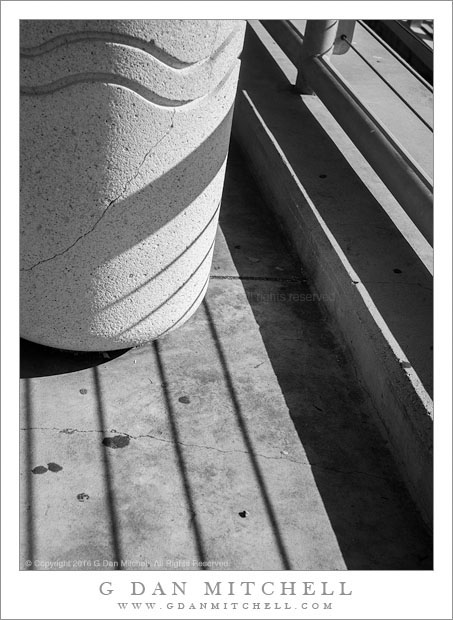
Shadow and Line Study

Shadow and Line Study
Patterns of lines, curves, concrete and shadows

Shadow and Line Study. San Francisco, California. May 20, 2016. © Copyright 2016 G Dan Mitchell – all rights reserved.

Patterns of lines, curves, concrete and shadows

I have always been intrigued by and occasionally obsessed with patterns and juxtapositions and form. When I go back and look at my earliest photography from when I was in middle school or high school I can now see that even then I wasn’t just looking at things for what they “are,” but for the other things that they might also be — the aspects of them that are not immediately visible. This is simple (or so it seems) study of some lines and curves and perspective lines, made quickly while walking along the Embarcadero on San Francisco’s waterfront one morning.

Recently the discussion about realism and honesty and manipulation in photographs has crescendoed a bit, as it does from time to time. On one side are those who think that anything goes — not exactly my point of view, though I might be more “permissive” that you would expect. On the other side are members the “no manipulation” faction, who want to apply the supposed standards of photojournalism to all photographs — their job is to show truth and be completely objective and no “manipulation” is permitted. The problem with the extremes of the first position are obvious. The problems with the extremes of the second deserve a lot more thoughtful scrutiny then they have generally been receiving. All photographs lie, even those that tell truths. Some might imagine that a photograph like this one represents an objective truth, a straightforward (and straight photography) look at the true nature of a thing. But if you saw this subject, you would not likely see anything like this, and my choices (to make it black and white, to use a particular lens, to render the image in black and white, to look at this particular subset of the whole, and much more) are entirely subjective. In the end, this is still truth — but it is my very subjective truth about this subject and it most certainly is not an objective “record” of a thing.


G Dan Mitchell is a California photographer and visual opportunist. His book, “California’s Fall Color: A Photographer’s Guide to Autumn in the Sierra” is available from Heyday Books and Amazon.
Blog | About | Flickr | Twitter | FacebookGoogle+ | LinkedIn | Email


All media © Copyright G Dan Mitchell and others as indicated. Any use requires advance permission from G Dan Mitchell.
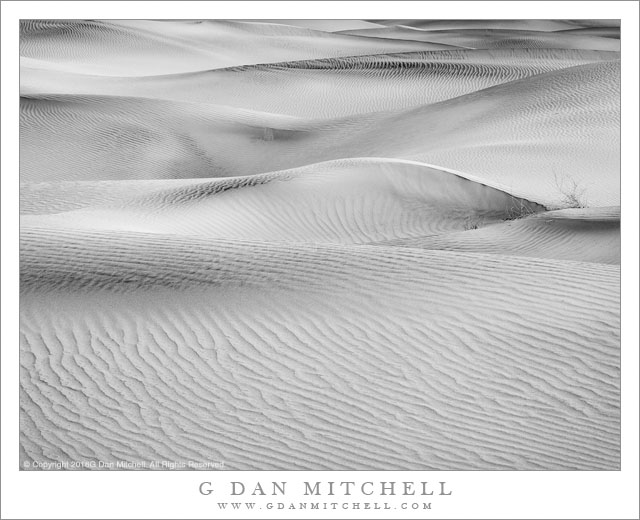
Sea of Sand

Sea of Sand
Overlapping sand dune patterns, morning

Sea of Sand. Death Valley National Park, California. March 31, 2016. © Copyright 2016 G Dan Mitchell – all rights reserved.

Overlapping sand dune patterns, morning

On the last day in Death Valley this spring we were planning to head off to the Los Angeles area in the morning, but I decided I wanted to photograph one more time before departing. Although I really wanted to sleep in, after many days of rising very early, I decided to get up early one more time and head back to the dunes alone for one final bit of photography. I headed out before dawn and arrived at a location I had been to before, parked the car, hoisted a backpack and tripod, and headed out across the playa toward a section of dunes where I was reasonably certain I would be able to photograph alone. The distances are always deceiving, and the playa walk took much more than the ten minutes one might guess that it would take if unfamiliar with these places. Eventually I came to the low dunes that I had been aiming for, and I began to look for places where I could make sand fill the frame.

The dunes are deceiving on other ways, too. You might imagine that they are on the march, being pushed along by winds. The wind does move sand — and it was blowing around my feet on this morning — but overall the dune forms are actually quite stable. Sometimes these active looking yet stable features make me think of a sort of stop motion ocean, with waves and crests and valley mostly frozen — a stopped landscape mirroring the active surface of water. The patterns here range from small (the little ripples in the foreground) to quite large (the overlapping crests marching into the distance.) I worked this scene and others like it for an hour, and then it was time to leave — a walk back across the playa back to my vehicle, and then the long drive out of the desert.


G Dan Mitchell is a California photographer and visual opportunist. His book, “California’s Fall Color: A Photographer’s Guide to Autumn in the Sierra” is available from Heyday Books and Amazon.
Blog | About | Flickr | Twitter | FacebookGoogle+ | 500px.com | LinkedIn | Email


All media © Copyright G Dan Mitchell and others as indicated. Any use requires advance permission from G Dan Mitchell.
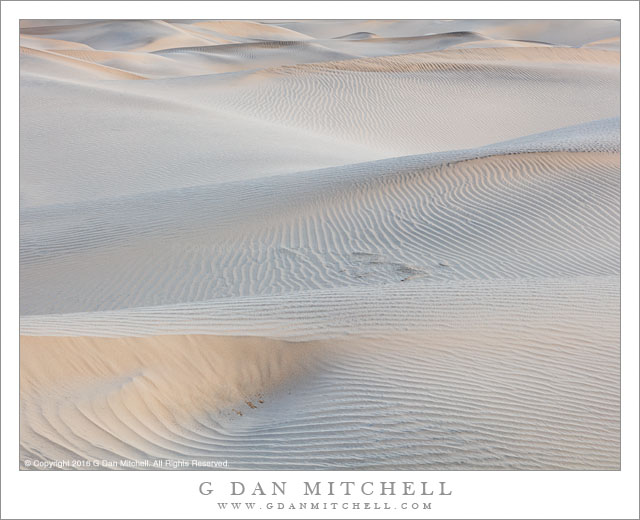
Sand Dunes, First Light

Sand Dunes, First Light
The first morning light reveals textures in sand dunes, Death Valley National Park

Sand Dunes, First Light. Death Valley National Park, California. March 31, 2016. © Copyright 2016 G Dan Mitchell – all rights reserved.

The first morning light reveals textures in sand dunes, Death Valley National Park

These dunes, and others like them, are both more ephemeral and more permanent that many may expect. The permanence initially surprised me. I had always imagined the peaks of dunes marching gradually across the landscape like slow motion ocean waves, producing a landscape that would never be the same twice. However, observing certain dunes in Death Valley National Park over a period of time made it clear that the broad features of the dunes are actually very nearly permanent. From year to year the overall form of the dunes remains largely the same — no surprise, perhaps, given that the forces that form them are constant, including the prevailing winds and surrounding geological features. Yet, other things are more ephemeral. Plants come and go, and footprints are erased by the next dust storm. The light is constantly changing, through the daily cycles and the annual cycle.

This was the final morning of this trip to Death Valley. Since dust storms (and rain!) had passed through the previous evening I was certain that I could find areas unmarked by footprints, where the natural patterns produced by wind would be found. I drove to a less popular area near the dunes, loaded up my equipment, and set out across the playa to get to the low dunes I had in mind. I arrived in soft pre-dawn light and began to photograph, trying to work with this subtle light and its extraordinarily low contrast, all the while watching the sky to the east to see when sunlight would strike the dunes. I composed this photograph in that soft light, but as I worked the sun cleared the mountains far to the east and warmer colored light began to more clearly show the sand patterns. I made this photograph during the very brief interval — literally only seconds — when that first light began to softly light the sand and before it struck with full intensity.


G Dan Mitchell is a California photographer and visual opportunist. His book, “California’s Fall Color: A Photographer’s Guide to Autumn in the Sierra” is available from Heyday Books and Amazon.
Blog | About | Flickr | Twitter | FacebookGoogle+ | 500px.com | LinkedIn | Email


All media © Copyright G Dan Mitchell and others as indicated. Any use requires advance permission from G Dan Mitchell.
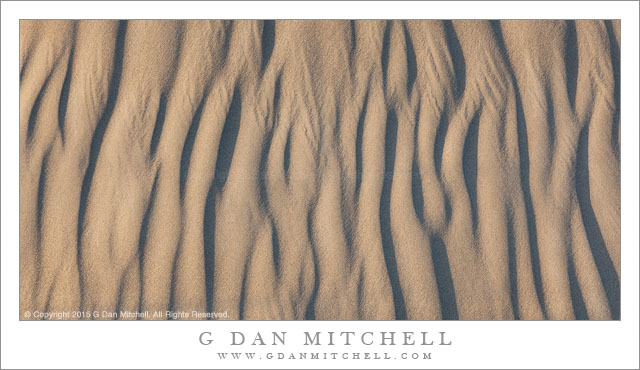
Sand Dune Patterns

Sand Dune Patterns
Sand Dune Patterns

Sand Dune Patterns. Death Valley National Park, California. April 2, 2015. © Copyright 2015 G Dan Mitchell – all rights reserved.

Sand dune patterns following a day of dust storms

Sometimes we flatter ourselves by saying that we make photographs. Indeed, there is truth to that — if there wasn’t something unique in each act of photographic creation everyone would produce photographs of equal interest. However, there is also a distinct element of simply finding things — I like to think of it as hunting. In a location such as the one where I found this subject, there is, for all practical purposes, an infinity of possible subjects — and they are not static, but very much the result to constantly evolving processes of light and wind and erosion and rain and more. We like to tell ourselves that the photographs are out creations, but if we are honest we must admit that there is a great deal in our subjects that is completely beyond our control.

I understand the periodic feeling that “there is nothing to photograph.” However, many times the opposite problem is the challenge — there are so many possible photographs and so many potential ways to approach each subject that it can be overwhelming. During perhaps an hour or a bit more on these dunes I was never without something to photograph, and there were moments the work seemed almost frantic as I spotted some effect of light and hurried to find a way to photograph it during the brief time before it was gone. These patterns were the result of dust storms and high winds over the past 24 hours or more. These conditions had piled sand up near the tops of dunes, and on the leeward side the sand had drifted downward, following patterns that seem more like those of a liquid than a solid. I happened to show up as the low angle evening light briefly passed from left to right across the surface of this texture, and working quickly I was able to make a few exposures before the light faded.


G Dan Mitchell is a California photographer and visual opportunist whose subjects include the Pacific coast, redwood forests, central California oak/grasslands, the Sierra Nevada, California deserts, urban landscapes, night photography, and more.
Blog | About | Flickr | Twitter | FacebookGoogle+ | 500px.com | LinkedIn | Email

Text, photographs, and other media are © Copyright G Dan Mitchell (or others when indicated) and are not in the public domain and may not be used on websites, blogs, or in other media without advance permission from G Dan Mitchell.