Tag Archives: peak

Hohenwerfen Castle

Hohenwerfen Castle
Hohenwerfen Castle

Hohenwerfen Castle. Werfen, Austria. July 19, 2013. © Copyright 2013 G Dan Mitchell – all rights reserved.

Hohenwerfen Castle stands on a hill above Werfen, Austria, in the Salzach Valley with the alps as a backdrop.

This castle has an almost “fairytale” appearance, standing alone atop a tall hill in the middle of the Salzach river valley with tall mountains rising on almost all sides. It is not far from Salzburg, Austria. From what I have read, the actual story might be a bit more prosaic, and there is even a hint that the castle may be associated with some grim and somewhat awful stuff in its role as a place where various people were imprisoned.

We had come here to visit the popular Eisreisenwelt Ice Caves, high up in the mountains above the castle and the valley. The castle is an obvious central point of interest in the valley, but perhaps because we had been so high up in the mountains I had not really thought to photograph it. However, as we came back down on the road from Eisriesenwelt to the valley, we came to a hairpin turn closer to the valley where we suddenly had an unobstructed view of the castle with the town behind and successive mountain valleys rising beyond. Although it looks clear in the photo, it was raining lightly from a passing thunderstorm and this made the light a bit more dramatic.

G Dan Mitchell is a California photographer and visual opportunist whose subjects include the Pacific coast, redwood forests, central California oak/grasslands, the Sierra Nevada, California deserts, urban landscapes, night photography, and more.
Blog | About | Flickr | Twitter | FacebookGoogle+ | 500px.com | LinkedIn | Email

Text, photographs, and other media are © Copyright G Dan Mitchell (or others when indicated) and are not in the public domain and may not be used on websites, blogs, or in other media without advance permission from G Dan Mitchell.

Ridges, Evening Light

Ridges, Evening Light
“Ridges, Evening Light” — Evening light shines on forested ridges and high peaks, Olympic National Park

I have not had a lot of luck trying to photograph the Hurricane Ridge area in the past. You’ve probably seen the beautiful and iconic photographs by other photographers – lavish displays of wildflowers, striking alpine ridges holding snow fields and glaciers, spectacular cloud-filled skies. However, on the few occasions when I have tried to shoot there I have contended with wind, fog that held visibility down to mere yards, and poor seasonal timing. Since we were in the Seattle area (for something non-photographic) with a free day, I figured I might try one more time. Initially I had thought of the run up to Artist Point in North Cascades, but the weather forecast there was not at all promising, with rain expected. Initially I thought that there might be similar weather out on the Peninsula, but as we started out I got a call from my brother, who is a Seattle area photographer much more familiar with the patterns of the area, saying “go to the Olympic Peninsula. I’m looking at a web cam and it seems clear!”

In fact, by the time our ferry crossed to the west side of Puget Sound, it was looking quite clear. After some midday, lowland shooting, we figured that we would try Hurricane Ridge at the end of the day. With this in mind, it was a bit after 5:00 when we arrived there. The first look around was not too encouraging – the wildflowers were mostly spent and it was cloudy, though sun was breaking through the clouds from time to time. I decided to give it a try since I know that conditions can change quickly and because it was likely too late to get to any other interesting points in the remaining daylight. Setting up and watching the scene, I noticed that while it was cloudy and even a bit rainy, breaks in the clouds to the west were sending occasional beams of light chasing across the landscape, especially the large forest-covered ridge in the foreground of this photograph.


COMMENT OR QUESTION? Scroll down to the comment form.

G Dan Mitchell is a California photographer and visual opportunist. His book, “California’s Fall Color: A Photographer’s Guide to Autumn in the Sierra” (Heyday Books) is available directly from him. Blog | Bluesky | Mastodon | Substack Notes | Flickr | Email

All media © Copyright G Dan Mitchell and others.
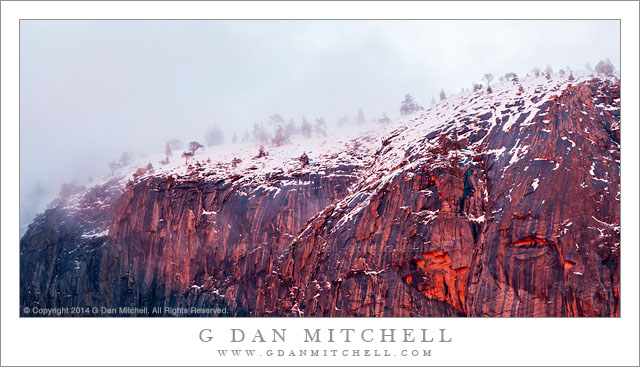
Grazing Deer, Ragged Peak

Grazing Deer, Ragged Peak

Grazing Deer, Ragged Peak. Yosemite National Park, California. August 7, 2013. © Copyright 2013 G Dan Mitchell – all rights reserved.

A group of deer graze in Tuolumne Meadows near sunset beneath the summit of distant Ragged Peak

Perhaps I’ve simply missed this in the past, but on this early August trip to the Tuolumne Meadows area I saw a herd of deer grazing in the meadow in the evening that was larger than any I have encountered before. I’ve often seen small groups of perhaps a half-dozen or so there, but this group had at least two dozen individuals on the two evenings I was there. Many were bucks with antlers, but there were also some very young and very frisky critters among them, including one who seemed to be the ringleader of periodic high-speed races back and forth across the meadow. While waiting for interesting light for photographing other subjects (and that light is just beginning to appear on the dome behind the meadow) I spent some time with the long lens photographing them.

There are, of course, quite a few ways to photograph wildlife, ranging from what amount to intimate and close-up portraits to photographs that show the animals in their landscape – with the latter verging on “landscape with animals,” a different thing than much wildlife photography. I like doing both, but here I was thinking a lot more about photographing the animals in their world. This affected my approach in a couple of perhaps obvious ways. First, while I could have gotten quite a bit closer with the long lens I was using, I hung back so that I could include more than one deer in the frame, include more of the surrounding landscape, and not intrude to closely on the deer. Second, as soon as I had clicked of a first “insurance shot” of the animals, I stopped and looked at the landscape in order to find things that I could align with the deer. In this case, I was able to move some distance to one side and get a group to line up with the low dome (which, lucky for me, got hit with a bit of soft evening sunlight at the right moment!) and the distant ridge holding Ragged Peak, an area that I know quite well from many pack trips into nearby areas.

G Dan Mitchell is a California photographer and visual opportunist whose subjects include the Pacific coast, redwood forests, central California oak/grasslands, the Sierra Nevada, California deserts, urban landscapes, night photography, and more.
Blog | About | Flickr | Twitter | FacebookGoogle+ | 500px.com | LinkedIn | Email

Text, photographs, and other media are © Copyright G Dan Mitchell (or others when indicated) and are not in the public domain and may not be used on websites, blogs, or in other media without advance permission from G Dan Mitchell.

Salt Flat Patterns

Salt Flat Patterns
Salt Flat Patterns

Salt Flat Patterns. Death Valley National Park, California. March 30, 2011. © Copyright 2012 G Dan Mitchell – all rights reserved.

Detail of a section of Death Valley salt flats as seen from Dantes View

Death Valley is often not quite what it seems to be. Repeat visits and views from different perspectives – far away, very close up, from above – begin to reveal things that you might not see at first. From next to and on the salt flats in the lowest section of the Valley, you see a very desolate terrain – one of the most non-human terrains I know. Here, well below sea level, there are places that seem completely inhospitable and alien, landscapes of caked salt, worked and sharp-edged salt and dried mud, seeps of shallow water, occasional odd plants, and landscape that often seems to go on almost endlessly the same way. But just as looking more closely reveals surprises (such as living creatures in those millimeters-deep pools of salty water), the view from overhead shows patterns that cannot be readily seen up close.

This photograph was made from the summit of Dantes View. This high point along the eastern side of the valley is close to a mile above the Valley floor. The view can often be panoramic, stretching for tremendous distances in almost all directions, blocked only by the higher peaks of the Panamint Range to the west and a few other high points nearby. Although Dantes View is one of the best known “iconic” locations in the park, I have a complicated relationship with the place. First of all, I seem to attract awful weather when I go there, perhaps because I tend to do so in the season that is winter elsewhere in the state. Not too long ago I attempted to drive to the summit on a winter day and was turned back by a snow storm perhaps a half mile from the end of the road. In addition, it has been hard for me to warm up to the place as a photographic subject. In some ways, there is almost just too much in the view for me to see how to isolate a photograph out of that detailed immensity. I dealt with that here by using a very long lens and restricting my view to a small section of the valley floor, without much context of surrounding terrain, which I think produces a photograph that allows the features in this frame to be seen as abstractions.

G Dan Mitchell is a California photographer and visual opportunist whose subjects include the Pacific coast, redwood forests, central California oak/grasslands, the Sierra Nevada, California deserts, urban landscapes, night photography, and more.
Blog | About | Flickr | Twitter | FacebookGoogle+ | 500px.com | LinkedIn | Email

Text, photographs, and other media are © Copyright G Dan Mitchell (or others when indicated) and are not in the public domain and may not be used on websites, blogs, or in other media without advance permission from G Dan Mitchell.