
Tag Archives: photography

Storyville Coffee

Storyville Coffee
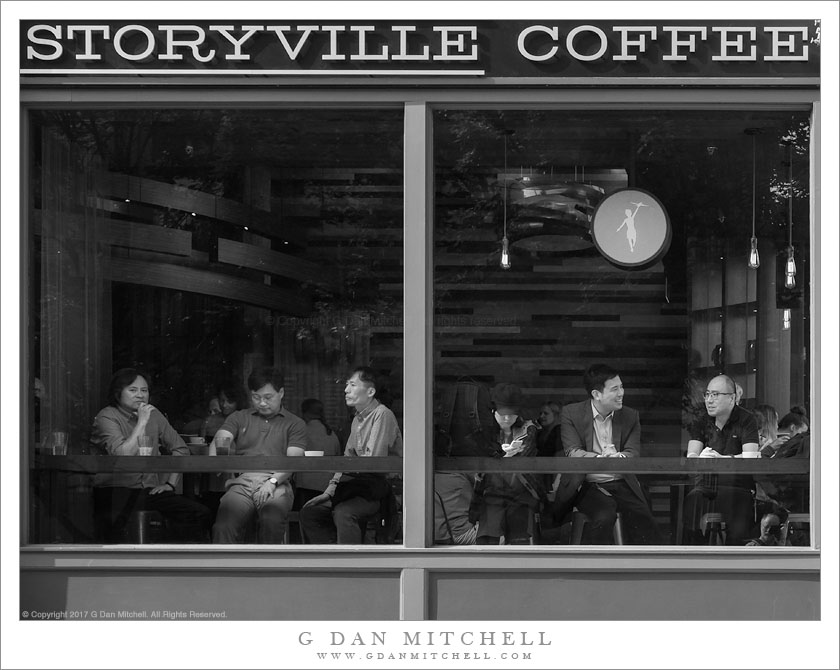
Patrons sitting at the window of a Seattle coffee shop

Storyville Coffee. Seattle, Washington. September 8, 2017. © Copyright 2017 G Dan Mitchell – all rights reserved.

Patrons sitting at the window of a Seattle coffee shop

As you may have noticed — at least if this isn’t the first time you have seen one of my posts — I like to photograph a rather wide range of subjects. Some know me as a “landscape” or “nature” photographer, but my subjects include many other things: night photography, street photography, urban landscapes, musicians, and more. One line of thinking holds that this is not a good thing — that it dilutes one’s photographic identity and fails to produce a recognizable style. Yet, it turns out that I’m not alone, and lots of other photographers are fascinated by multiple subjects. (Last weekend I ran into a couple of fine photographers and friends high in the Yosemite Sierra, people who have a reputation for photographing the natural world. When I met them they were just finishing up photography of peeling paint on an empty building…) Once they have been typecast, they tend to accept that — since being recognized for a type of photography is a good thing — but they occasionally admit to being frustrated when their other work isn’t understood.

So this is from my “other photography” — the work I do when I spend time in urban environments. It is hard for me to explain the fascination of “street photography” to those who don’t get it, but I’ll try. First, I think we can regard this world as a kind of “urban landscape” — and some of the same attractions of light and texture and color and form are found here. Second, it can be an incredibly dynamic “landscape.” When things are going well, I often feel that I’m in the midst of a continuous flow of people and compositions and their collisions and that there is almost too much to see. The trick is often (though not always) to stay tuned in and to be read to see and photograph quickly. Third, the human layer is something found much less in landscape photography, and it fascinates me. Here I just happened to spot one of the little vignettes that are everywhere in the city — an interest group of people in different poses and likely with different attitudes.


G Dan Mitchell is a California photographer and visual opportunist. His book, “California’s Fall Color: A Photographer’s Guide to Autumn in the Sierra” is available from Heyday Books and Amazon.
Blog | About | Flickr | Twitter | FacebookGoogle+ | LinkedIn | Email


All media © Copyright G Dan Mitchell and others as indicated. Any use requires advance permission from G Dan Mitchell.
Photographic Myths And Platitudes — Diffraction Limited Aperture

It has been a while since I posted an article in my “Photographic Myths And Platitudes” series — so here is a new one! It is a bit different than some of the previous posts in that it is based on something I wrote elsewhere in response to a lengthy (and long-winded!) discussion that suggested hyper-awareness of the so-called diffraction-limited aperture

What is the diffraction-limited aperture, you ask? It is a real thing — not a myth — though it is sometimes over-emphasized by overzealous techno-photographers.  In simple terms, as you stop down a lens its potential maximum resolution declines as a result of diffraction blur. (Keep in mind that other factors affect sharpness, too. Also, this happens to every lens, from the cheapest to the most expensive — it is a universal optical phenomenon.) At some aperture, the increase in blur becomes significant enough, in a technical sense, to be more of a “limitation” on image sharpness than the ability of the sensor to record detail — e.g. the “number of megapixels” of the sensor. A simplistic interpretation of the concept suggests that a photographer should avoid other apertures in order to “get the sharpest image.”

As with many things in photography, it isn’t that clear-cut.

Now on to my original post. It is a bit technical, though I think most photographers should be able to follow it — and I will conclude with some simple, straightforward practical advice. (And here I remind readers that sharpness is not the most important, much less the only important thing in photography. Far from it!)


Sharpness, or at least the perception of sharpness, is a more complex thing than choosing the aperture the provides (to the extent that this can be determined) the highest optical resolution at the sensor plane, measured at either a) the best performing point in the frame, or b) the average across the frame.

(Speaking of “the extent that this can be determined,” I wonder how folks would answer the following question: Which is “sharper,” the image with the best center resolution but slightly lower corner resolution or the image with slightly less center resolution but better overall resolution across the frame?)

While we might consider whether f/16 will be softer than f/8 on some lens/camera combination — it almost certainly will be softer — it isn’t irrelevant to ask: “How much softer, and will this affect my print?” In quite a few cases the difference in maximum resolution in the print will be essentially invisible. In other words, while you will get optimal resolution at some particular aperture, you will actually still get extremely good print resolution at a smaller (or larger) aperture, too.

If there is no particular photographic reason to choose a smaller (or larger!) aperture, you might as well use whatever aperture you think will produce the highest resolution. That best resolution aperture will vary based on the lens you are using, the camera format, and arguably the photo site density of the sensor. To generalize, if you are shooting full frame it will probably be somewhere in the f/5.6-f/8 range with many lenses. (Other things can affect that — for example, what the maximum aperture of the lens is.) On a cropped sensor camera you could, in many cases, use either the same aperture or guess at one stop larger or so — while realizing that there could be resolution downsides to going larger with some lenses. Trade-offs abound! (I’ll spare you the technical discussion of all of the variables. You can think me later.)

But, seriously, if you are calculating the “sharpest” aperture to the closest 1/3-stop for each lens and using that aperture in the field and avoiding others that are slightly different, you probably aren’t really gaining anything significant from your efforts, and you may be sacrificing things that could make your photographs better.

That said, if we know that some mid-range aperture can provide the highest resolution, why use other apertures? And if we do use other apertures, won’t we end up with a softer print? Continue reading Photographic Myths And Platitudes — Diffraction Limited Aperture

A Shadow

A Shadow
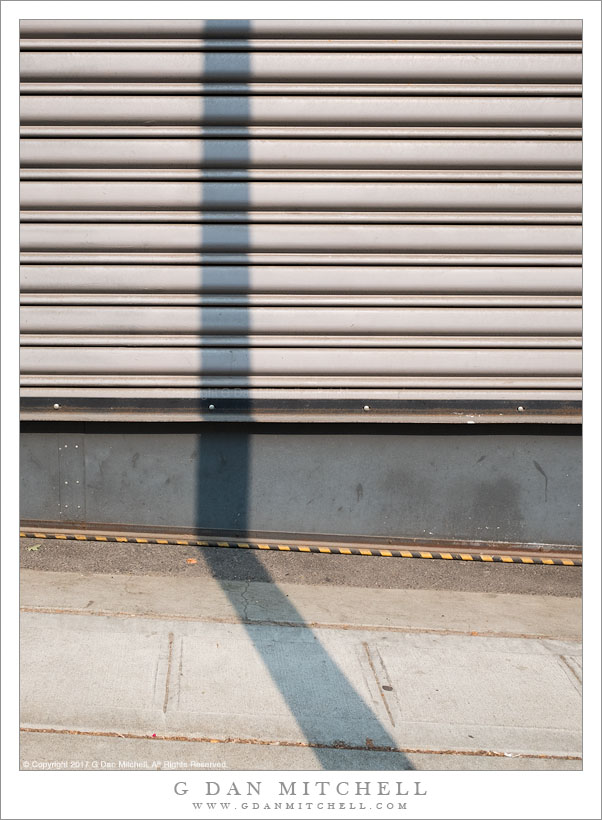
A shadow falls across a Seattle sidewalk and roll-up door

A Shadow. Seattle, Washington. September 8, ,2017. © Copyright 2017 G Dan Mitchell – all rights reserved.

A shadow falls across a Seattle sidewalk and roll-up door

In early September I had the opportunity to spend several days in the Seattle area. I was actually there on a sort of business — not photography related — but I did have enough spare time that I could do some photography, too. It turned out that I had two opportunities. On nearly the last time of the trip I managed the long drive to the North Cascades, where I photographed in the Mount Shuksan and Artist Point area for an afternoon. Before that I managed to head to downtown Seattle for a bout of street photography. This photograph comes from that visit.

When I do street photography I work in ways that are both related to my landscape photography and also different. In both cases I tend to only select general subjects ahead of time, preferring to head out and explore and see what I can find. In both cases I am looking not just for “depictions” of the subjects, but also for bits of visually interesting material that might stand on their own outside of the specific location context. Of course, I use different equipment — for street I leave the tripod behind and I work with a small camera, typically using one or two small prime lenses. As I walk, often slowly, I am attentive to what is around me. I am discrete with the camera, only lifting it in front of me when I make a photograph. I often spot something, make the photograph, and move on quickly. (Not always, though. Some subjects demand more patience or are worth a careful exploration.) I may photograph people, architecture, or fragments of the scene. This is one of those fragments, an odd shadow falling across the slightly warped geometry of the metal roll-up door, and offset by the tilting sidewalk below.


G Dan Mitchell is a California photographer and visual opportunist. His book, “California’s Fall Color: A Photographer’s Guide to Autumn in the Sierra” is available from Heyday Books and Amazon.
Blog | About | Flickr | Twitter | FacebookGoogle+ | LinkedIn | Email


All media © Copyright G Dan Mitchell and others as indicated. Any use requires advance permission from G Dan Mitchell.
Beecher’s

Beecher's
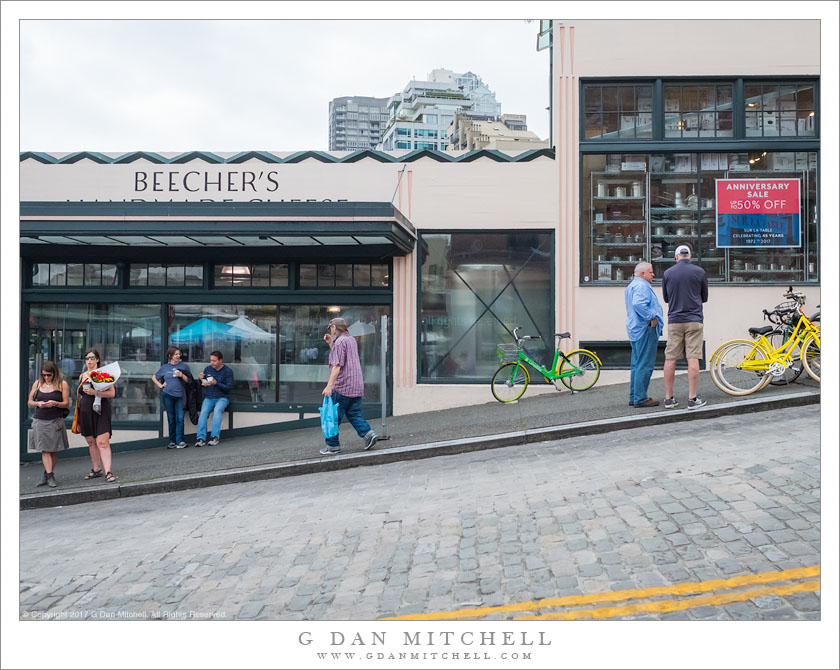
Seattle street scene

Beecher’s. Seattle, Washington. September 8, 2017. © Copyright 2017 G Dan Mitchell – all rights reserved.

Seattle street scene

I made this photograph on a recent visit of several days to the Seattle, Washington area. Much of this visit was not photographically oriented, but I did have a couple of days that I could devote to photography. Seattle has a particular character that I enjoy — to generalize, it is partly about the light and weather, partly about the nature of the city itself, and partly about the people. The light is softer and lower angled than what I’m used to in California. The “nature” of the city is a bit hard to explain — though it has both the woodsy quality of being built-in forest as another quality that is shared with San Francisco and its older buildings. There is something, again to generalize, about the people as well. Perhaps more beards and more informal and slightly outdoorsy clothing?

I made this photograph in the Pike Place area, and I just happened to notice the little tableau of people, buildings, and colorful bicycles and other elements as I walked by. If the photograph is about anything, that anything might include the contrasting square shapes of the building and the angled lines of the road and sidewalk, plus something about the positioning of the people. It is also about color, from the yellow line to the colorful elements sprinkled throughout the frame.


G Dan Mitchell is a California photographer and visual opportunist. His book, “California’s Fall Color: A Photographer’s Guide to Autumn in the Sierra” is available from Heyday Books and Amazon.
Blog | About | Flickr | Twitter | FacebookGoogle+ | LinkedIn | Email


All media © Copyright G Dan Mitchell and others as indicated. Any use requires advance permission from G Dan Mitchell.