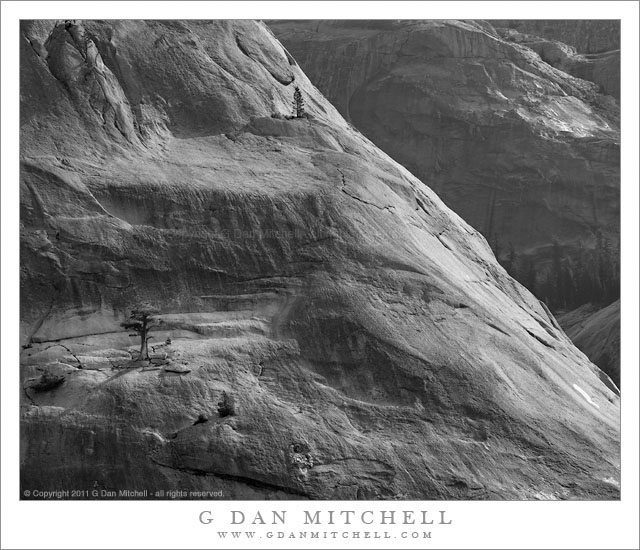
“Trees in Morning Light, Granite Dome” — Trees grow on a bit of talus at the base of a Yosemite dome.
Scenes like this are a big part of what characterizes Yosemite, especially the park’s high country: trees growing on granite, domes, forests, and that “range of light” atmosphere. The features are so common that it is possible for a longtime visitor to almost take them for granted.
I have paused at this spot on virtually every visit to the Yosemite high country for decades. The dome rising to the left in the photograph was my original interest — it is a beautiful dome in an especially aesthetic location. But later on the trees became an equal attraction — easy to overlook among millions of other trees, but once you see them you don’t forget.
Morning light shines on the trees clinging to massive granite domes in the high country of Yosemite National Park.
I’ll write a bit less about this photograph since I posted it already in a color rendition and described some of the background of the image in that earlier post. The basic idea is that I used a very long focal length to isolate the single primary tree against a world of granite that recedes toward the rising sun that is above and out of the frame to the right.
When I made the photograph I had a pretty good idea that it might work as black and white. In fact, though I don’t recall for certain, I think I was leaning towards thinking of the scene in black and white when I made the exposure. (Those last two sentences must seem strange if not almost perverse to people whose primary background is in film!) Sometimes, as with this scene, I end up liking both versions, at least at first. While I may end up leaning toward one or the other more after I live with the prints a while, right now I go back and forth. Of course, when two things are different it is not necessarily the case that one must be better than the other; sometimes they are just different.
Oddly, one thing that inclined me towards black and white ends up also suggesting color. Because so much of the content of the frame is nearly monochromatic I think I originally felt that with so little color to work with that it might make sense to just let it be monochromatic. But then, “with so little color to work with,” the subtle effect of color begins, in some ways, to be even more important.
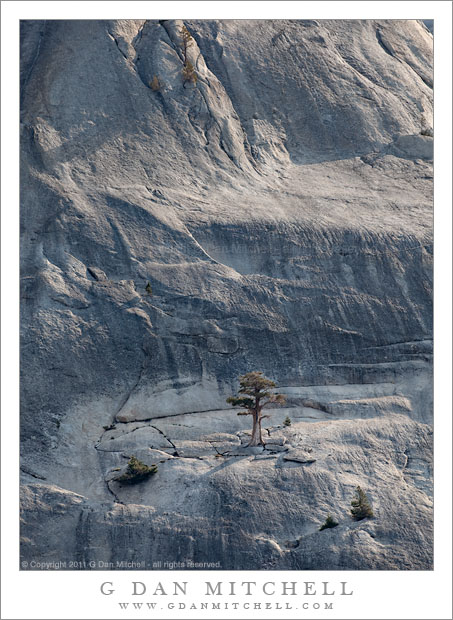
A weathered juniper tree grows high on the granite face of Pywiack Dome, Yosemite National Park.
This is another “take” on the same juniper tree high up on the slopes of Pywiack Dome that was seen in another photograph of this area that I posted earlier this week. I went through a process of “refining” the photograph that I described in the earlier post, and this was the interpretation that I came up with right before the landscape orientation version that I posted earlier. Unlike that photograph, this one frames the area of the dome containing the tree more tightly.
The color balance is a bit different in this one, also. I thought about that quite a bit, at first feeling that the coloration should be essentially identical since the images were made at about the same time and include some of the same subject matter. But the more I thought about it – and the more I experimented with the results of trying for uniformity – the more I felt that the two photographs are different images and that different interpretations make sense.
These trees never cease to amaze me. I often come across what are evidently very old trees that seem to grow almost straight out of solid rock, and only a closer inspection reveals that roots have grown tightly into small and unlikely cracks and weaknesses in the granite. That this tree should have managed to take root half way up the side of this large dome is even more amazing, much less that it managed to avoid growing into the stunted and twisted sort of shape that is so common among such trees.
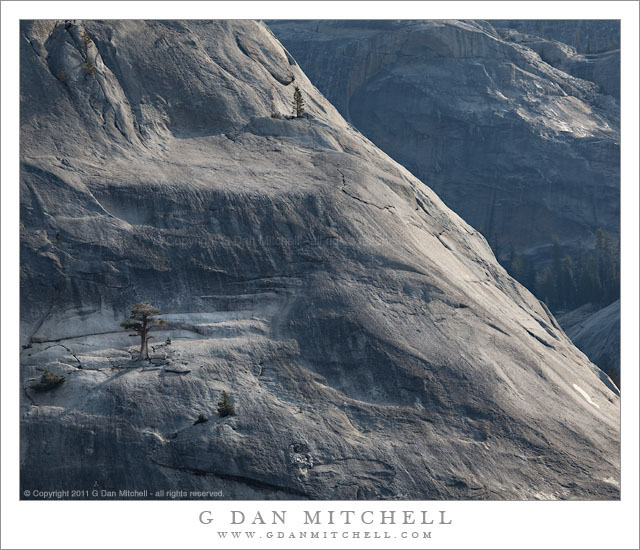
Morning light shines on the trees clinging to massive granite domes in the high country of Yosemite National Park.
This photograph was the result of an odd little sequence of events. While driving along Tioga Pass Road in the afternoon I looked more closely at an area that I have passed by many times and noticed that it was filled with glacial erratics, “loose” boulders left behind when glaciers retreated. It seemed like these boulders might be an interesting subject and since they were in a position where morning light seemed likely, I made a mental note to return in the morning over the next couple of days and see what I could photograph here.
The next morning, after photographing at dawn nearby, I decided to go to this spot and see what I could come up with. I arrived without a specific idea in mind beyond the plan to look around and see what I could find. My first idea was to photograph the boulders themselves, and I did make a few mediocre exposures of individual boulders and groups of boulders. As I played around with this idea I noticed that the light slanting across granite slabs a bit to the north of me looked interesting, especially since this light was also side- and back-lighting some of the trees. So I turned my attention to this potential subject.
Working with this idea I gradually became less interested in the boulders and more interested in the trees of the lodgepole forest that extended beyond the slabs, so I found a somewhat higher spot to shoot from and made a series of exposures that included layers of backlit trees extending beyond the granite. Beyond the trees was the base of Pywiack Dome, a subject that I have worked with a number of times in the past. Now I looked a bit higher than the forest that led my eye to the dome, and I photographed the boundary between the forest and the base of the dome. (Producing, I might add, a really, really boring photograph!) Looking a bit higher I saw the solitary tree near the lower left of this photograph, and I made a vertical exposure that included mostly just the tree and the expanse of granite above and around it. (This photograph will be here in a few days.) They I thought I would try a landscape orientation photograph, and as I worked with this I got the idea to include the right face of the closer granite dome against the darker shape of a more distant cliff. And, finally, I found this photograph.
(There is also a black and white version of this photograph. The text accompanying that version talks a bit about the black and white versus color issue.)
Photographer and visual opportunist. Daily photos since 2005, plus articles, reviews, news, and ideas.
Manage Consent
To provide the best experiences, we use technologies like cookies to store and/or access device information. Consenting to these technologies will allow us to process data such as browsing behavior or unique IDs on this site. Not consenting or withdrawing consent, may adversely affect certain features and functions.
Functional
Always active
The technical storage or access is strictly necessary for the legitimate purpose of enabling the use of a specific service explicitly requested by the subscriber or user, or for the sole purpose of carrying out the transmission of a communication over an electronic communications network.
Preferences
The technical storage or access is necessary for the legitimate purpose of storing preferences that are not requested by the subscriber or user.
Statistics
The technical storage or access that is used exclusively for statistical purposes.The technical storage or access that is used exclusively for anonymous statistical purposes. Without a subpoena, voluntary compliance on the part of your Internet Service Provider, or additional records from a third party, information stored or retrieved for this purpose alone cannot usually be used to identify you.
Marketing
The technical storage or access is required to create user profiles to send advertising, or to track the user on a website or across several websites for similar marketing purposes.


Join the discussion — you are welcome to leave a comment or question. (Comments are moderated and may not appear immediately.)