Tag Archives: range

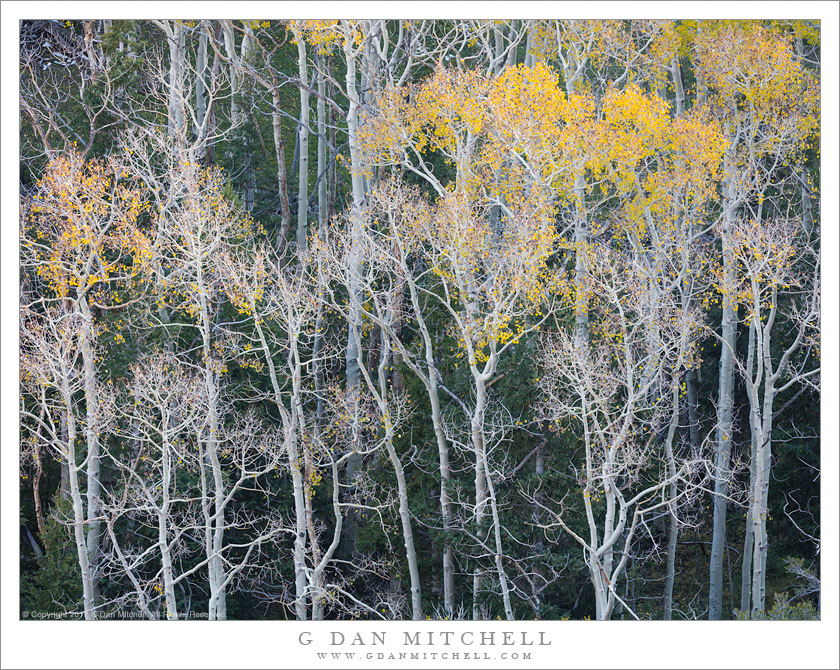
Nearly Bare Aspens

Nearly Bare Aspens
Aspen trees with only a few leaves remaining, Great Basin National Park

Nearly Bare Aspens. Great Basin National Park, Nevada. September 27, 2017. © Copyright 2017 G Dan Mitchell – all rights reserved.

Aspen trees with only a few leaves remaining, Great Basin National Park

In this post I continue, at least a bit, the theme of my last post: the varied rate of fall color change. In the previous post I wrote about the variations in the eastern Sierra Nevada — how early the first signs of color can occur, how late in the season it may be when the final aspen leaves fall, and the varying rates at which the colors arrive, even in limited geographical areas of the range. But if you stretch your horizons beyond the Sierra the variations are even greater.

We first “discovered” this a few years back when we visited Utah in the fall. I often make a point of not doing too much research before visiting a new area, and often this has the advantage of letting me discover the place on my own terms. On the downside, sometimes I miss the timing a bit! On that Utah trip I assumed that the colors might change on the schedule I’m used to in the Sierra… and we ended up arriving too late for the best aspen color. On the trip where I made this photograph I assumed that, since the location is virtually on the Nevada-Utah border, color would come earlier, and I arrived about a week before the end of September. In fact, the color change was underway, though still not quite peaking. But in a few spots, including the little grove where I made this photograph, some trees had almost completed their fall color season already!


G Dan Mitchell is a California photographer and visual opportunist. His book, “California’s Fall Color: A Photographer’s Guide to Autumn in the Sierra” is available from Heyday Books and Amazon.
Blog | About | Flickr | Twitter | FacebookGoogle+ | LinkedIn | Email


All media © Copyright G Dan Mitchell and others as indicated. Any use requires advance permission from G Dan Mitchell.
Autumn Aspens, Great Basin

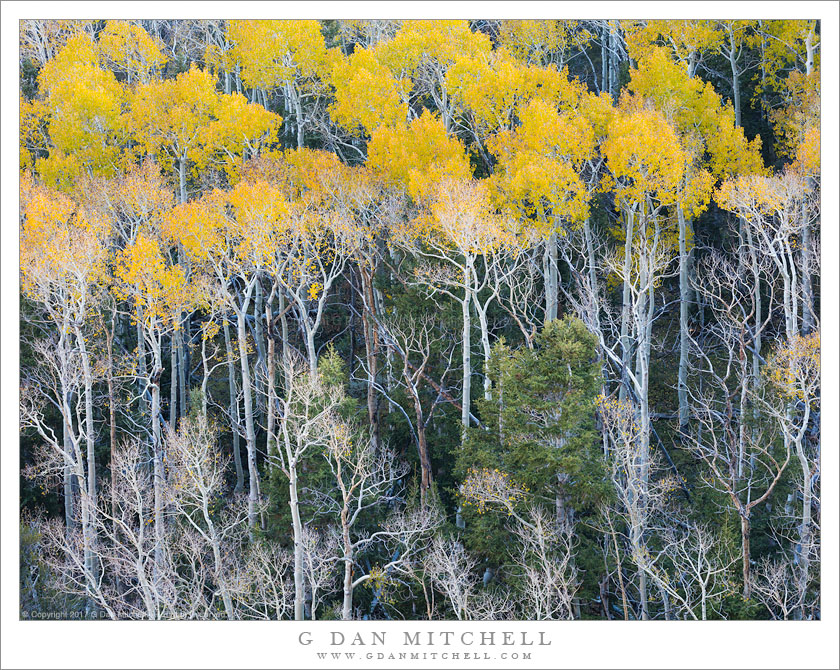
Autumn Aspens, Great Basin
Autumn aspen trees drop their leaves, Great Basin National Park

Autumn Aspens, Great Basin. Great Basin National Park, Nevada. September 27, 2017. © Copyright 2017 G Dan Mitchell – all rights reserved.

Autumn aspen trees drop their leaves, Great Basin National Park

I began this year’s Great Fall Color Chase in a different location — not the Eastern Sierra Nevada, but instead about as far east as one can go in Nevada, at the Great Basin National Park. Several factors led me to make this trip — some specifically fall color related, and others that don’t connect to that activity. Over the past few years I have noticed a few things about Sierra Nevada fall color season. The crowds have been increasing, to the point that they can sometimes be a bit too much. But quieter and less crowded places are still available if you look around a bit. And sometimes looking a bit beyond the confines of the Sierra turns up some interesting color, perhaps in places you might not expect. The latter realization has pushed me gradually further east of the Sierra itself… and what could be a more natural extension of that process than going to the eastern boundary of Nevada?

But fall color was only part of my reason for making the long trip to Great Basin National Park. I know a bit about the basin and range country, but my direct experience with it is limited — and this park (and the long drive across many basins and ranges to get there!) offered the chance to confront this new, to me, landscape. I arrived a few days before the end of September, thinking that the somewhat earlier color change that I’ve seen in next-door Utah might be mirrored in Nevada. This turned out to be partially true — there was already aspen and cottonwood and other types of color, but it wasn’t quite at peak just yet. But I learned a lot on this trip, about where to look for the color (including one canyon I discovered just a bit too late) and when to find it. I made this photograph of trees growing in a large valley below the summit ridge that holds Wheeler Peak, the 13,000+ footer that is the second-tallest peak in Nevada.


G Dan Mitchell is a California photographer and visual opportunist. His book, “California’s Fall Color: A Photographer’s Guide to Autumn in the Sierra” is available from Heyday Books and Amazon.
Blog | About | Flickr | Twitter | FacebookGoogle+ | LinkedIn | Email


All media © Copyright G Dan Mitchell and others as indicated. Any use requires advance permission from G Dan Mitchell.
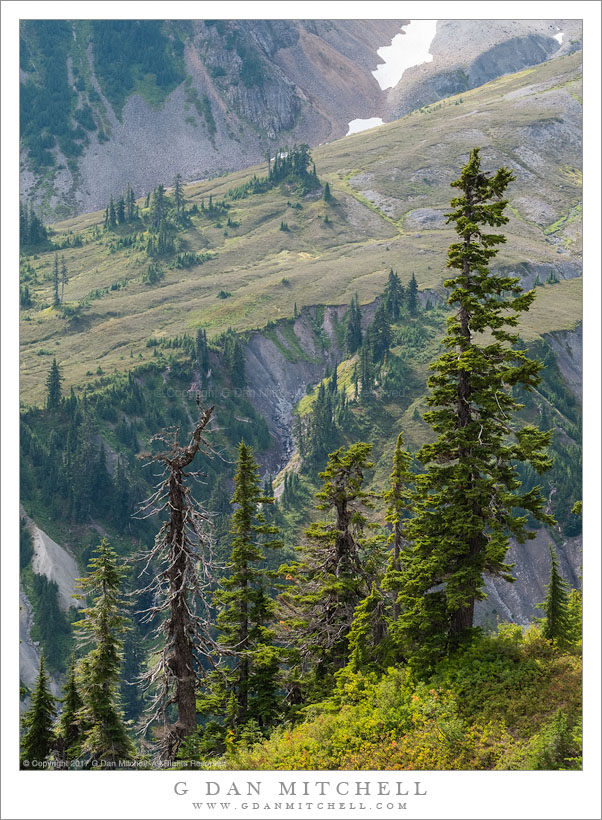
Trees, Alpine Terrain

Trees, Alpine Terrain
A group of small trees stands on the edge of a deep valley, Cascade Mountains, Washington

Trees, Alpine Terrain. North Cascades, Washington. September 10, 2017. © Copyright 2017 G Dan Mitchell – all rights reserved.

A group of small trees stands on the edge of a deep valley, Cascade Mountains, Washington

This is another photograph from my brief visit to Washington’s North Cascades at Artist Point, high in the mountains at the end of the road between Mount Shuksan and Mount Baker. I had a free day, a rental car, and a forecast to relatively clear weather, so I went. The location is both popular and spectacular. The road ends at a very high point where snow still lay on the ground, and nearby are many trails, including the popular Artist Point trail that ascends a small rise nearby and offers excellent views in all directions.

There is a lot of intriguing stuff in this spot. Obviously the nearby alpine peaks with their extensive glaciers are impressive. Below there are two deep valleys leading away in opposite directions — one to the south towards a very large lake and the other to the north and leading to peaks on the Canadian border. The immediate terrain is alpine, with rocky areas (though less so that in the Sierra Nevada), small tarns, many plants, and small stands of beautiful trees that I believe are mountain hemlock. In this photograph one of those stands is positioned above the upper reaches of the valley that eventually leads south, and across this valley there are a few more trees, deeply eroded terrain, and some meadowy areas.


G Dan Mitchell is a California photographer and visual opportunist. His book, “California’s Fall Color: A Photographer’s Guide to Autumn in the Sierra” is available from Heyday Books and Amazon.
Blog | About | Flickr | Twitter | FacebookGoogle+ | LinkedIn | Email


All media © Copyright G Dan Mitchell and others as indicated. Any use requires advance permission from G Dan Mitchell.
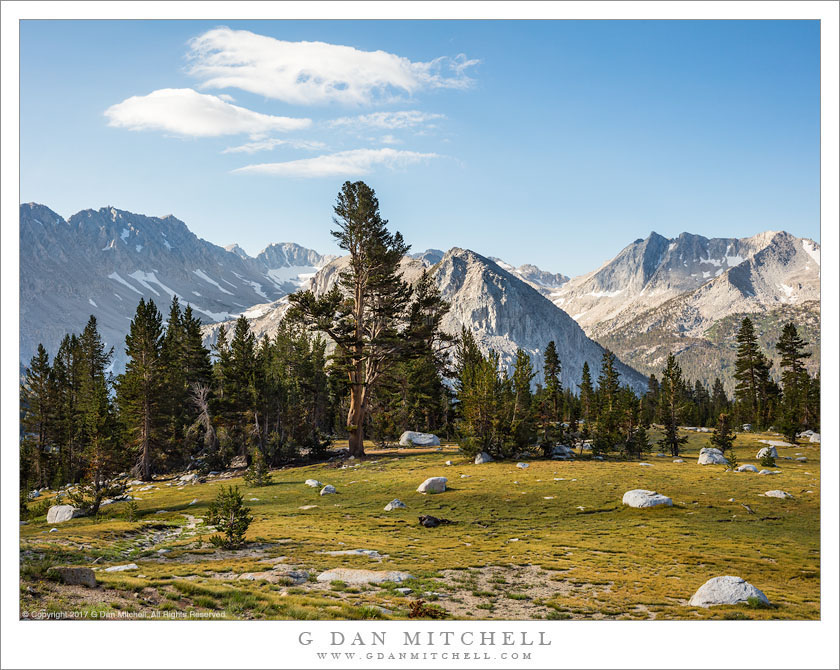
What You Get Is Not What You See

Recently I spent more than a week photographing in a beautiful area of the Sierra Nevada backcountry. A short walk above the spot where we camped was a magical meadow — a place filled with light, grasses still green but starting to turn golden, high elevation trees scattered around the edge of the meadows, and a deep valley separating us from alpine valleys topped by steep granite peaks and ridges with scattered snow fields. At times clouds would float by and add some interest to the blue Sierra Nevada sky.

What I saw

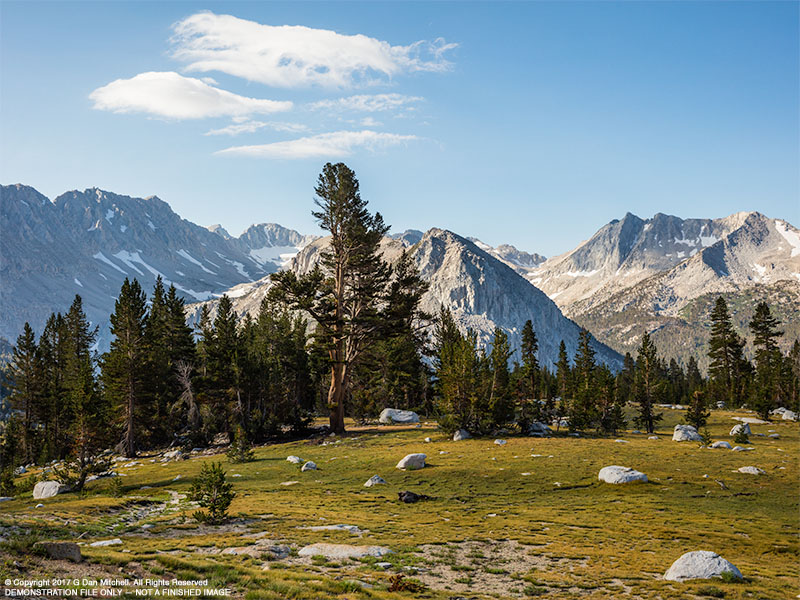
Here is one of several photographs I made in this meadow, with the first example being a small version of a print-ready final interpretation…

Subalpine Meadow, Forest, and Peaks
At the edge of a subalpine meadow, surrounded by forest and high peaks

Here is another version of the photograph, straight out of my raw file conversion program and before I did additional work in Photoshop…

File after raw conversion operations

I think it reflects fairly well what I saw while I stood behind the tripod as light softened by closer clouds spread across the meadow. I’m confident that anyone who had been there with me would agree.

What the camera saw

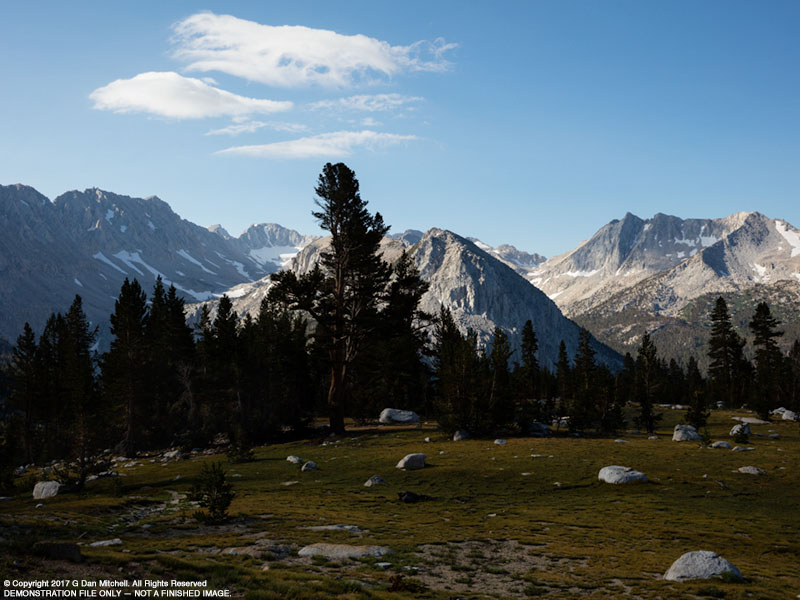
But that is not what the camera saw. Here is what my captured file looked like before I did my raw conversion post-processing…

RAW file as exposed before conversion processing

Yuck!

This SOOC (“straight out of camera”) image looks pretty bad. The sky is OK, but the meadow is dark and flat-looking, not showing the actual quality of light at all, and the forest appears to be almost completely black.

What’s up here? Am I trying to trick you and present a false version of the scene? Am I an incompetent photographer who completely blew the exposure? Am I trying to “compensate” for a bad exposure by using radical post-processing?

The answer is “none of the above.” Continue reading What You Get Is Not What You See