
Tag Archives: range

Kit Fox Hills

Kit Fox Hills
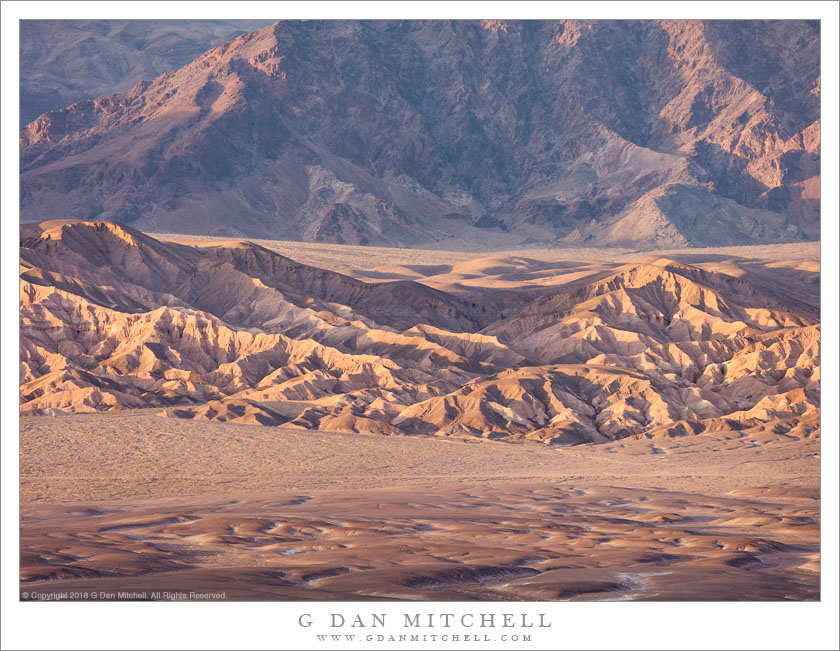
Evening light on the Kit Fox HIlls, Death Valley

Kit Fox Hills. © Copyright 2018 G Dan Mitchell – all rights reserved.

Evening light on the Kit Fox HIlls, Death Valley

This photograph was a bit of a lucky catch. I had gone to an elevated location where I had a more commanding view of a wide section of Death Valley, but late-afternoon clouds had drifted in above the Cottonwood Mountains to the west and the light ranged from filtered to “blah.” I try to “read” the clouds to predict what may come, and my reading on the conditions was that a small gap between the bottom of the cloud bank and the top of the mountains would produce a brief bit of good light just before the sun dropped beyond the peaks. These predictions don’t always pan out, but this one did. The light first appeared a great distance away at the upper end of the valley, but soon worked its way south across the Grapevine Mountains and then flowed across the low Kit Fox Hills.

I’ve been intrigued by this small row of furrowed hills for a long time. Their coloration and patterns let them stand out from the less differentiated material of the washes above and below them. I did a bit of reading about them during this recent trip, and I understand that they are a remnant of a very old earthquake fault along the west side of the valley. (There are fault zones along the sides of Death Valley, separating the rising mountains from the valley, which is largely filled with material washed down from the mountains.)


G Dan Mitchell is a California photographer and visual opportunist. His book, “California’s Fall Color: A Photographer’s Guide to Autumn in the Sierra” is available from Heyday Books and Amazon.
Blog | About | Flickr | Twitter | FacebookGoogle+ | LinkedIn | Email


All media © Copyright G Dan Mitchell and others as indicated. Any use requires advance permission from G Dan Mitchell.
Desert Mountains

Desert Mountains
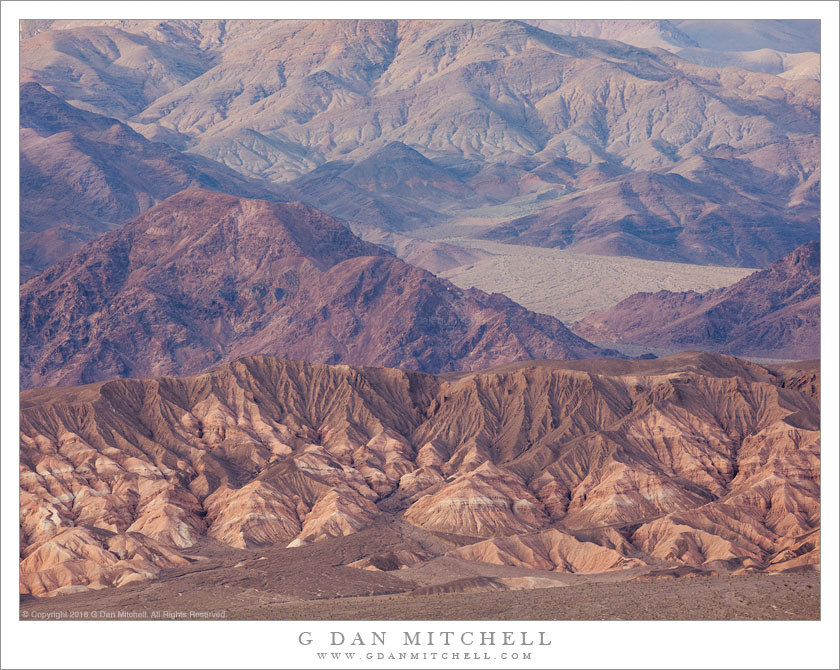
Desert mountains rise above Death Valley in evening light

Desert Mountains. © Copyright 2018 G Dan Mitchell – all rights reserved.

Desert mountains rise above Death Valley in evening light

This view takes me back to something I believe I understood the very first time I saw Death Valley. It was close to twenty years ago, and I had gone there as an adult with a group of middle school and high school kids who were planning a long hike in the park. (The event did not come off quite as planned, but that is a long story that I’ll have to tell some other time.) We arrived at the park boundaries after dark and made camp at the first possible place, a small and mostly unimproved campsite right off the road between the pass we had come over and the valley itself. In the dark I could tell little about the place: it was warm, the wind was blowing, I didn’t see much in the way of plant life. We climbed into tents and sleeping bags for the night.

Early the next morning I crawled out and got my first view of Death Valley. There’s nothing quite like suddenly coming upon your first view of such an iconic place. I recall the specific view even today, looking down across massive alluvial fans, across the valley itself, and at these rugged and bare hills and mountains on the far side so many miles away. This photograph, made from a different location this spring, includes a small section of the scene I looked at back then. It also illustrates one of my strongest impressions of Death Valley — it is a place where the geology is laid bare with virtually no forests or water to obstruct the land itself, even more so than above timberline where there are still lakes and where snow may linger all year. It is also a place, perhaps to our surprise, in which one of the largest factors shaping the landscape has been… water!


G Dan Mitchell is a California photographer and visual opportunist. His book, “California’s Fall Color: A Photographer’s Guide to Autumn in the Sierra” is available from Heyday Books and Amazon.
Blog | About | Flickr | Twitter | FacebookGoogle+ | LinkedIn | Email


All media © Copyright G Dan Mitchell and others as indicated. Any use requires advance permission from G Dan Mitchell.
Post-Sunset Geese

Post-Sunset Geese
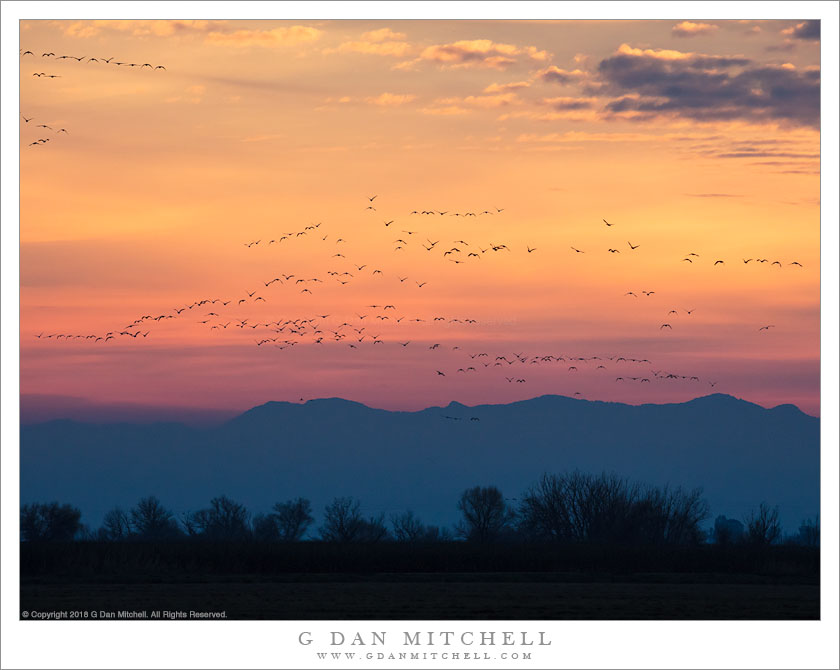
Winter geese fly toward San Joaquin Valley wetlands after sunset

Post-Sunset Geese. © Copyright 2018 G Dan Mitchell – all rights reserved.

Winter geese fly toward wetlands after sunset

These days photographing wild birds are frequently long. For me they begin about three hours before dawn, when I awake to a (very) early alarm, grab coffee and a bit of food, load my vehicle, and start out on a two-hour drive in the darkness. As I approach my destination the first color is coming to the sky above the Sierra — that is if tule fog doesn’t reduce visibility to 100 feet or so! I arrive a half hour before sunrise, set up camera equipment, and begin to work. At first I may make some landscape photographs, since it is often still too early to handhold the camera for bird photography, but soon the first birds fly up from the ponds. I usually spend the next three hours of so photographing birds and landscape — though the precise time varies depending on the conditions — and then I take a break in the middle of the day. By mid-afternoon I’m back, looking for evening photographic opportunities, and the pace of the work increases as sunset approaches. During the last few minutes of light a lot happens quickly, and then I photograph until the light is gone.

I made this photograph during that late period, following sunset, when lingering light colored the thin clouds above the western mountains. Around sunset there is a period of coming and going by the birds. Birds may rise up from ponds and fly away, or flocks may arrive from distant points and settle in for the night. Often cranes arrive just after sunset. The birds in this photograph are geese, most likely Ross’s geese, approaching the wetland ponds from that western sunset sky.


G Dan Mitchell is a California photographer and visual opportunist. His book, “California’s Fall Color: A Photographer’s Guide to Autumn in the Sierra” is available from Heyday Books and Amazon.
Blog | About | Flickr | Twitter | FacebookGoogle+ | LinkedIn | Email


All media © Copyright G Dan Mitchell and others as indicated. Any use requires advance permission from G Dan Mitchell.
Ring Of Aspens

Ring Of Aspens
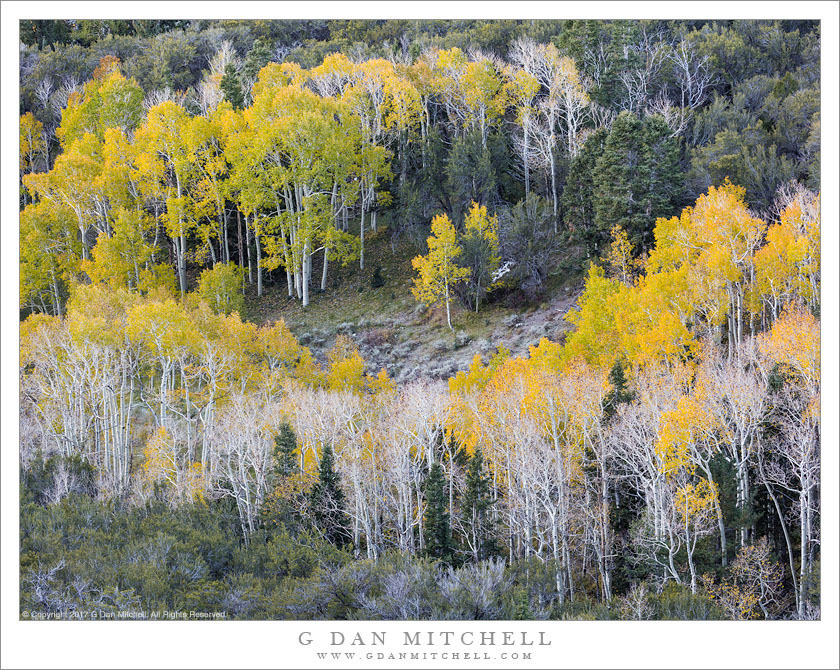
Two autumn aspens in a small clearing, surrounded by a circular grove of larger trees

Ring Of Aspens. Great Basin National Park, Nevada. September 27, 2017. © Copyright 2017 G Dan Mitchell – all rights reserved.

Two autumn aspens in a small clearing, surrounded by a circular grove of larger trees

Thinking that I would like to explore some new areas, in late September I headed out to Great Basin National Park along the eastern border of Nevada, just a few miles from Utah. I picked this time to go since I knew that Utah aspen color can peak than that in California — late September rather than early October — and I figured that the same calendar might work in Nevada. I made the long (12 hour!) drive from the San Francisco Bay Area to Baker, Nevada in a day, and the next morning I set out to enjoy a rare thing — the first experience in a new (to me) national park. To describe it briefly, much of the park encompasses and mountain range among the many found in Nevada’s basin and range country. The highest peak is over 13,000′ tall and even supports a small glacier. This high area is, at least to most people, on of the two main features of the park. The other is Lehman Caves, which I did not visit on this trip.

While much of Nevada is “basin,” and therefore dry and without a ton of vegetation, these mountain ranges can support a lot of life. They are often covered with forests, and there are lots of aspens if you look in the right places. The aspens were high on my list of photographic targets. But it seemed that I may have slightly miscalculated on the dates of peak color, and when I arrived many of the trees were still quite green. (Others had apparently just dropped leaves, and late in the visit I finally did “discover” a less-traveled canyon with lots of colorful trees.) I found one lookout high in the mountains from which I could look across a large valley, and in this valley there are quite a few aspens — solid groves of them and other trees interspersed with the conifers. This small grove caught my attention with its unusual arrangement — a ring of trees surrounding a couple of isolated trees.


G Dan Mitchell is a California photographer and visual opportunist. His book, “California’s Fall Color: A Photographer’s Guide to Autumn in the Sierra” is available from Heyday Books and Amazon.
Blog | About | Flickr | Twitter | FacebookGoogle+ | LinkedIn | Email


All media © Copyright G Dan Mitchell and others as indicated. Any use requires advance permission from G Dan Mitchell.