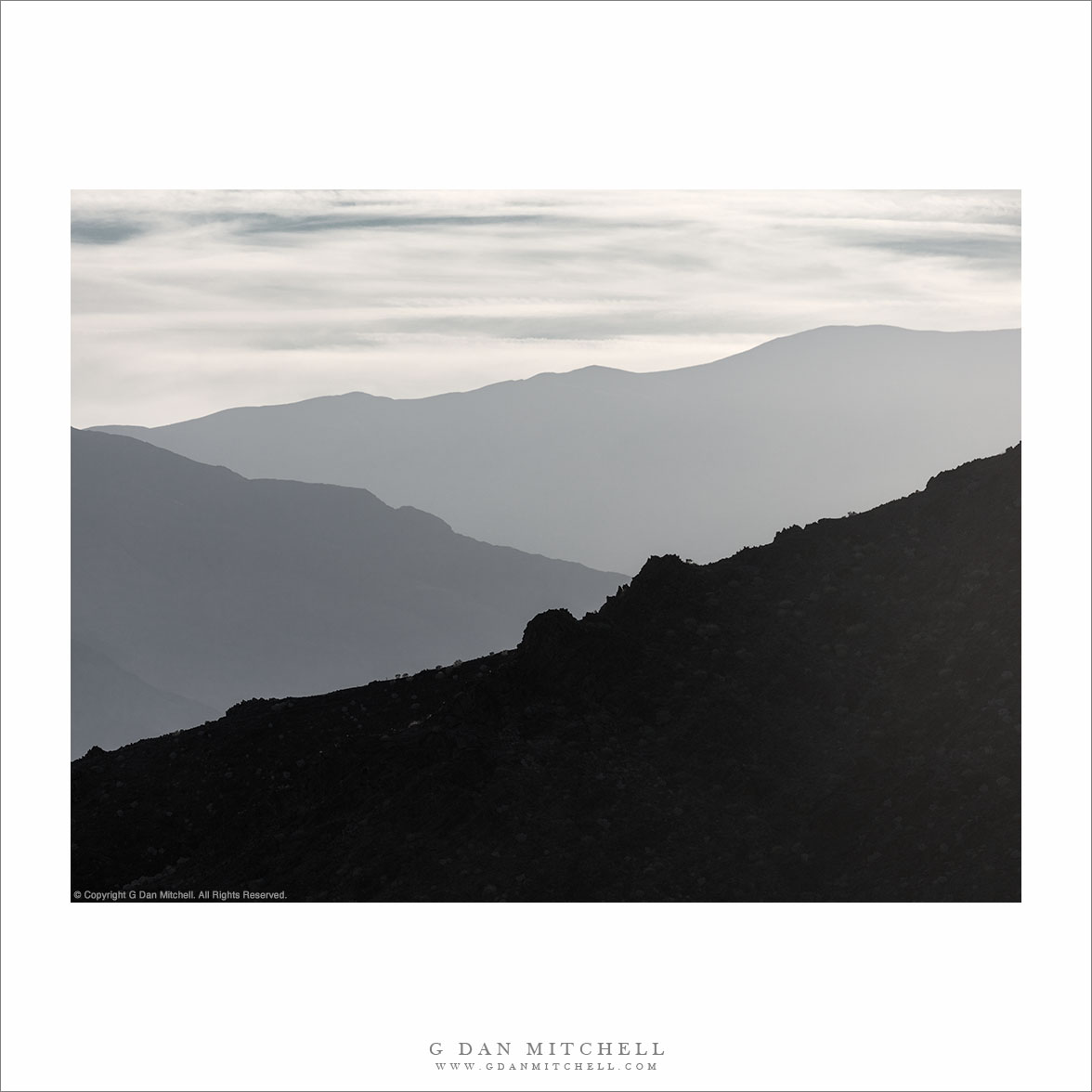
“Receding Desert Ridges” — Desert ridges recede into the distance, Death Valley.
The desert is a fine place to photograph basic geological forms and effects of light. At first glance this may appear to be a monochromatic photograph, but it is just that the colors are so soft and subtle, being muted by the desert atmospheric haze. That haze is also responsible for the lighter tones of the distant mountains — an effect known as “atmospheric recession.”
Now, weeks after I made the photograph, I can only recall the location in general terms. It certainly was not an iconic spot nor a location where most people would stop. But these patterns speak to me, and I’m fascinated by the conjunctions and relationships of lines and by the layers of tonality in a such scenes.
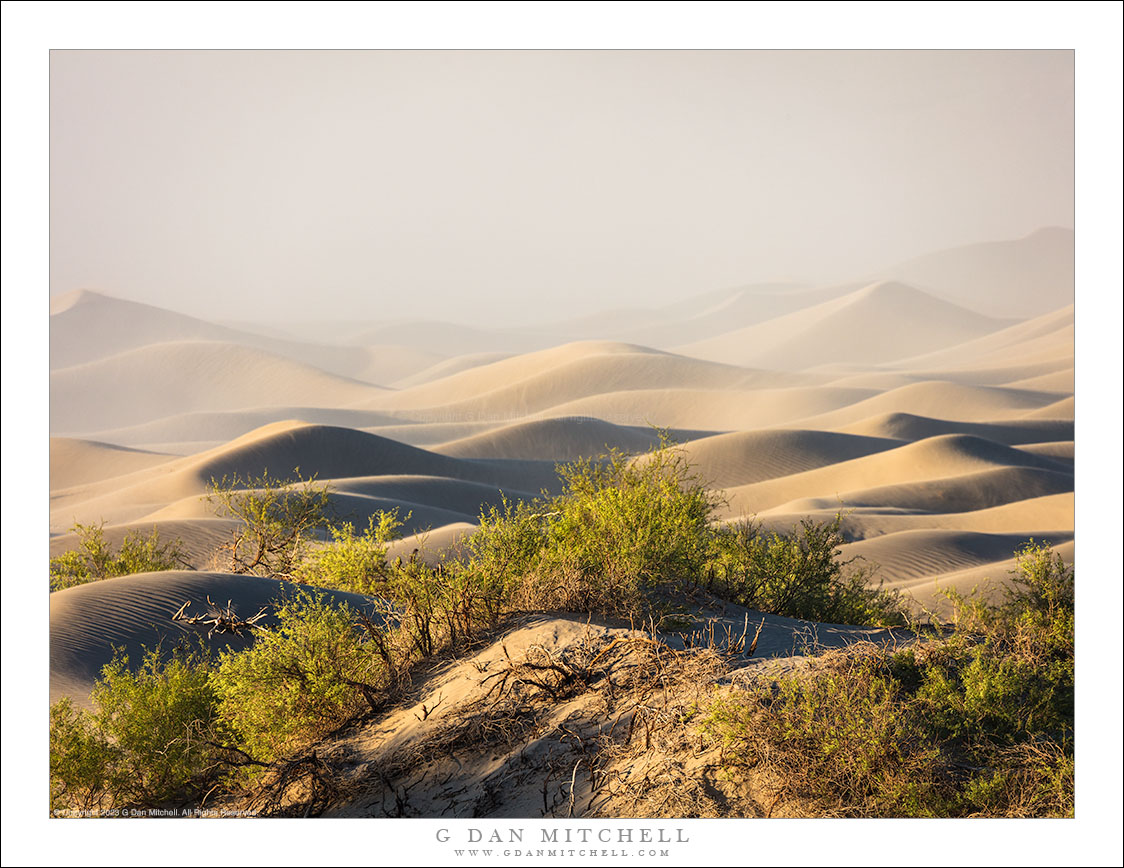
Desert plants in late-day sun. backed by dunes receding into sand storm haze.
This photograph is a different “take” on the late-March evening sand storm I photographed earlier this year in Death Valley. The forecast was for afternoon wind, so we were not surprised when the dust started to rise a few miles away from san dunes. I’m often a bit torn in situations like this — operating in the strong winds and blowing sand is not pleasant, but some very interesting photographic opportunities tend to crop up in these conditions. So I went out and got to work.
Fortunately, as I faced the dunes the wind was at my back. Even though the wind was strong enough to make photography challenging, the sand was being picked up from the dunes and blown away from me. The blowing sand, combined with the early evening light, made for some spectacular conditions. The focus in this photograph is on the plants growing on the close dunes. I had visited them a couple of months earlier, and they were mostly quite dried out. But a couple of months later and this years wet and cool spring had brought them back to life.
G Dan Mitchell is a California photographer and visual opportunist. His book, “California’s Fall Color: A Photographer’s Guide to Autumn in the Sierra” is available from Heyday Books, Amazon, and directly from G Dan Mitchell.
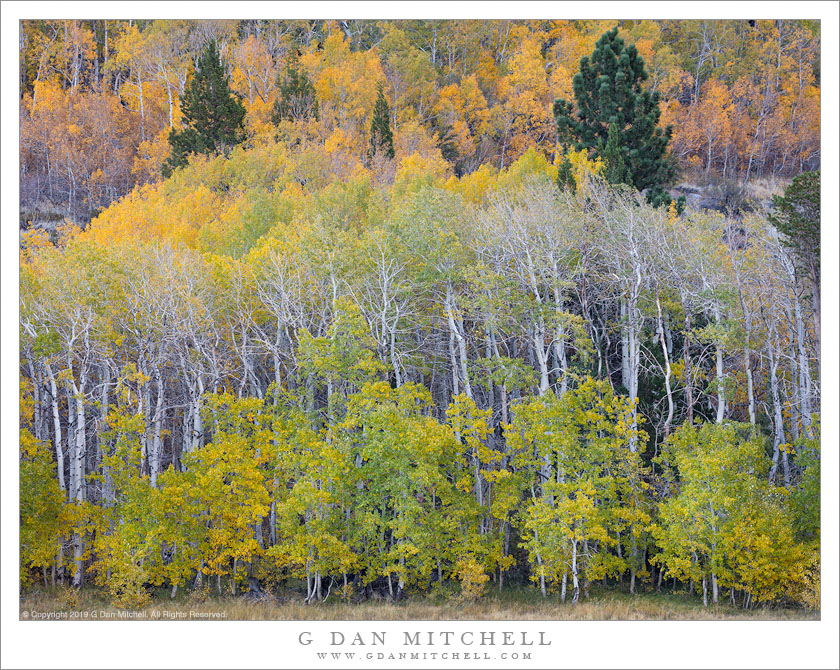
Overall, the current Eastern Sierra Nevada fall color season has seemed less stunning than in the best years. The start was promising, with good high elevation color arriving on the expected schedule. But later on a number of areas that frequently offer up amazing color did not quite deliver. However, a few points are in order. Even in a less-than-astonishing year there is great color to be found if you just look around a bit. (And some of it is not in the usual iconic locations.) And a lot depends on the specific moment you arrive — the day and even the time of day.
This grove may serve as an example. We first spotted it while driving past in the early morning, when the sun had not yet arrived on this spot. We continued up the road a bit, thinking we’d turn around and photograph it a bit later. It turned out that “a bit later” produced some pretty uninspiring light on this subject… so we returned the next day and timed our visit more carefully. Photographing fall color in shaded light can produce a very different effect than photographing in full sun, with more color subtle and varied color with more shadow detail. This grove offered an additional compositional detail — the heights of both the small and large trees produced a sort of arch shape.
G Dan Mitchell is a California photographer and visual opportunist. His book, “California’s Fall Color: A Photographer’s Guide to Autumn in the Sierra” is available from Heyday Books and Amazon.
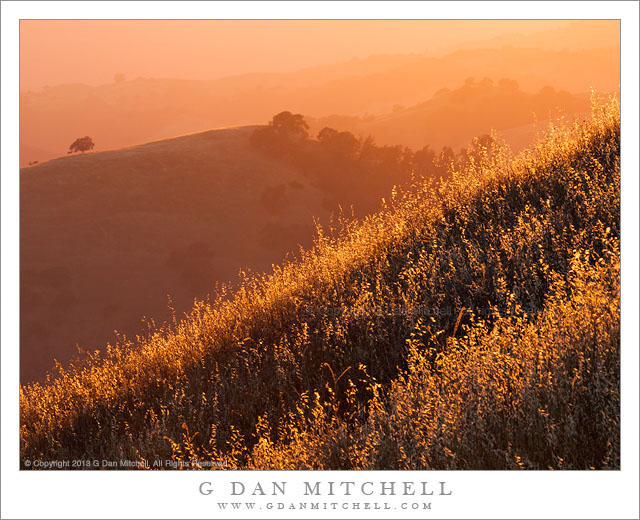
Late summer dry grass in golden hour light with distant hills receding into the haze
I made this photograph on what we sometimes refer to around here as a “random ride,” on an evening when I wanted to photograph something but didn’t have time or inclination to get to some of the usual spots. I formed a vague plan to head up towards the Lick Observatory on Mount Hamilton, above the Santa Clara Valley. I have a long history with Mount Hamilton. Since I was brought up in the Santa Clara Valley (now known to many as “Silicon Valley”), we used to head up this road when the occasional snow fell in the Diablo Range. Today they close the road when there is snow, but back then the authorities were less restrictive, and many families found their way up there to make snow men and have the rare snowball fights. Later, during a long period when I was a very serious bicyclist, I used to regularly do the 60 or so mile round trip from the valley to the summit and back, often as a morning ride. It is literally true to say that I know many of the twists and turns of this road like I know the back of my hand. As I drove up there on this evening I could still anticipate what the road would do a couple of blind turns beyond where I was.
I think I had a general idea of some photographs including oak trees and grass land, perhaps with evening vistas beyond. But as I drove it seemed like the right wasn’t quite right in most of the promising locations, and where the light was good the subjects didn’t appeal so much. But this turned out to be one of those trips on which I wasn’t anxious about whether or not I would get photographs, so I continued on and even explored a bit. In fact, when all ways said and done, I photographed exactly one subject – making several photographs of this bit of grassy ridge with the sunset light behind it on the receding hills.
G Dan Mitchell is a California photographer and visual opportunist whose subjects include the Pacific coast, redwood forests, central California oak/grasslands, the Sierra Nevada, California deserts, urban landscapes, night photography, and more. Blog | About | Flickr | Twitter | Facebook | Google+ | 500px.com | LinkedIn | Email
Photographer and visual opportunist. Daily photos since 2005, plus articles, reviews, news, and ideas.
Manage Consent
To provide the best experiences, we use technologies like cookies to store and/or access device information. Consenting to these technologies will allow us to process data such as browsing behavior or unique IDs on this site. Not consenting or withdrawing consent, may adversely affect certain features and functions.
Functional
Always active
The technical storage or access is strictly necessary for the legitimate purpose of enabling the use of a specific service explicitly requested by the subscriber or user, or for the sole purpose of carrying out the transmission of a communication over an electronic communications network.
Preferences
The technical storage or access is necessary for the legitimate purpose of storing preferences that are not requested by the subscriber or user.
Statistics
The technical storage or access that is used exclusively for statistical purposes.The technical storage or access that is used exclusively for anonymous statistical purposes. Without a subpoena, voluntary compliance on the part of your Internet Service Provider, or additional records from a third party, information stored or retrieved for this purpose alone cannot usually be used to identify you.
Marketing
The technical storage or access is required to create user profiles to send advertising, or to track the user on a website or across several websites for similar marketing purposes.