
Tag Archives: reflection

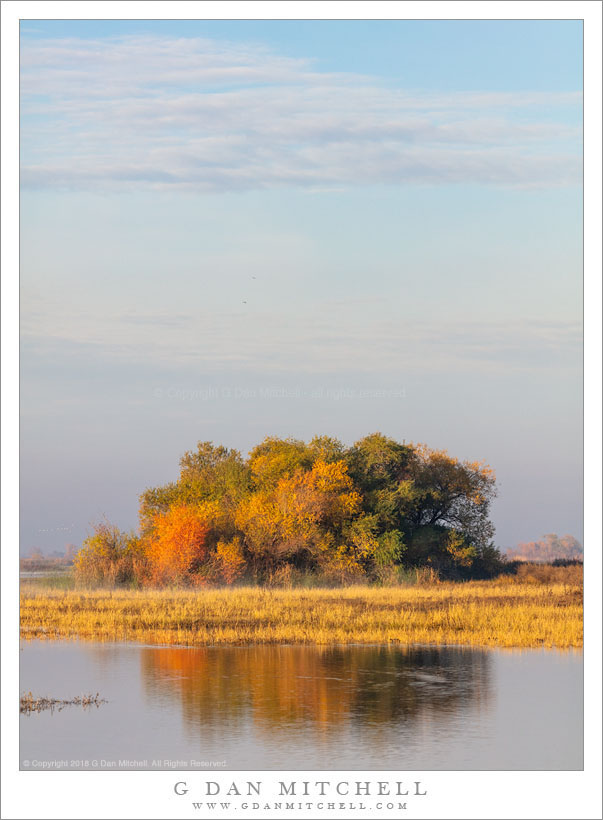
Shoreline, Fallen Tree, Autumn Aspens

Shoreline, Fallen Tree, Autumn Aspens
Beyond a dead tree lying in shoreline grasses, an autumn aspen grove rises up a Sierra Nevada hillside

Shoreline, Fallen Tree, Autumn Aspens. © Copyright 2018 G Dan Mitchell – all rights reserved.

Beyond a dead tree lying in shoreline grasses, an autumn aspen grove rises up a Sierra Nevada hillside

Trying to find different ways to photograph this well-known subject, here I excluded some of the most characteristic features, included both the near and far shorelines, and placed an old fallen tree in the lower part of the frame. If memory serves, that dead tree has been there for a while, and I may have thought of incorporating it during previous visits. The grassy foreground — with grass growing in the lake — produces its own interesting fall colors as it changes from green to brown.

The grove of brilliantly colored aspens across the lake is, at this point, iconic. Indeed, there are frequently quite a few people photographing here. I arrived at an atypical time of day, and on an afternoon when the clouds may have made the conditions seem unpromising to some. As a result there was hardly anyone else there! The clouds worked to my advantage, as they softened the light coming onto the grove from the left, filling the shadows with a bit more light and avoiding the overly bright highlights that are difficult to deal with in full sun.


See top of this page for Articles, Sales and Licensing, my Sierra Nevada Fall Color book, Contact Information and more.

G Dan Mitchell is a California photographer and visual opportunist. His book, “California’s Fall Color: A Photographer’s Guide to Autumn in the Sierra” is available from Heyday Books and Amazon.
Blog | About | Flickr | Twitter | Facebook |
Email


All media © Copyright G Dan Mitchell and others as indicated. Any use requires advance permission from G Dan Mitchell.

Autumn Aspens, Reflection

Autumn Aspens, Reflection
A grove of autumn aspen trees descends to the shoreline of a reflecting lake

Autumn Aspens, Reflection. © Copyright 2018 G Dan Mitchell – all rights reserved.

A grove of autumn aspen trees descends to the shoreline of a reflecting lake

I’ll use today’s post for several purposes — the usual photograph shared with comments, plus some thoughts and observations about the Sierra Nevada autumn color season. The photograph comes from a well-known location in the Eastern Sierra. I was fortunate to visit on a day when the usual crowds weren’t there, and I had the place almost to myself! It probably helped that I arrived at an unusual time of day, taking advantage of some broken clouds that produced some special light on the river of aspen trees flowing down the hillside to the edge of this subalpine lake. Parts of the grove were past the proverbial prime, but in some ways I like seeing a few bare trees in the scene.

On this past week’s short trip to photograph Eastern Sierra Nevada fall color I thought a bit about what I’ve learned over the years regarding the timing of the annual transition. One thing that I finally have accepted is that it is more or less impossible (with some minor exceptions) to accurately predict the evolution of the color in a particular year. A second thing I’ve realized is that, despite year-to-year variations within the season, the overall color transition tends to take place on more or less the same schedule each year. In other words, leaving aside truly exceptional times such as year five of the recent five-year drought, things tend to start and end on about the same schedule each year — despite the annual initial “observations” about how the season is going to be an unusual one — beginning high and working down the mountains to lower elevations, with other local variations in the evolution. (I confess… I’ve made those predictions, too.)

While the start/end times of the fall color transition tend to be fairly consistent (for example, week two of October is almost always a good bet), there are sometimes variations within that time frame. Some are obvious. For example, a big, windy storm when there are lots of yellow leaves will blow down many of those leaves, and there will be a gap of a few more days before other leaves change color and take their place. Others are more mysterious. I noted a few of those mysteries this year. For example, in one location where I often find trees losing their leaves somewhat earlier than elsewhere, this year there were still some green trees! Yet, in other nearby locations trees that are often coming into form just a bit later… were in full color already!

What to do? My advice is still pretty much the same. Target a time around the end of the first week of October for your visit, expecting that the week starting then is likely to produce good color. Once on the scene, be alert for variations and be ready to change plans. If one area is still green, try going higher. If the trees you visit seem to be losing (or have already lost!) their leaves when you get there, try a lower elevation, a location with larger trees, or a deep east side canyon. And realize that it is almost unheard of for all the trees in an area to be at peak color simultaneously — you are far more likely to find some bare and some green trees mixed in with your trees in prime condition.

What about this year? Based on what I saw last week, this weekend (October 12, 13, 14) should be great in many places. In addition, given the number of purely green trees I saw in various locations, it should be quite possible to still find excellent color in another week.


See top of this page for Articles, Sales and Licensing, my Sierra Nevada Fall Color book, Contact Information and more.

G Dan Mitchell is a California photographer and visual opportunist. His book, “California’s Fall Color: A Photographer’s Guide to Autumn in the Sierra” is available from Heyday Books and Amazon.
Blog | About | Flickr | Twitter | Facebook |
Email


All media © Copyright G Dan Mitchell and others as indicated. Any use requires advance permission from G Dan Mitchell.
Talus, Cliff, Shoreline

Talus, Cliff, Shoreline
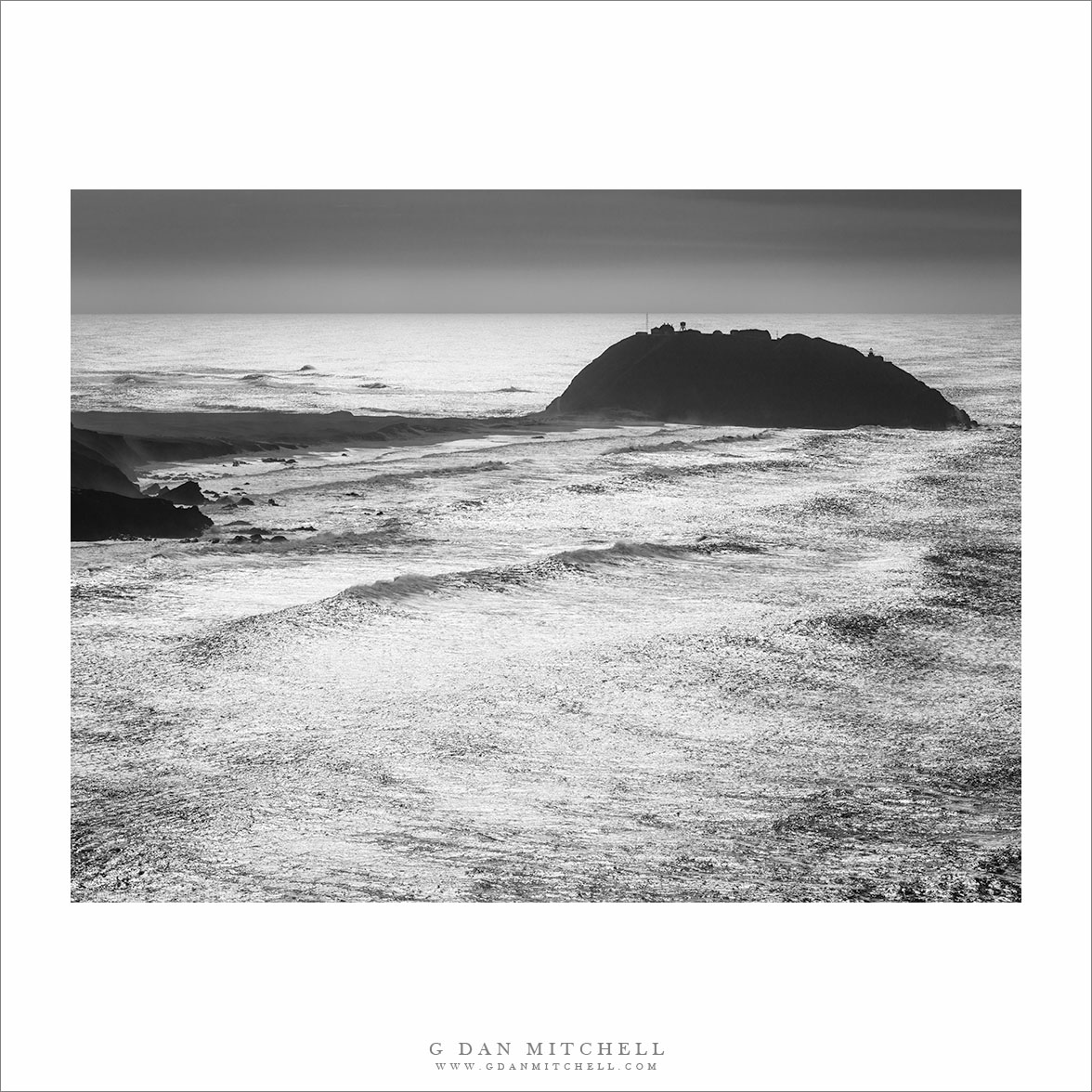
A talus field of giant boulders tumbles to the edge of an alpine lake at the foot of a cliff

Talus, Cliff, Shoreline. © Copyright 2018 G Dan Mitchell – all rights reserved.

A talus field of giant boulders tumbles to the edge of an alpine lake at the foot of a cliff

There are multiple ways to look at this photograph. One is to think of it as a record of a specific place at a particular time. That is perhaps important to me and to the others with whom I shared this week in the Sierra Nevada backcountry, but I think it is far less important to others who may view it. Another way to view it is as an example of a particular kind of landscape — the subalpine terrain of the eastern slope of this mountain range — and to note the cliff face at the left, the base of the talus field that reaches to the shoreline, and the lake itself. Sierra travelers probably have their own collection of memories of similar places.

A third way to view it is to try to step back from the seeming objective reality of location and subject, and to try to look at it as a structure of colors and forms and textures. This isn’t always easy, and it perhaps it isn’t for every viewer… though the elements mirrored in the reflective surface of the lake may encourage a viewer to try. In fact, this gets a little closer to how I see such things and such places. Yes, I do respond to them a real locations and as examples of the Sierra terrain I love. However, in most cases that isn’t enough for a photograph, at least not to me. I’m always looking for shape and texture and color and relationships in these subjects. (Of the recent photographs of talus slopes, water, and soft light, this may be my current favorite.)


See top of this page for Articles, Sales and Licensing, my Sierra Nevada Fall Color book, Contact Information and more.

G Dan Mitchell is a California photographer and visual opportunist. His book, “California’s Fall Color: A Photographer’s Guide to Autumn in the Sierra” is available from Heyday Books and Amazon.
Blog | About | Flickr | Twitter | Facebook |
Email


All media © Copyright G Dan Mitchell and others as indicated. Any use requires advance permission from G Dan Mitchell.
From Shore to Shore

From Shore to Shore
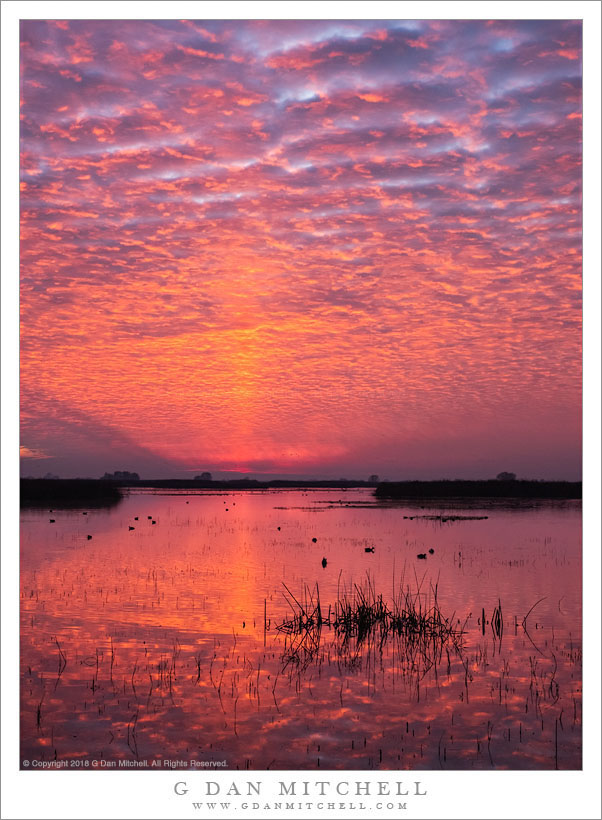
Both shorelines of a rock-bound alpine lake

From Shore to Shore. © Copyright 2018 G Dan Mitchell – all rights reserved.

Both shorelines of a rock-bound alpine lake

The Sierra Nevada is sometimes called the Range of Light, in recognition of (or so I think) the open quality of its forests, the tendency toward summer sunshine, and the resulting abundant light. It is a very different place than, say, the mountains of the Pacific Northwest. There are day-to-day exceptions to the rule, but overall the characterization holds. As a matter of fact, on our mid-to-late September backcountry visit this year we experienced an unbroken string of perfect blue sky days for over a week. (By the way, photographers don’t necessarily regard that as a good thing!)

However, it is quite possible to experience different sorts of light in these mountains. Obviously, anyone who has experienced a major winter storm in the Sierra has seen the other end of this spectrum. Thunderstorms do sweep through in the summer months. And in some places where the mountains are close, tall, and very steep there can be lengthy “blue hour light” at the start and end of the day. I made this photograph in such a place, where the sun didn’t arrive until many hours after sunrise, and the shadows returned hours before sunset. In this light, the rocky terrain around this lake took on an appearance that doesn’t fit with that “range of light” description.


See top of this page for Articles, Sales and Licensing, my Sierra Nevada Fall Color book, Contact Information and more.

G Dan Mitchell is a California photographer and visual opportunist. His book, “California’s Fall Color: A Photographer’s Guide to Autumn in the Sierra” is available from Heyday Books and Amazon.
Blog | About | Flickr | Twitter | Facebook |
Email


All media © Copyright G Dan Mitchell and others as indicated. Any use requires advance permission from G Dan Mitchell.