
Tag Archives: rugged

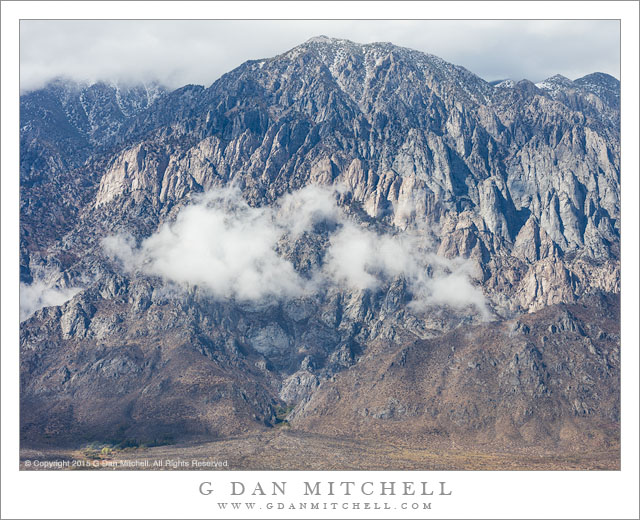
Eastern Escarpment, Clearing Autumn Storm

Eastern Escarpment, Clearing Autumn Storm
An early season autumn leaves a dusting of snow atop Wheeler Ridge, Eastern Sierra Nevada

Eastern Escarpment, Clearing Autumn Storm. Eastern Sierra Nevada, California. October 4, 2015. © Copyright 2015 G Dan Mitchell – all rights reserved.

An early season autumn leaves a dusting of snow atop Wheeler Ridge, Eastern Sierra Nevada

This long ridge in the Eastern Sierra just north of the town of Bishop has long fascinated me, though for the most part I’ve only looked at it from a distance. (Or from the other side, as there is access via along valley to the west, but that’s a story for another post.) At first I was mostly aware of this steep section of the eastern escarpment of the range when it served as a spectacular backdrop for views of the pastureland and cottonwood trees of Round Valley. But with increased familiarity with the area and opportunities to view if from many directions and distances, I began to note what a tremendously rugged and daunting bit of terrain it is. In many ways, if you ignore the scant vegetation on its slopes, it looks more like the mountains of the desert, even reminding me a bit of places in Death Valley, though with more granite-like rock. Unlike many other Eastern Sierra locations, there is little (no?) evidence of glaciation, but plentiful evidence of erosion from water, including the classic alluvial fan spreading from the steep valley between the low hills in the foreground.

Despite the lack of glacial evidence, the scene presents many other classic components of the eastern face of the range in Autumn. Although it is small against the tremendous landscape, there is an aspen grove and a bit of summer-brown grass near the lower left. The main rocks seem to be the granite that we expect to see in the Sierra. The rocks are lit by filtered sunlight from the southeast. And the cloud drifting in front of the rugged face is the remnant of a passing storm that has dusted the highest peaks with a bit of early season snow, promising that winter cannot be far off.


G Dan Mitchell is a California photographer and visual opportunist. His book, “California’s Fall Color: A Photographer’s Guide to Autumn in the Sierra” is available from Heyday Books and Amazon.
Blog | About | Flickr | Twitter | FacebookGoogle+ | 500px.com | LinkedIn | Email


All media © Copyright G Dan Mitchell and others as indicated. Any use requires advance permission from G Dan Mitchell.
Eastern Escarpment

Eastern Escarpment
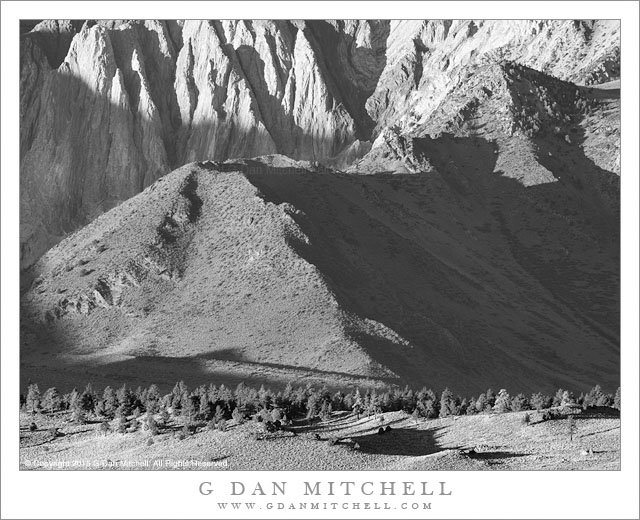
The eastern escarpment of the Sierra Nevada rises from desert hills to rugged aretes lit by dawn sun

Eastern Escarpment. Sierra Nevada, California. October 10, 2015. © Copyright 2015 G Dan Mitchell – all rights reserved.

The eastern escarpment of the Sierra Nevada rises from desert hills to rugged aretes lit by dawn sun

Depending on how you approach the range, the Sierra Nevada presents two quite different aspects to the visitor. For many decades, as a long time resident of the San Francisco Bay Area, I was only familiar with one of them. I always came to the range from the west, on long drives over coastal mountains and then across the Great Central Valley. As I approached the east side of the Valley I would encounter the low hills, at first almost imperceptible, that humbly mark the beginning of this might range. Because it tilts upward from the west, the western slopes are overall very gradual. Rising through these first low hills, the grass and oak covered landscape raises over a distance of many miles, and it is quite a while before the range starts to feel like “the mountains,” and many hours before the visitor arrives in the high alpine zone of rugged granite peaks. Even here, to the west of the crest there are plenty of gentle valleys and meadows.

The east side is a radically different world, as I finally began to understand two or three decades ago. The eastern base of the range is an arid near-desert place, made more so by Los Angeles’ historic draining of east side waters that once irrigated now-dry places and once filled today’s dusty playas with shallow lakes. The Sierra rises abruptly from this lower landscape, and in places you can look up nearly 10,000′ to the highest summits — you stand in desert and look at alpine peaks, and you see every zone in between. I made this photograph at dawn from one such valley location where the landscape that of sagebrush and playa and alkali lakes. From this spot I looked across low hills with the first coniferous trees toward the abrupt rise of the eastern foothills, backed by jagged and rugged slopes leading upward to high peaks.


G Dan Mitchell is a California photographer and visual opportunist. His book, “California’s Fall Color: A Photographer’s Guide to Autumn in the Sierra” is available from Heyday Books and Amazon.
Blog | About | Flickr | Twitter | FacebookGoogle+ | 500px.com | LinkedIn | Email


All media © Copyright G Dan Mitchell and others as indicated. Any use requires advance permission from G Dan Mitchell.
Eastern Sierra Pack Station, Fall Colors

Eastern Sierra Pack Station, Fall Colors
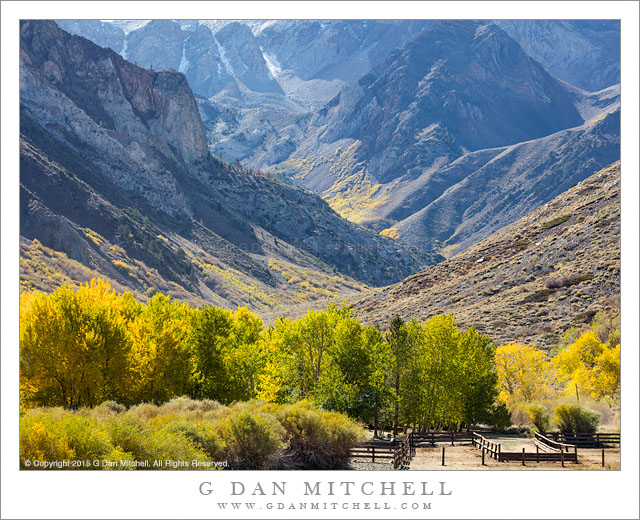
Autumn cottonwood and willow color at the McGee Creek pack station at the base of McGee Canyon

Eastern Sierra Pack Station, Fall Colors. McGee Canyon, California. October 9, 2015. © Copyright 2015 G Dan Mitchell – all rights reserved.

Autumn cottonwood and willow color at the McGee Creek pack station at the base of McGee Canyon

These eastern Sierra Nevada canyons have long fascinated me. My initial orientation to the range came from decades of approaching the mountains from the west, where they rise gradually, beginning almost imperceptibly with small irregularities and hills far out in the eastern portions of the Great Central Valley and then build slowly over many miles to eventually reach the Sierra crest. I “discovered” the east side of the range decades later, and was amazed by the contrast. Rather than beginning in the gentle west side grassland and agricultural areas, the base of the east side is frequently high desert, a spare and dry land of sage and open vistas. The Sierra begins abruptly, and in some cases you can stand at the actual base of the escarpment and look almost straight up to peaks that are many thousands of feet above you. The east side is cut by many short but deep canyons, where steep creeks drain a terrain originally cut by glaciers. In a very short distance — often traversed in a single day — one can move from high desert to the alpine zone.

In addition to focusing on that landscape, this photograph includes an element representing another component of life on the east side, a trailhead pack station. Here, too, my experience was such that I only recognized the role of these outfits more recently. For decades I was primarily oriented to the range as a backpacker and, to be honest, I regarded those using pack animals as representing an intrusion in the wilderness experience that I sought. (On the other hand, I recall many years ago seeing the occasional individual backpacker leading a single donkey along the trail, something you almost never see any more.) A few years ago I began to work with photographic colleagues who use pack trains once each year to get into the back country to photograph in ways that are more or less impossible when traveling on foot, and before long I had my first real experience with packers. I’m less certain of my old disdain for those who rely on pack animals, and I’m now much more aware of the long history of these pack outfits in the eastern Sierra. My perspective has changed. While I think that their place must evolve, I also have come to think of them as an intrinsic part of what makes the Sierra the Sierra, and I have acquired a real respect for the wranglers and the work they do.


G Dan Mitchell is a California photographer and visual opportunist. His book, “California’s Fall Color: A Photographer’s Guide to Autumn in the Sierra” is available from Heyday Books and Amazon.
Blog | About | Flickr | Twitter | FacebookGoogle+ | 500px.com | LinkedIn | Email


All media © Copyright G Dan Mitchell and others as indicated. Any use requires advance permission from G Dan Mitchell.
Autumn Haze, Sabrina Basin

Autumn Haze, Sabrina Basin
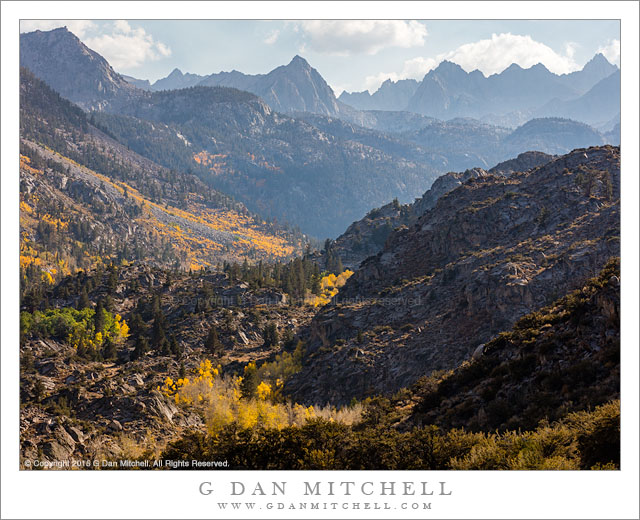
Aspen colors scattered across the rugged granite landscape of Sabrina Basin

Autumn Haze, Sabrina Basin. Eastern Sierra Nevada, California. September 25, 2015. © Copyright 2015 G Dan Mitchell – all rights reserved.

Aspen colors scattered across the rugged granite landscape of Sabrina Basin

This particular view may be a familiar one to many who follow the autumn aspen color in the eastern Sierra Nevada, as Sabrina Basin and, more broadly, the Bishop Creek area, is well-known for extensive groves of aspens. This photograph comes from a point just a bit earlier in the color transition season than most of my photographs of the area, and a close look at some of the more distant ridges reveals extensive color among the smaller, high elevation aspens that typically change colors first. The foreground trees were also more colorful than usual for this late September date, though the afternoon backlight emphasizes the effect.

The Sierra present many different appearances, ranging from gentle meadows full of green grasses and flowing water to the most rugged, spare alpine regions filled with rocks and the hard edges of ridge lines. While an up close view of certain parts of this scene — perhaps from standing within one of the colorful aspen groves in the foreground — would present more of the gentle view, the panorama from this high, exposed location reveals the tremendous world of rugged granite in this part of the range, where the Sierra crest rises quite quickly from the high desert terrain to the east.


G Dan Mitchell is a California photographer and visual opportunist. His book, “California’s Fall Color: A Photographer’s Guide to Autumn in the Sierra” is available from Heyday Books and Amazon.
Blog | About | Flickr | Twitter | FacebookGoogle+ | 500px.com | LinkedIn | Email


All media © Copyright G Dan Mitchell and others as indicated. Any use requires advance permission from G Dan Mitchell.