
Tag Archives: sand

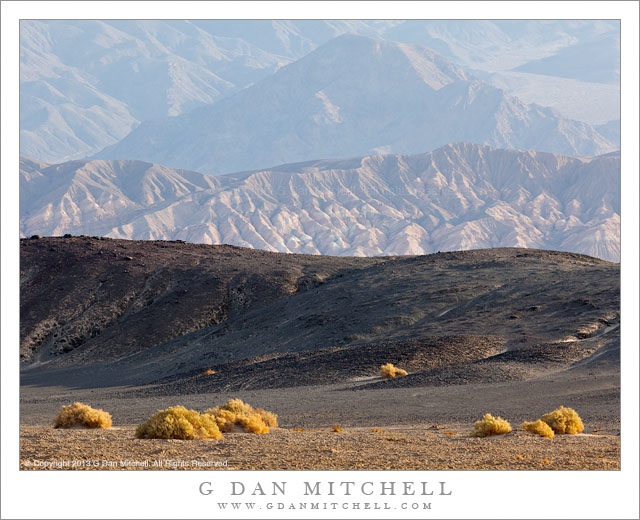
Desert Plants, Black Hill

Desert Plants, Black Hill

Desert Plants, Black Hill. Death Valley National Park, California. April 7, 2013. © Copyright 2013 G Dan Mitchell – all rights reserved.

Morning light on desert arrow weed plants at the base of a black hill, with Death Valley Buttes receding into the hazy distance

This was very nearly the last photograph I made on my recent early April visit to Death Valley National Park. I try to go there to photograph at least once each year, and I’ve probably visited during the first week of April more often than at any other time. This tends to be a transitional season in the park, at least in my experience, and the conditions can range from cool to downright hot. On this visit it was, for the season, “downright hot” – temperatures with in at least the mid to high-nineties every day, and rose to just over 100 degrees on one day. This is not unheard of at this time of year, though it is on the high side of normal for the first week in April. This trip was a challenge for other reasons, too. On the second day I encountered a significant sand storm with accompanying winds, and the light was not exactly cooperative. On two mornings and two evenings clouds shut down the golden hour light, and there was quite a bit of general haze.

On this morning I figured I would do an hour or two of shooting before returning to camp to tear everything down and start my drive back home. I started by going up just past the turn off to Wild Rose Canyon, with the plan being to shoot some long distance photographs of sunrise light on some mountains that I have been thinking about shooting. The sunrise itself was more or less a washout – the atmosphere was so murky that I wasn’t even quite sure when the sun cleared the horizon! Eventually I did get some soft directional light from the sun, but I was finished with this subject somewhat quickly. I decided to go with a backup plan to photograph the Mesquite Dunes with a long lens. As I worked this subject I decided to head a bit further east and see if I could get anything from the backlight coming across the low hills above Salt Creek, and as I traveled that direction I passed this small black hill, where I have photographed before, and saw these backlit arrow weed plants and the more distant hills near Death Valley Buttes in the morning haze.

G Dan Mitchell is a California photographer and visual opportunist whose subjects include the Pacific coast, redwood forests, central California oak/grasslands, the Sierra Nevada, California deserts, urban landscapes, night photography, and more.
Blog | About | Flickr | Twitter | Facebook | Google+ | 500px.com | LinkedIn | Email

Text, photographs, and other media are © Copyright G Dan Mitchell (or others when indicated) and are not in the public domain and may not be used on websites, blogs, or in other media without advance permission from G Dan Mitchell.


Mesquite Dunes, Cottonwood Mountains

Mesquite Dunes, Cottonwood Mountains

Mesquite Dunes, Cottonwood Mountains. Death Valley National Park, California. March 20, 2010. © Copyright 2012 G Dan Mitchell – all rights reserved.

The Mesquite Dunes and the Cottonwood Mountains late on a hazy afternoon, Death Valley National Park, California

The Mesquite Dunes are a well-known icon of Death Valley and are often photographed in the early morning or around sunset. I made this photograph at a somewhat different time – late in the afternoon but well before the golden hour light of evening. The sun was still high enough to illuminate the tops of the dunes and even the sides away from the sun, and the afternoon haze made the atmosphere blue and obscured the rugged features of the Cottonwood Mountains beyond the dunes and across the Valley.

If you look closely enough, you can find a number of features that characterize this area of the valley. The foreground flats are “filled” with plants that grow a good distance apart from one another, apparently due to the limited water. The edge of the dunes spills over slightly into the gravelly flat but then rises quite high. Beyond the dunes, and faintly seen through the haze, a giant alluvial fan slants down from higher mountains to the left. (It sometimes surprises visitors to see how much the terrain in this very dry place has been shaped by water.) Beyond the sloping fan, the rugged Cottonwood Mountains, part of the Panamint Range, begin to rise to quite high peaks.

G Dan Mitchell is a California photographer and visual opportunist whose subjects include the Pacific coast, redwood forests, central California oak/grasslands, the Sierra Nevada, California deserts, urban landscapes, night photography, and more.
Blog | About | Flickr | Twitter | Facebook | Google+ | 500px.com | LinkedIn | Email

Text, photographs, and other media are © Copyright G Dan Mitchell (or others when indicated) and are not in the public domain and may not be used on websites, blogs, or in other media without advance permission from G Dan Mitchell.

Striped Rock, Grass, and Sand

Striped Rock, Grass, and Sand
“Striped Rock, Grass, and Sand” — A striped rock atop sand, Grand Staircase-EscalenteNational Monument

I made this photograph in the first canyon we investigated during my late-October 2012 visit to Utah with photographer friends. We drove up a long gravel road and pulled off at a wide spot to find the creek that came out of this canyon, which we followed a good distance upstream. Believe it or not, this was the first time that I had hiked such a canyon and it was exciting to move from imagining the experience to actually doing it! We started out by essentially walking up the creek bed though the flats below where it left the canyon, wading through shallow water and little sand bars. Soon we entered the canyon itself and the “path” involved walking alongside the creek, frequently crossing from one side of the stream to the other to avoid obstacles, and sometimes just walking right up the stream bed, as that often provided the clearest path.

In the location where I made this photograph, the light became very red as it reflected between the upper sandstone canyon walls, and although I was shooting in the shade I had unusually warm toned light to work with. The sand here comes from – no surprise! – sandstone, and was very red in places. This bit of sand had been smoothed by the passage of higher water which had also flattened the grasses and wrapped them around this small rock with its bright red stripe.


COMMENT OR QUESTION? Scroll down to the comment form.

Prints are available. Read about licensing and print sales.

G Dan Mitchell is a California photographer and visual opportunist. His book, “California’s Fall Color: A Photographer’s Guide to Autumn in the Sierra” (Heyday Books) is available directly from him.
Blog | Bluesky | Mastodon | Substack Notes | Flickr | Email

All media © Copyright G Dan Mitchell and others.

Autumn Leaves, Sand

Autumn Leaves, Sand
“Autumn Leaves, Sand” — Autumn oak and box elder leaves lie on the pink sand in the bottom of a wash, Zion National Park

The thing that most often first catches my attention in the bottom of slot canyons, such as this small one in the Zion National Park high country, is the way that they twist between closely spaced vertical walls. There is virtually nothing quite like this in our experience. But the thing I notice first is not necessarily the thing I remember most. I often wonder how others might regard my photographs, since I know that they cannot share the full context of the images that I know from being in these places. (I’ve often said that we, as the photographers, are perhaps the least able to see our own work objectively, since we cannot easily put aside these non-photographic things that are no longer present in the purely visual medium within which we work.) When I think of these canyons I think of the sound, often deadened by the sand and perhaps by vegetation, and of the feeling of the air, which always different from the feeling of the air outside the canyon – most often cooler when the “outside” air is warm but also warmer when the canyon provides shelter from cool-season winds. And it those canyons with water flowing through them, there is the constant, though often gentle sound of water flowing and trickling.

I also usually end up slowing down and looking at many small things that might not first be seen – the leftover pattern of water than may have flowed through weeks or months earlier, place where the sand has been marked by the passage of a small animal or by grass moving across its surface in the breeze, the mixture of rocks that must have come from distant places, plants growing in odd cracks in the rock, patterns in the rock walls, the passage from one rock layer to another, and more. On this fall day it had been windy and lots of autumn “stuff” was littering the canyon floor, which here was pink sandstone sand, further colored by the glowing light reflected from the red rock canyon walls.


Leave a comment or question using the form. (If you are reading this on the home page, click the article title to see the full article and the comment form.

G Dan Mitchell is a California photographer and visual opportunist. His book, “California’s Fall Color: A Photographer’s Guide to Autumn in the Sierra” (Heyday Books) is available directly from him. Blog | Bluesky | Mastodon | Substack Notes | Flickr | Email

All media © Copyright G Dan Mitchell and others.