
Tag Archives: sandstone

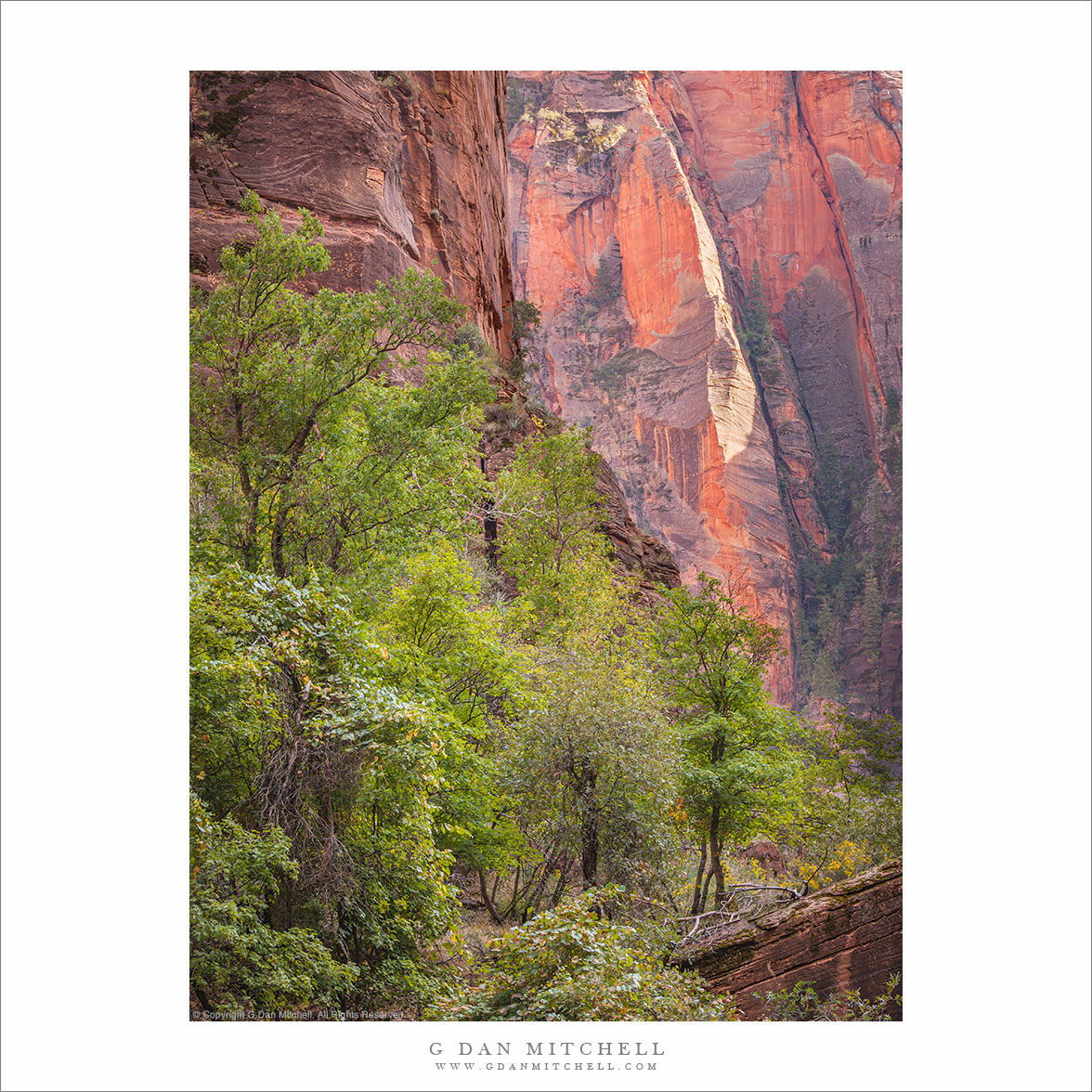
Trees and Sandstone Cliffs

Trees and Sandstone Cliffs
“Trees and Sandstone Cliffs” — Trees near the base of sandstone cliffs, Zion Canyon.

There is a lot going on here related to textures and colors. Color first: the cliff and tree colors are almost complementary. The green trees at the base of the cliff are in full shade. The further cliff face is getting both direct and reflected light. The cliffs seem massive and solid, but the surfaces are surprisingly varied. We see lighter and redder sections contrasting with almost-blue darker areas.

I was a little surprised to see trees growing so close to the base of he cliff. Often these areas are littered with accumulated rockfall debris, but here the trees don’t show any signs of that. It isn’t easy to tell from the photograph, but some of the trees are actually growing from cracks in the rock wall.


Leave a comment or question using the form. (Click the title to see the full article and to comment if you are viewing it on the home page.)

G Dan Mitchell is a California photographer and visual opportunist. His book, “California’s Fall Color: A Photographer’s Guide to Autumn in the Sierra” (Heyday Books) is available directly from him. Blog | Bluesky | Mastodon | Substack Notes | Flickr | Email

All media © Copyright G Dan Mitchell and others.

One Small Tree

One Small Tree
“One Small Tree” — A lone tree grows from a crack in a sandstone cliff, Zion Canyon.

The massive layers of red sandstone in the American Southwest are impressive. But seeing that plants manage to live on these formations is equally so. The variety of ways they eke out a living is surprising — at the bottom of huge holes in the rock, in tiny cracks, along ledges. Here a small tree adds a contrasting bit of green to the sandstone cliff.

Of course, this is not something that is unique to The Southwest. As a long time Sierra Nevada visitor I still marvel at mature trees that seem to grow almost straight out of rock, sometimes in very exposed positions high in the mountains. It seems to take little to provide enough sustenance — a crack that collects some other plant debris and a little water will do it. Before long, little plant and animal communities spring up beneath these trees.


Leave a comment or question using the form. (If you are reading this on the home page, click the article title to see the full article and the comment form.

G Dan Mitchell is a California photographer and visual opportunist. His book, “California’s Fall Color: A Photographer’s Guide to Autumn in the Sierra” (Heyday Books) is available directly from him. Blog | Bluesky | Mastodon | Substack Notes | Flickr | Email

All media © Copyright G Dan Mitchell and others.
Virgin River, Zion Canyon

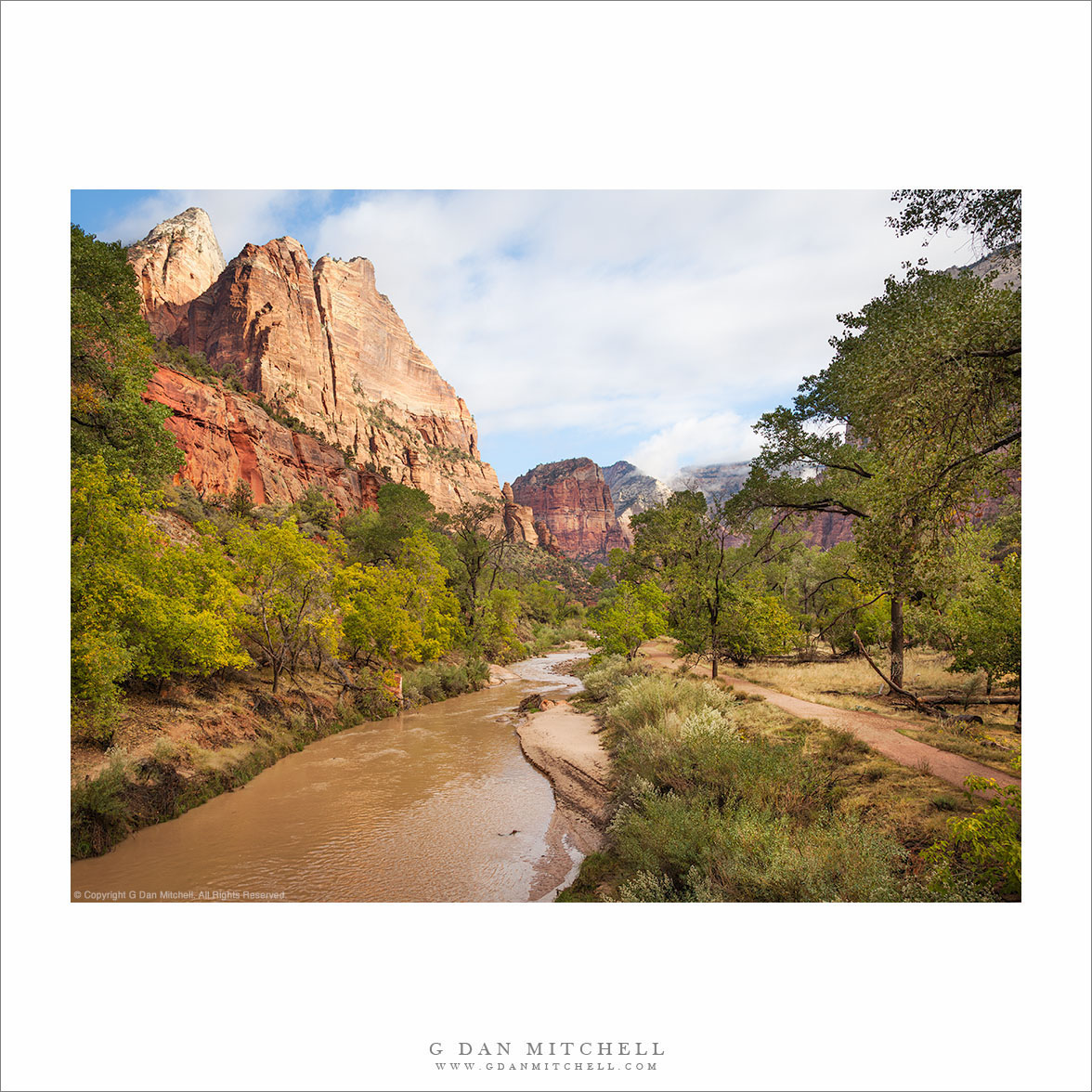
Virgin River, Zion Canyon
“Virgin River, Zion Canyon” — The Virgin river flows past trees and sandstone formations, Zion National Park.

Judging from the muddy water, a substantial amount of Utah landscape appears to be disolved in the Virgin River and flowing out of the park! A walk through the bottomlands of Zion Canyon reveals a riparian landscape subject to periodic flooding. Seeing this, you can begin to understand the role that water has played in forming this remarkable landscape.

On this morning we left our vehicle behind, shouldered photographic gear, and crossed to the far side of the canyon and the river, then followed a trail upstream. It was quiet and there was a lot to see, including a lovely little waterfall at one point.


Leave a comment or question using the form. (If you are reading this on the home page, click the article title to see the full article and the comment form.

G Dan Mitchell is a California photographer and visual opportunist. His book, “California’s Fall Color: A Photographer’s Guide to Autumn in the Sierra” (Heyday Books) is available directly from him. Blog | Bluesky | Mastodon | Substack Notes | Flickr | Email

All media © Copyright G Dan Mitchell and others.
Slot Canyon Walls

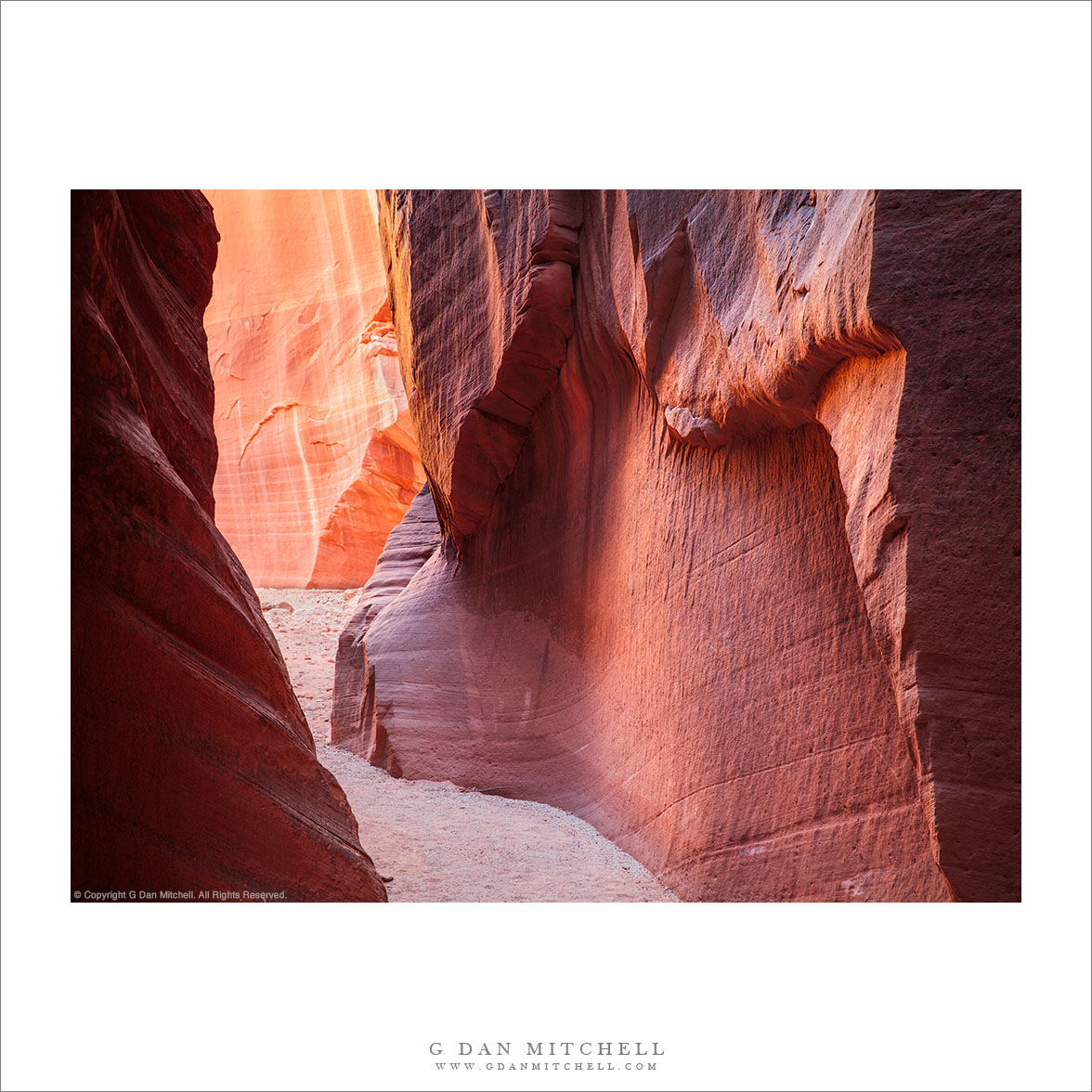
Slot Canyon Walls
“Slot Canyon Walls” — Soft light penetrates the depths of a slot canyon.

The material making up the walls of Southwest slot canyons varies quite a bit depending on which strata the canyon traverses. Sometimes the rock can be broken and somewhat unattractive, sometimes it can hold fossils or show joints between different layers. But in some places the sandstone seems pristine — solid layers of rock broken only by small details and textures. That was the case here, at a spot where a canyon junction allowed in a bit of extra light.

I made this photograph on my first visit to this spot about a decade ago. Because I like to see with fresh eyes and because I enjoy discovery, I often intentionally forego a lot pre-visit research, preferring to show up and just look on my own. That was the case on this day when I turned, more or less on a lark, down a gravel side road, found a place to park, and just started walking, eventually coming to this spot and others that were equally beautiful.


Leave a comment or question using the form. (If you are reading this on the home page, click the article title to see the full article and the comment form.

G Dan Mitchell is a California photographer and visual opportunist. His book, “California’s Fall Color: A Photographer’s Guide to Autumn in the Sierra” (Heyday Books) is available directly from him. Blog | Bluesky | Mastodon | Substack Notes | Flickr | Email

All media © Copyright G Dan Mitchell and others.