Tag Archives: shadows

Young Lake, Mount Conness

Young Lake, Mount Conness
Cloud shadows race across the landscape on a summer day near the Sierra crest below Mount Conness

Young Lake, Mount Conness. Yosemite National Park. September 11, 2007. © Copyright 2015 G Dan Mitchell – all rights reserved.

Cloud shadows race across the landscape on a summer day near the Sierra crest below Mount Conness

This is an older photograph, made eight years ago back in 2007 on a late-season solo backpack trip into the Yosemite back-country. A week or so after the Labor Day holiday, the crowds almost disappear from the park’s high country, and everything seems to sort of slow down as the summer comes to and end and the inevitable signs of impending autumn remind us that summer is over and winter is not that far away. I think that this can be the most beautiful time of year in the Sierra, especially on a day with beautiful, warm autumn-like light, golden brown meadows, blue sky, comfortable temperatures, solitude, and perhaps a few passing clouds.

There is a story about how I found myself in this high spot overlooking this lake and the mountains beyond. That morning I had been poking around near by bivy sack camp when I saw someone napping in the lakeside meadow. It turned out to be a backcountry ranger. I made some wise-guy remark (intended entirely in jest, and he took it that way) about the challenges of the ranger’s life, and we got to talking. For him, this late season period was a time to slow down a bit and enjoy his own solitude. As we talked he pointed up towards a rocky saddle above the lake and pointed out what, in retrospect, should have been obvious to me — there was a well-used cross-country route through the saddle. So I decide to depart the lake via this alternative route, and when I reached the top of the climb and looked back I saw this spectacular Sierra panorama.


G Dan Mitchell is a California photographer and visual opportunist. His book, “California’s Fall Color: A Photographer’s Guide to Autumn in the Sierra” is available from Heyday Books and Amazon.
Blog | About | Flickr | Twitter | FacebookGoogle+ | 500px.com | LinkedIn | Email


All media © Copyright G Dan Mitchell and others as indicated. Any use requires advance permission from G Dan Mitchell.
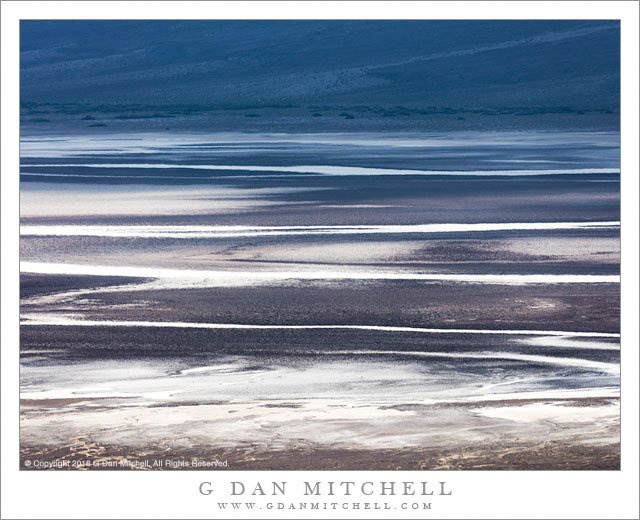
The Canon 5Ds R — Dynamic Range Examples

Updated August 13, 2015 to add a second dynamic range adjustment example.

Ongoing development and refinement of digital camera technology continues to improve cameras and the technical quality of the images they produce. Color accuracy improves, dynamic range expands, sensor resolution increases, AF accuracy gets better, and so on.

The Canon EOS 5Ds and the Canon EOS 5Ds R continue this process. Their most notable feature is the 50.6 megapixel (MP) sensor, currently the highest sensor photo site density available on full frame digital cameras. (Nikon and Sony both produce 36MP sensor cameras using Sony sensors, and Sony has introduced a camera with a 42MP sensor. Note that the differences between 36MP, 42MP, and 50.6MP are less than you might expect.)

When it comes to dynamic range — the ability of the sensor to record a wide range of luminosity levels from very bright to quite dark in a single exposure — Sony is the current champion, and cameras using their sensors have the largest available dynamic range among comparable cameras. (Some MF cameras have more dynamic range capability than any current full frame camera. )

(All current digital cameras capture images with more dynamic range than we can display on monitors or in prints — the display media cannot keep up with the capture technology. Consequently, the primary advantage of greater dynamic range comes in post-production, where the photographer will find more useful scene data in darker areas that can be “pushed” or otherwise recovered while maintaining useful image quality.)

If you can get more dynamic range without giving up anything else, there is no reason not to have it. In marginal situations, that extra bit of dynamic range might enable you to get a bit more image data in a single exposure, while a photographer with a camera providing less dynamic range is a bit more likely to have to use exposure bracketing or HDR techniques (which combine multiple images in post-production), use a graduated neutral density filter, or possibly find ways to suppress noise in shadow areas of scenes with very wide dynamic range. That said, all current high quality digital cameras capture a wide dynamic range — much larger, for example, that was possible with typical film media. (Note, however, that no currently available full frame camera can capture in a single exposure the largest dynamic range scenes that you may encounter.)

With all of that in mind, I thought I’d share a couple examples of files from the Canon 5Ds R that have been pushed quite a bit. Continue reading The Canon 5Ds R — Dynamic Range Examples

Woman with Umbrella, Salzburg Street

Woman with Umbrella, Salzburg Street
A Salzburg, Austria street scene including a woman with an umbrella

Woman with Umbrella, Salzburg Street. Salzburg, Austria. July 17, 2013. © Copyright 2013 G Dan Mitchell – all rights reserved.

A Salzburg, Austria street scene including a woman with an umbrella

This is one of those photographs that you could see in any number of ways, I think. It is a narrow street in Salzburg, Austria, not far from the main square and the Salzburg Cathedral and perhaps right in front of the building that is described as the birthplace of Mozart. (Somehow the juxtaposition of a shopping district with that place seems just a bit jarring.) You could regard it as an almost random scene from this street, though I think there is a bit more going on.

One of the things I like about street photography is working quickly and spontaneously, reacting quickly to people, events, and juxtapositions that may last only for a brief moment. If I recall correctly, I perhaps began simply by thinking “there is a shot here somewhere, with all these people on this narrow street.” Then things began to coalesce a bit when I noticed the bright backlight streaming almost directly down the street and stretching long shadows toward me. Then I saw the woman with the dark umbrella — and who can resist a photograph of umbrellas!? As she walked past I quickly made a brief series of photographs, trying to instantly place her and her shadow in some kind of compositional relationship with people and objects in the scene. From this series, this one has her standing slightly apart from others and with her shadow stretching toward the lower part of the frame, and a similar shadow from another woman almost parallels it. The people at front right were in shadow (yes, some work in post makes them more visible) but I felt like they provided some balance to the brightness on the left side of the frame and, to me at least, there is something a bit odd and interesting about their intense gaze at something behind me. Looking closer at the people in the scene — closer than I could consciously look when I pressed the shutter release — I find the dark figure on the right margin interesting, and as the people stretch into the distance several of them seem to have stories to tell, too.


G Dan Mitchell is a California photographer and visual opportunist whose subjects include the Pacific coast, redwood forests, central California oak/grasslands, the Sierra Nevada, California deserts, urban landscapes, night photography, and more.
Blog | About | Flickr | Twitter | FacebookGoogle+ | 500px.com | LinkedIn | Email

Text, photographs, and other media are © Copyright G Dan Mitchell (or others when indicated) and are not in the public domain and may not be used on websites, blogs, or in other media without advance permission from G Dan Mitchell.
Dunes and Mountains, Evening Shadows

Dunes and Mountains, Evening Shadows

Dunes and Mountains, Evening Shadows. Death Valley National Park. March 31, 2015. © Copyright 2015 G Dan Mitchell – all rights reserved.

Evening light on sand dunes, Death Valley National Park

I can photograph dunes at any time of day, but for me the evening hours are the most interesting. The scene goes through a sequence of transformations that fascinate me, even on evenings when I wonder if the magic will be there. IN Death Valley, during all but the coolest times of the year, the dunes can be hot places with stark light and washed out colors in the late afternoon — yet even this kind of scene has photographic potential. But soon the sun drops toward the horizon, the color of the light warms, and the shadows lengthen, revealing the textures of the dunes that are hidden in brighter light. As the sun sets the show continues but transforms again as the light takes on a blue tint (from open sky) and fills the shadows, now revealing colors that are not seen in the daylight.

This whole transition occurs relatively quickly, perhaps over the course of an hour and a half or less, and I often feel like I have to work somewhat quickly. This photograph comes from a point in time when direct sun was still on the dunes, though it was muted by haze from earlier sand storms on this evening. The light catches the higher parts of the dunes and gives them a warm color, but the lower areas have already fallen into shadow and have taken on the blue tones of light from the open sky.


G Dan Mitchell is a California photographer and visual opportunist whose subjects include the Pacific coast, redwood forests, central California oak/grasslands, the Sierra Nevada, California deserts, urban landscapes, night photography, and more.
Blog | About | Flickr | Twitter | FacebookGoogle+ | 500px.com | LinkedIn | Email

Text, photographs, and other media are © Copyright G Dan Mitchell (or others when indicated) and are not in the public domain and may not be used on websites, blogs, or in other media without advance permission from G Dan Mitchell.