
Tag Archives: tule

Tree With Two Hawks, Fog

Morning tule fog clears beyond a tree with a pair of hawks

Tree With Two Hawks, Fog. © Copyright 2018 G Dan Mitchell – all rights reserved.

Morning tule fog clears beyond a tree with a pair of hawks

I was in this location to photograph something quite different from what is seen here, but tule fog interfered with that subject to some extent. So I found myself wandering a bit more afield and looking for other subjects. Eventually the fog began to thin and drift away.

This solitary tree appeared against the background of a long grove of (mostly) cottonwood trees, and the thinning fog began to allow light from the morning sky into the scene. Initially I simply saw the tree itself as the subject, but as I composed the photograph I realized that a pair of hawks for perched side-by-side on one of the limbs.


See top of this page for Articles, Sales and Licensing, my Sierra Nevada Fall Color book, Contact Information and more.

G Dan Mitchell is a California photographer and visual opportunist. His book, “California’s Fall Color: A Photographer’s Guide to Autumn in the Sierra” is available from Heyday Books and Amazon.
Blog | About | Flickr | Twitter | Facebook | LinkedIn | Email


All media © Copyright G Dan Mitchell and others as indicated. Any use requires advance permission from G Dan Mitchell.
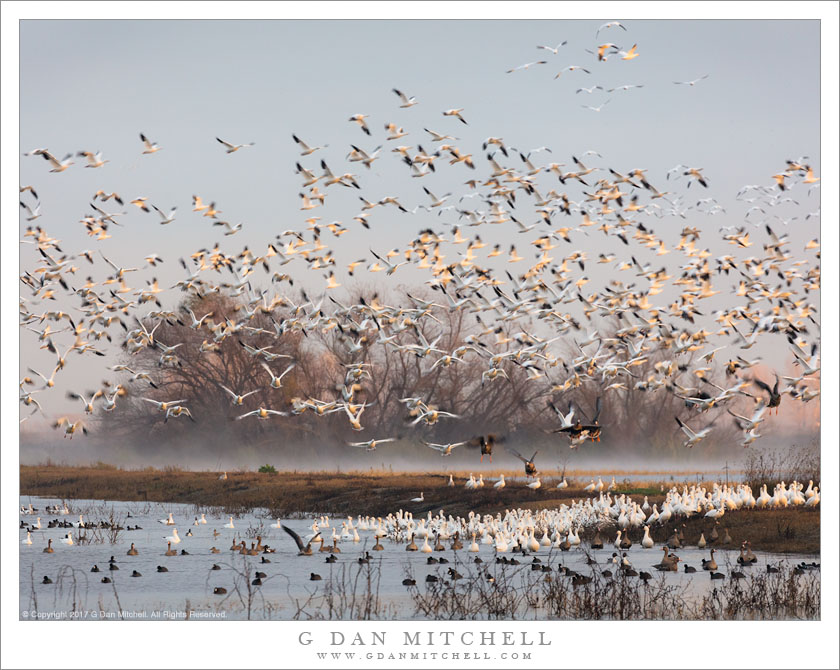
Morning Fly-Out

Morning Fly-Out
Migratory geese take to the air in morning light and thin tule fog

Morning Fly-Out. © Copyright 2018 G Dan Mitchell – all rights reserved.

Migratory geese take to the air in morning light and thin tule fog

As I mentioned in an earlier post, I am (finally!) going back and revisiting my 2017 (!) photographs. I usually review the previous year’s raw files each December as I come up with my annual favorites post. However, I didn’t do that post (yet) for 2017, and I therefore missed that all-important opportunity look through the year’s raw file archive. Why is that important? For various reasons, which could be the subject of an article at some point, I miss some interesting photographs right after I make them — perhaps I had to move on to other subjects, I may not yet have been able to “see” the images for what they are, etc.

This comes from the very beginning of 2017, in the middle of winter. In many parts of the country winter is when migratory birds show up, as they arrive in our relatively warmer climate from areas that may be literally frozen during this season. Geese are among the long-distance travelers, and every fall and winter I look forward to their return all up and down the California flyway. I photographed this group early in the morning as the sun arrived and the birds began to leave their overnight accommodations in wetland ponds.


See top of this page for Articles, Sales and Licensing, my Sierra Nevada Fall Color book, Contact Information and more.

G Dan Mitchell is a California photographer and visual opportunist. His book, “California’s Fall Color: A Photographer’s Guide to Autumn in the Sierra” is available from Heyday Books and Amazon.
Blog | About | Flickr | Twitter | Facebook | LinkedIn | Email


All media © Copyright G Dan Mitchell and others as indicated. Any use requires advance permission from G Dan Mitchell.
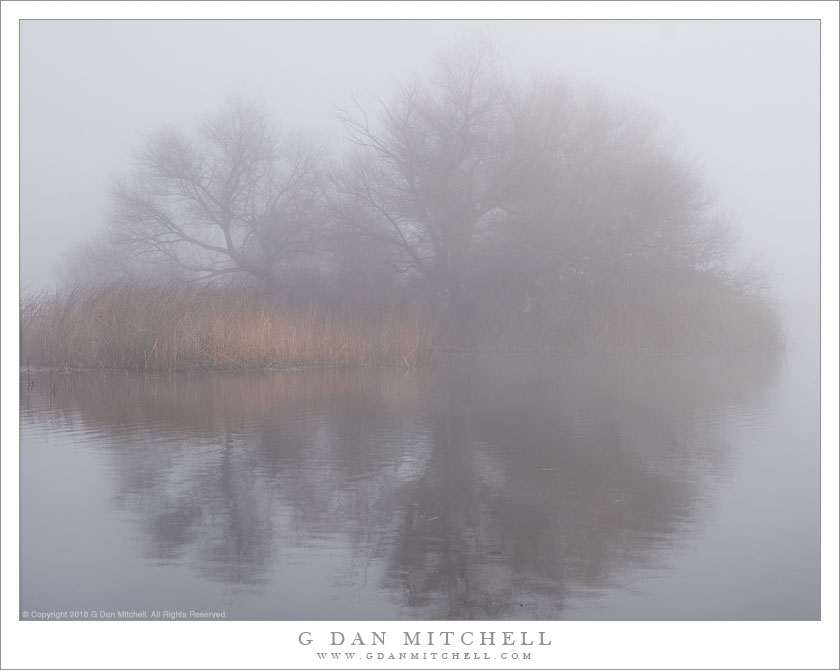
Island With Trees, Thinning Fog

Island With Trees, Thinning Fog
Sunlight begins to illuminate a small wetland island as San Joaquin Valley tule fog thins

Island With Trees, Thinning Fog. © Copyright 2018 G Dan Mitchell – all rights reserved.

Sunlight begins to illuminate a small wetland island as San Joaquin Valley tule fog thins

We all know that (apparently false) story about the number of words that Inuit people have for the myriad types of snow. I suspect that it would be possible to have a similarly diverse vocabulary of descriptions for fog, dependent upon its thickness, temperature, quality and color of light, tendency to move, effect on sound, time of day, season, persistence, and much more. Photographing in California is something of a laboratory in the nature of fog, in that we have so many types. Living in the San Francisco Bay Area I am very familiar with the type of fog created by the marine influence — often cold and gray and damp, and frequently a feature of the late-spring and summer months. Photographing Central Valley birds (and driving across the great valley while traveling to and from the Sierra Nevada) has given me ample opportunities to know the tule fog, mostly a winter phenomenon caused by cool and damp conditions over land.

On winter days when I photograph in the valley I experience transitions though many different types of fog and fog-light. I often start before dawn, when the fog and darkness can close the world down to what I can (barely) see in my headlights, or by the glow of commercial signs and streetlights as I pass through towns. Before sunrise the fog can glow in colors ranging from sky blue to the gaudy reds, oranges, yellows, and purples of first light on clouds above the fog. Eventually that color dissipates and the fog can simply become gray. Then, as it things (often from the top down), and light begins to filter down to the ground level, the colors of grasses and trees and water being to appear faintly.


G Dan Mitchell is a California photographer and visual opportunist. His book, “California’s Fall Color: A Photographer’s Guide to Autumn in the Sierra” is available from Heyday Books and Amazon.
Blog | About | Flickr | Twitter | FacebookGoogle+ | LinkedIn | Email


All media © Copyright G Dan Mitchell and others as indicated. Any use requires advance permission from G Dan Mitchell.

Fog, Tree, And Pond

Fog, Tree, And Pond
“Fog, Tree, And Pond” — A tree reflected in a wetland pond in dawn tule fog, San Joaquin Valley

I love fog, and I especially love the thick and mysterious tule fog of California’s Central Valley — comprised of the northern Sacramento Valley and the southern San Joaquin Valley, and draining to the Pacific Ocean via San Francisco Bay. This fog is mostly a winter thing, when the moisture rises from the ground, farmland, and ponds as the temperature drops at night. It often reaches its peak in the early morning, just after dawn. (It also creates some very challenging driving conditions — so bad that lots of people simply try to avoid them.)

If you stop and get out of your car, the world of tule fog is quiet and mysterious and still. Your universe closes down to a radius of perhaps a couple hundred feet or less, and you can sense as much about your surroundings by sound as you can by vision — you might hear but not see a flock of crane passing overhead. Surprising to some who are new to these conditions, while the tule fog is incredibly dense, it is often astonishingly shallow. On occasion I have seen conditions so bad that it was almost impossible to drive… but I could look up and see clouds in the sky overhead. The tops of trees and utility poles might poke out of the top of the fog layer. This, of course, can produce some very special light, since this thick fog may also be intensely illuminated by that overhead sky and sun, to the point that at times it can almost hurt to look into the brightness. Those were not the conditions when I made this photograph, but the astonishing blue color (which I actually had to tone down a bit in post) is the result of the glowing fog picking up the color of the blue morning sky.


Leave a comment or question using the form. (If you are reading this on the home page, click the article title to see the full article and the comment form.

G Dan Mitchell is a California photographer and visual opportunist. His book, “California’s Fall Color: A Photographer’s Guide to Autumn in the Sierra” (Heyday Books) is available directly from him. Blog | Bluesky | Mastodon | Substack Notes | Flickr | Email

All media © Copyright G Dan Mitchell and others.