
Tag Archives: valley

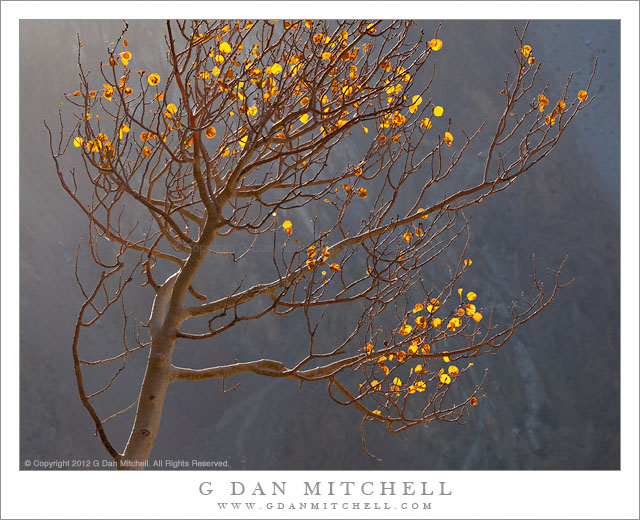
Early Fall Color, McGee Canyon

Early Fall Color, McGee Canyon - Early fall color comes to McGee Canyon in the eastern Sierra Nevada, California
Early fall color comes to McGee Canyon in the eastern Sierra Nevada, California

Early Fall Color, McGee Canyon. Eastern Sierra Nevada, California. September 16 2012. © Copyright 2012 G Dan Mitchell – all rights reserved.

Early fall color comes to McGee Canyon in the eastern Sierra Nevada, California.

I’m going to use today’s post not only as the opportunity to share another daily photograph, but also to share some observations about the arrival of the fall aspen color season in the eastern Sierra Nevada range, where I spent a good part of the past week.

I made the photograph at the very end of a three-day backpack trip up into the McGee Creek drainage, where we settled in at a 10,000+” lake for a couple of nights to enjoy the late-season solitude. (Before starting the pack trip I had spent a couple of days in Tuolumne Meadows, and upcoming posts will concern that part of the trip.) McGee Canyon is an eastern Sierra “type” – a typical trailhead canyon that rises from the high desert, into forests, through increasing rugged and rocky country, and finally reaches the crest of the range at a pass. On this early afternoon we were fortunate to get a few clouds, moderating the intense sun and adding a bit of texture to the landscape. The photo was somewhat casual – still wearing my full pack, I shot hand-held.

About the onset of fall color… I have watched this transition carefully for a number of years. While I have learned a lot about how the process unfolds, I have also learned that many aspects of it defy precise prediction. Every September, those of us who chase eastern Sierra aspen color start to watch for signs that might provide clues about the nature of this season – the amount of snow during the previous winter, how late it remained before melting out, long-range weather forecasts, early color changes in many other plants that can show up even in late August, and more. But, truth be told, in the end every aspen season seems to hold surprises and defy out attempts to know in advance how it will play out. A season may start with early color up high, only to be interrupted by early storms. Or a season may start late and then move very quickly. Or poor early color in one part of the range may lower expectations… only to be followed by great low-elevation later on. Or there may be any number of other possible variations, too numerous to list.

All of this is my way of saying to take my observations with a suitable dose of salt. :-)

Several weeks ago I began to read the typical early September notes about “early color” here and there, especially in portions of the Rockies and some areas of the Southwest. I was intrigued, but not ready to believe it. I read and hear these reports of early color every season – and generally the correlation between what is written and what occurs in the actual event is weak.

This has been an odd summer season for me, for reasons I won’t go into here. As a result, I had not been to the Sierra since early July or so – a very large gap of time for me, since I rarely allow more that a couple of Sierra-free weeks to occur in the summer. I was not there at all during August – which is almost unheard of. I usually catch my first hint of oncoming autumn on one of those late-August visits. It is hard to put my finger on precisely what it is, but invariably (well, almost invariably, since it didn’t happen this year…) there will be a day when I sense “something” in the air that reminds me that summer will end very soon – whether it is a breeze, a quality of light, a change in the plants, I can never tell for sure. But I am sure when I experience it.

Soon there are more concrete signs. The golden-brown dried meadow areas start to expand, the wildflowers are harder to find, corn lily plants begin to turn golden-yellow, bilberry leaves turn dark red (and brilliant red when back-lit) and the leaves of willows near streams and lakes turn yellow. By mid-September all of this is typically underway, and at this point I start thinking about aspen color in earnest. Whether it is because we tend to go to different places to find our aspens or because we have experienced different seasonal variations, individuals will tell you to look for the aspen show to begin at somewhat varying times. I tend to look for real aspen color around the very beginning of October, and to expect a peak roughly a week into the month in the higher country. Except for watching for the odd tree with a branch full of yellow leaves, I don’t expect to seem much real color in September.

But… I just returned from a pack trip that was right in the middle of September… and I saw a significant amount of aspen color. As I drove over the Sierra crest on my way to the east side I was not expecting to see aspen color, and I did not see much. Despite the other sources of fall color, the aspens just east of Tioga Pass and down in Lee Vining Canyon were almost uniformly as green as I expected. When we arrived at our eastern Sierra trailhead, there were a few yellow leaves here and there, but nothing too out of the ordinary. However, a mile or two up the trail I was quite surprised to find large stands of aspens in which many trees were showing color – just a few leaves on some, but perhaps a quarter or a third of the tree in the most extreme cases. In my experience, this is unusually early – but at least a week and arguably perhaps a bit more. (Not all of the color in the photograph comes from aspens, by the way.)

What does this mean? I’m not sure. If I had a bit more time I would have investigated one or two other east-slope canyons to see what is going on elsewhere – it could be that this canyon is somehow out of sync with others. But I doubt it. All I’ll say is the following: Some aspen color is already beginning to appear in some areas of the eastern Sierra. While no one knows when the main show will arrive (or what it will look like), if I were making plans for a visit to the eastern Sierra to photograph aspen color, at this point I would lean toward going a little bit early rather than a little bit late. However, as always, realize that you cannot count on the timing or the quality of the display, and flexibility increases your odds of being there at a good moment.

More articles on Eastern Sierra aspen photography:

G Dan Mitchell is a California photographer whose subjects include the Pacific coast, redwood forests, central California oak/grasslands, the Sierra Nevada, California deserts, urban landscapes, night photography, and more.
Blog | About | Flickr | Twitter | FacebookGoogle+ | 500px.com | LinkedIn | Email

Text, photographs, and other media are © Copyright G Dan Mitchell (or others when indicated) and are not in the public domain and may not be used on websites, blogs, or in other media without advance permission from G Dan Mitchell.
Hills and Trees Near Limantour, Drakes Bay

Hills and Trees Near Limantour, Drakes Bay - Soft sun light on trees and hills above Limantour Beach, as fog bank hovers over Drakes Bay, Point Reyes National Seashore.
Soft sun light on trees and hills above Limantour Beach, as fog bank hovers over Drakes Bay, Point Reyes National Seashore.

Hills and Trees Near Limantour, Drakes Bay. Point Reyes National Seashore, California. August 18,2012. © Copyright 2012 G Dan Mitchell – all rights reserved.

Soft sun light on trees and hills above Limantour Beach, as fog bank hovers over Drakes Bay, Point Reyes National Seashore.

Limantour Beach sits along the inner curve of Drakes Bay at the Point Reyes National Seashore north of San Francisco, California, and the area is one of the best-known and most visited in the park. On certain days, the air is clear and the sun is bright and the beach can be warm, and the view includes not only the nearby wildlife and the surf, but the peninsula leading to the tip of Point Reyes and the coast stretching south towards the Marin Headlands and the Golden Gate. One of the first times I visited this place to make photographs it was one of those clear days, and I recall photographing the curve of the Bay leading to the right with the beach and some birds in the foreground. I’ve carried a mental images of how I would like to improve that photograph, and it was with that in mind that I went to Limantour this time.

The weather did not cooperate with that plan. After crossing the ridge between Tomales Bay and Limantour, I could see right away that there was going to be fog along the beach. The shoreline edge of the water still reflected blue sky in a few spots a bit to the south, but at Limantour the fog came a good distance inland from the beach. So as I drove down toward the end of the road, I started looking for some spot that would let me photograph the rounded, grass-covered hills and the bits of forest in sunlight, with the Bay and its fog in the distance. Finding a spot that included all of these things and which made some visual sense was not easy, but with a bit of back-tracking I finally found this spot and made a few exposures.

G Dan Mitchell is a California photographer whose subjects include the Pacific coast, redwood forests, central California oak/grasslands, the Sierra Nevada, California deserts, urban landscapes, night photography, and more.
Blog | About | Flickr | Twitter | FacebookGoogle+ | 500px.com | LinkedIn | Email

Text, photographs, and other media are © Copyright G Dan Mitchell (or others when indicated) and are not in the public domain and may not be used on websites, blogs, or in other media without advance permission from G Dan Mitchell.
Photographing Icons – Or Not

Yesterday I shared elsewhere a photograph that someone had posted featuring a line-up of scores of photographers, arrayed tripod-to-tripod, ready to photograph one of those iconic views that we all know so well. I suspect that we have all been to such places and either found the experience of seeing and photographing them to be powerful… or we might have been repulsed by the crowds of people all apparently trying to “capture” the same thing, among them perhaps a number of folks who might be trying to almost literally recreate versions of the scene that they had seen elsewhere.

The point of the share (seen here and here) was not complimentary. My reaction to the photograph was to wonder, even more than usual, why people would want to make photographs that way. I phrased it as, more or less, “yet another reason to avoid photographing icons.”

However, a person wrote to me after I posted and pointed out, with a bit of anger and with some justification I think, that complaining about and putting down those who want to photograph a beautiful place might seem a bit pretentious and self-righteous.

She has a point.

While there is something a bit troubling about seeing dozens of people lined up to make the very same photograph, some of us might be a bit too quick to jump to overly negative conclusions. Perhaps there is a way to cast this as a positive lesson, rather than ridicule. So let me engage in a bit of reflection and honesty. Continue reading Photographing Icons – Or Not

Mount Conness and Ragged Peak, Forest

Mount Conness and Ragged Peak, Forest - Evening light slants across forest below Ragged Peak and Mount Conness, Yosemite National Park, California.
Evening light slants across forest below Ragged Peak and Mount Conness, Yosemite National Park, California.

Mount Conness and Ragged Peak, Forest. Yosemite National Park, California. July 11, 2012. © Copyright 2012 G Dan Mitchell – all rights reserved.

Evening light slants across forest below Ragged Peak and Mount Conness, Yosemite National Park, California.

This photograph was made from the Tuolumne Meadows area with a long lens, and it includes the heights of Mt. Conness at the far right, the lesser prominence of Ragged Peak at the left, a shaded ridge running above the Young Lakes basin, and a closer bit of typical Yosemite forest mixed with a bit of dome-like granite, with sunset light slanting across from the left. By the way, I wondered for some time where the name “Mt. Conness” came from. I finally looked it up during the past year, and I found out that the namesake was Senator Conness, one of the two California senators during roughly the Civil War period – Conness was responsible for the legislation that initially set parts of the current Yosemite National Park aside for protection and preservation. All in all, a person deserving of a peak with his name.

Although photographed here from some distance, I know parts of the landscape encompassed by this photograph quite well, including the visible portions and some that are hidden from sight in this photo. For a number of years I have made a habit of visiting the Young Lakes area at least once each season, often late in the season when the summer crowds have dissipated – though I have also visited very early in the season, and I have the mosquito stories to prove it! Young Lakes lie on the other side of the shaded ridge traversing the center of the photograph, and I’ve often looked up at that ridge from the lakes. I have also hiked up into the valley on this side of the ridge. The trail to Young Lakes crosses the wooded area beyond the sunlit trees and passes through a beautiful semi-meadow area below Ragged Peak, a place where beautiful lupine flowers may be found at the right time of the year and from where one can obtain some panoramic views of a lot of high Yosemite Peaks. On one of my first visits to Young Lakes, it was so late in the season that the backcountry ranger who was patrolling the area apparently had little to do, and one morning we ended up having a very long conversation along the shore of one of the lakes. I remarked that a particular little gully in roughly the area of Ragged Peak looked like it might be interesting, and he shared enough information about the route that I chose to use it rather than the regular trail on my return to the trailhead. Mt. Conness, here the only peak or ridge still fully in sunlight, towers above everything else in this area. I have not climbed it, though I have investigated some trail less areas around its base and I’ve looked at it from almost every side.

G Dan Mitchell is a California photographer whose subjects include the Pacific coast, redwood forests, central California oak/grasslands, the Sierra Nevada, California deserts, urban landscapes, night photography, and more.
Blog | About | Flickr | Twitter | FacebookGoogle+ | 500px.com | LinkedIn | Email

Text, photographs, and other media are © Copyright G Dan Mitchell (or others when indicated) and are not in the public domain and may not be used on websites, blogs, or in other media without advance permission from G Dan Mitchell.