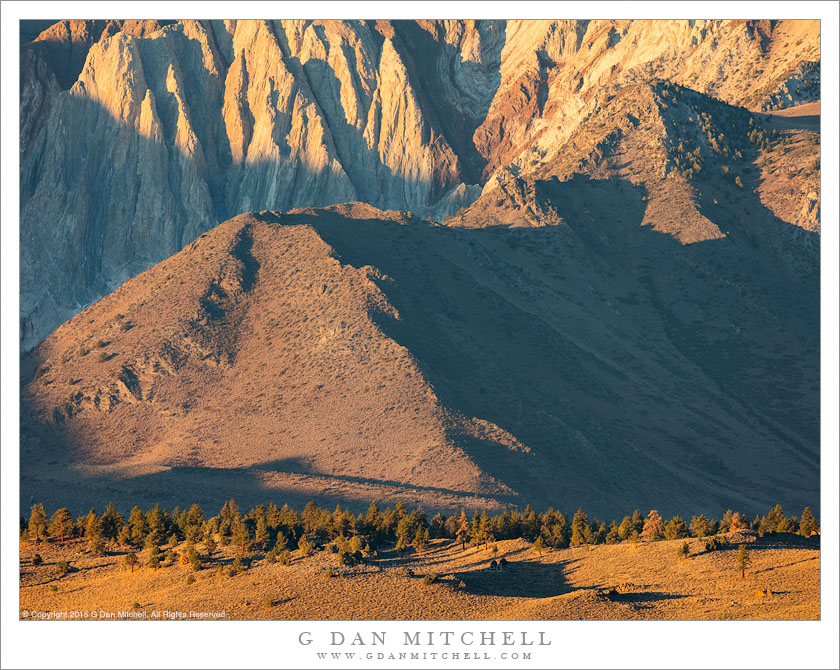
Dawn light on the eastern escarpment of the Sierra Nevada near Long Valley
I regard myself as a bit of a sunrise connoisseur, having arisen well before dawn on many, many mornings — almost every morning, actually — and often gone out to observe and photograph at first light. Trust me, I do understand how hard it is to get out of a warm bed (or warm sleeping bag) in darkness, dress, and head out into the still-dark world. But if you can start to make it a habit there is a good chance that you’ll become addicted — and what better kind of addiction is there than to need to see the first light?
I photographed this on an autumn morning when I headed out into the valley to the east of the escarpment of the Sierra. It was, as it usually is in mid-October, very cold when we arrived. But it was also very quiet and still, and steam was rising from nearby springs and creeks as the sky began to listen and the first light touched the peaks of the Sierra. It worked its way down the face of the range, across fluted alpine faces, into deep mountain valleys, and eventually to the rounded, tree-covered hills at the foot of the range.
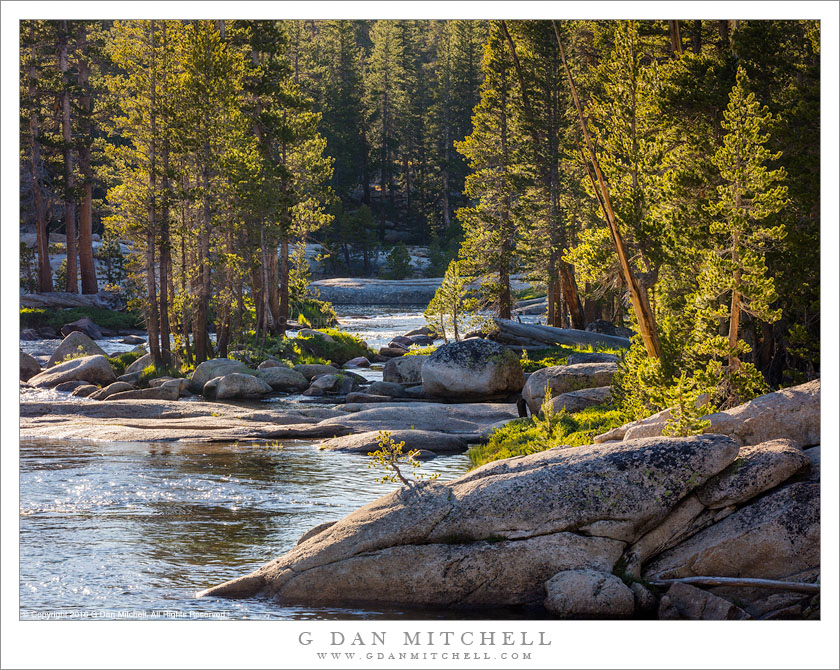
The Tuolumne river flows past forest and granite outcroppings on a summer afternoon.
This is a sort of “Sierra dreaming” photograph — a scene from last summer, of the sort that I’m looking forward to experiencing again this coming season. It is also a bit of a distraction from the fact that circumstances (nothing bad, just busy-ness and a deadline) have kept me away from the Sierra recently and will probably do so for another month of so. (Though I am sure that this particular spot, photographed in mid-July during a drought year, may look quite a bit different on that date this year!)
Many Sierra Nevada photographs focus on the monumental and spectacular — and for good reason. There are plenty of spectacular and monumental things in the range! But after many decades of wandering around these mountains I find that more and more it is more subtle features that define the experience for me and which draw me back again. This season I have started to see the reports of those venturing very early into the back-country, and each time I see another photograph of a bit of rocky trail, a path through forest, or a fast-flowing creek, it brings back my own memories of many such places — memories that go beyond the mere visual qualities to include sounds of water and rock, the fragrance of the trees, and the feeling of the breeze. Humor me with this somewhat unspectacular photograph of a place that isn’t special enough to be named — it, too, brings back almost all of those associations!
Two decades after agreements between Utah and federal government to protect this national monument for all Americans in perpetuity, Grand Staircase-Escalante National Monument is under threat from an administration that wants us to overlook its precious qualities and forget the hard-fought agreements (many of which benefit Utah) that let to its creation.
Some will tell you that places like Escalante-Grand Staircase National Monument are “empty” lands, and I can understand why a person might assume so — perhaps a first-time visitor or possibly a person who has never been there and is skeptical about what others say about the place.
I came to the red rock country rather late myself. I had decades in “my Sierra” under my belt, and it was hard to see how this Utah landscape could compare to the rocky heights,meadows, and forests I knew, especially since my only experience with Utah had come when I was very young and my family drove across the state past the Great Salt Lake on the way to someplace else.
Canyon Reflections
But friends insisted, “You have to go to Utah!” Eventually I went, hitting the big national parks, justifiably famous for deep canyons, red rock pinnacles, domes, and more. I even passed through Grand Staircase-Escalante National Monument, driving through the town of Escalante — I don’t recall stopping — on my way to one of those other places, unaware of and uninterested in what might be in the “empty” place outside the town.
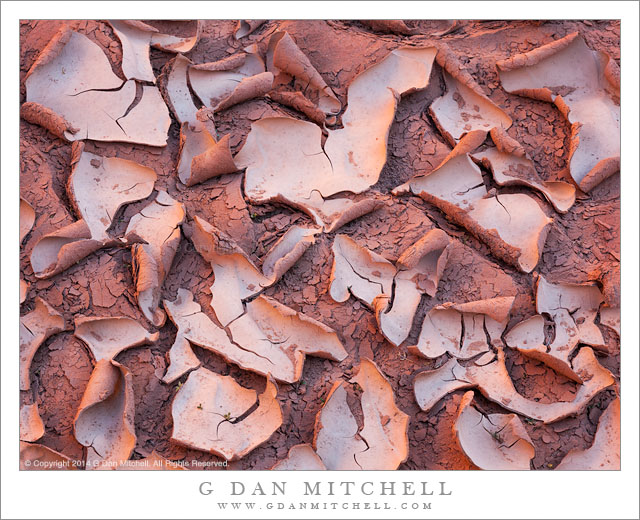
Dry, cracked mud on top of red sand under reflected canyon light, Grand Staircase-Escalante National Monument
Although I missed many things, at least I knew that I wanted to come back to Southern Utah.
Not long afterwards, a photographer friend suggested we go there in the fall and explore some places that he and his friends know. He has photographed here for decades, so I welcomed the chance to learn about places off the beaten track. We started in one of those big national parks, but then we headed to Kanab, and from there we decided to explore a few less known locations.
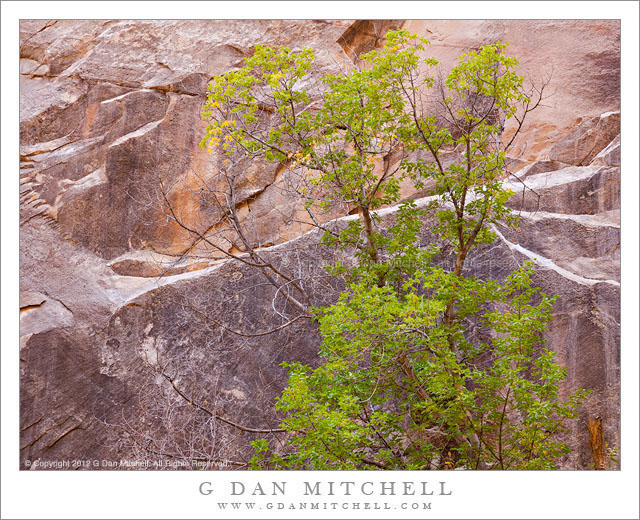
A box elder tree stands against the vertical sandstone walls of a Utah slot canyon
One morning we headed up a road into Grand Staircase-Escalante National Monument. There was the camaraderie of being on the road with friends, along with the expectation that I would “discover” interesting things. However, as we headed up this gravel track, I found the visual impact of the scene was, to be honest, less than stunning. It seemed like, dare I admit it, an “empty” landscape — dry, relatively flat, no rocky peaks, and on that day a boring sky.
Miles up the road we pulled out and parked along a short nondescript spur, dusty and surrounded by brush. (Stopping at nondescript places would eventually become something to look forward to in this country!) I couldn’t see a thing that suggested a photograph, but we loaded up and dropped down a hill to a small creek. This was to be, finally, my first real introduction to canyon country.
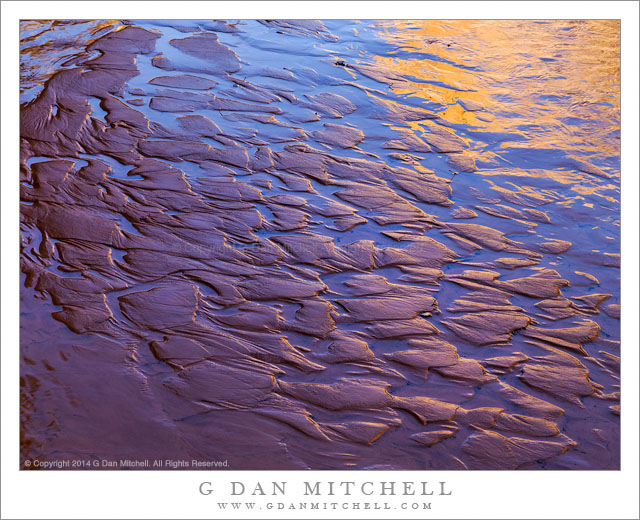
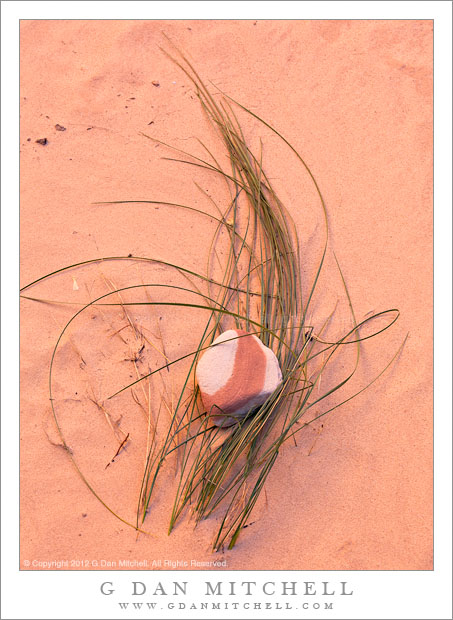
Striped Rock, Grass, and Sand
I’m in my element in the Sierra, where most everything is, by now, second nature. I was distinctly not in my element here, and almost everything was new. We followed the shallow stream, sometimes walking on soft and wet sand, at times crossing drier ground between meanders and passing beneath cottonwoods, and often just wading straight up the creek. Rock walls began to rise on either side of the creek, and before long we were in a fairly narrow canyon. In places brush grew from cracks in the red rock, lit by reflected light bouncing down the canyon walls from above. The gentle sound of the creek was a constant accompaniment. I began to notice small things — some reflecting mud, a riffle reflecting light from canyon walls and sky, a few leaves lying on red rock, grass bent by passing water, reddish sand, rock strata offset by a crack, the texture of wet sand — and each one warranted a pause to photograph.
Not all places worth protecting qualify on the basis of monumental, stupendous features. Saving those is easy, since anyone can see they are spectacular. (OK, almost anyone.) But just because a landscape like that of Grand Staircase-Escalante reveals itself gradually and more quietly and over a longer period of time, it and the “empty space” it occupies are no less precious. In fact, because this beauty is more fragile and less obvious, I would argue that it may be even more precious.
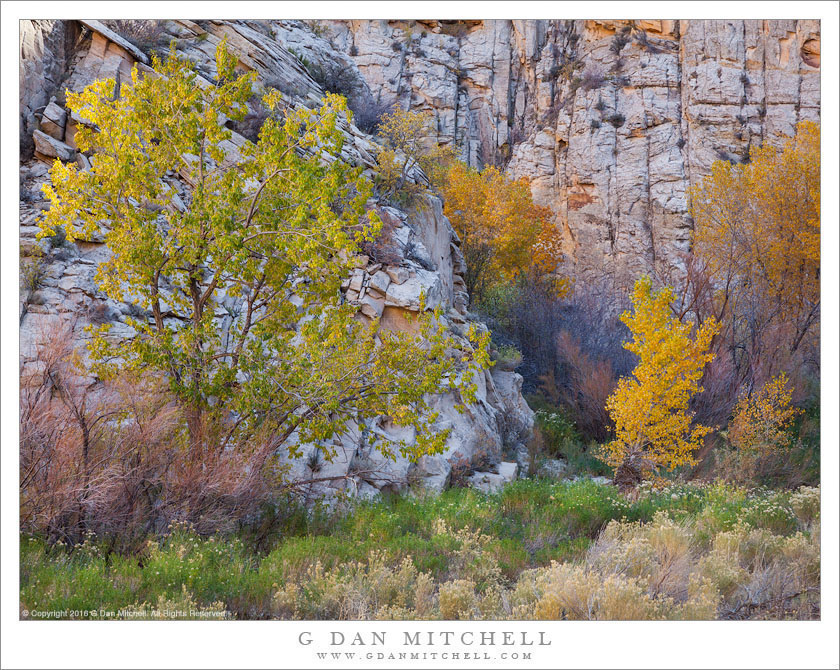
Cottonwood trees and other fall color along the bottom of a river canyon, Grand Staircase-Escalante National Monument
I made this photograph a few years back on a beautiful autumn day when a small group of friends walked down a river canyon, exploring and photographing the river, the vegetation, and the rocky walls. Direct sunlight does not reach the bottom of these canyons most of the time, especially during the times of the year when the sun’s path is lower in the sky and the daylight hours are shorter. Instead, the light strikes the upper walls, bouncing back and forth, diffusing and picking up the color of rocks and fall leaves as it makes its way downwards. If you look, you can see it in this photograph — in the glow on the canyon wall, the saturated colors of the leaves, and the light making its way into shadows.
Such canyons are wonderful places to go if you want to be cut off from the rest of the world. The landscape above the canyons is often relatively bare, perhaps dry and flat with occasional junipers. But none of that flat land world is visible once you are down in the canyon, where cottonwoods and brush spring up along the creek and every bend promises something new an interesting.
Photographer and visual opportunist. Daily photos since 2005, plus articles, reviews, news, and ideas.
Manage Consent
To provide the best experiences, we use technologies like cookies to store and/or access device information. Consenting to these technologies will allow us to process data such as browsing behavior or unique IDs on this site. Not consenting or withdrawing consent, may adversely affect certain features and functions.
Functional
Always active
The technical storage or access is strictly necessary for the legitimate purpose of enabling the use of a specific service explicitly requested by the subscriber or user, or for the sole purpose of carrying out the transmission of a communication over an electronic communications network.
Preferences
The technical storage or access is necessary for the legitimate purpose of storing preferences that are not requested by the subscriber or user.
Statistics
The technical storage or access that is used exclusively for statistical purposes.The technical storage or access that is used exclusively for anonymous statistical purposes. Without a subpoena, voluntary compliance on the part of your Internet Service Provider, or additional records from a third party, information stored or retrieved for this purpose alone cannot usually be used to identify you.
Marketing
The technical storage or access is required to create user profiles to send advertising, or to track the user on a website or across several websites for similar marketing purposes.

 G Dan Mitchell is a California photographer and visual opportunist. His book, “California’s Fall Color: A Photographer’s Guide to Autumn in the Sierra” is available from Heyday Books and Amazon.