
Tag Archives: winter

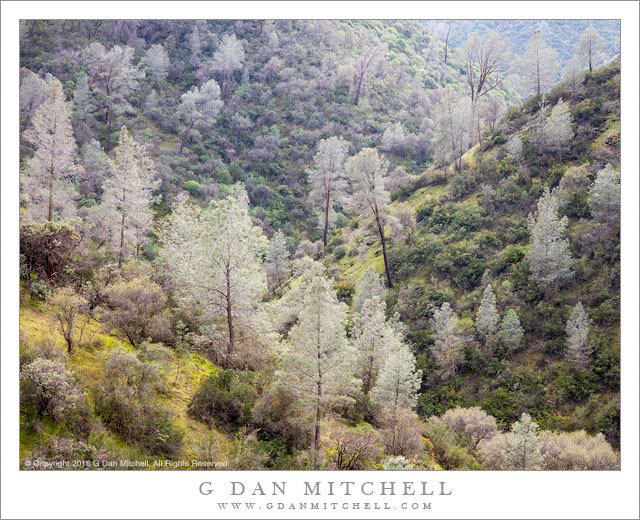
Sierra Foothills, Late Winter

Sierra Foothills, Late Winter
First growth of the season brings green to Sierra Nevada foothills in late winter

Sierra Foothills, Late Winter. February 27, 2016. Sierra Nevada Foothills, California. © Copyright 2016 G Dan Mitchell – all rights reserved.

First growth of the season brings green to Sierra Nevada foothills in late winter

During late winter many parts of California undergo stunning conversion. During the previous summer the landscape dried out under summer heat. As summer turns to fall the heat does not immediately abate, and the landscape may reach its driest point. Then, in a normal year, the winter rains finally arrive. At first the changes — mud, mostly — don’t speak of spring, but at some point in the middle of winter plants again gain a foothold and begin to sprout everywhere. Short and very greens grasses spring up. Wildflowers begin to appear on the hillsides.

This photograph is of an area that seemed to be starting the late winter transformation. Though some trees are still leafless, the hills are otherwise covered with the first, short grasses. A few flowers have begun to appear on some of the chaparral plants. And beautiful light is everywhere. This begins a short but intense period of wild land growth here. The short grasses turn to lush, thick grasses. Wildflowers take over, and the leafless trees begin to show new colors.


G Dan Mitchell is a California photographer and visual opportunist. His book, “California’s Fall Color: A Photographer’s Guide to Autumn in the Sierra” is available from Heyday Books and Amazon.
Blog | About | Flickr | Twitter | FacebookGoogle+ | 500px.com | LinkedIn | Email


All media © Copyright G Dan Mitchell and others as indicated. Any use requires advance permission from G Dan Mitchell.
Wetlands Island, Fog

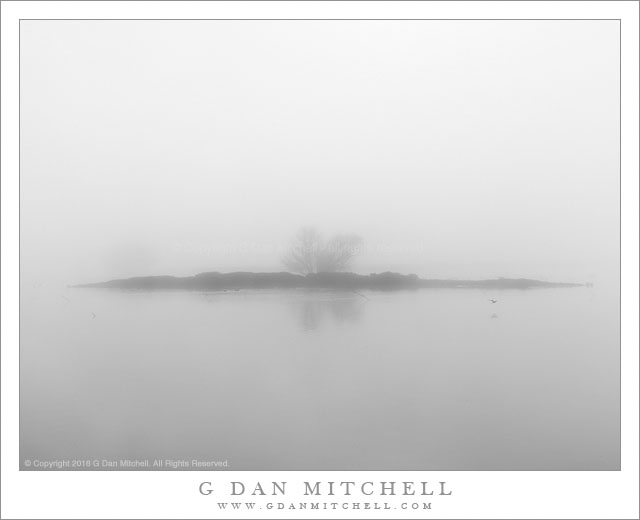
Wetlands Island, Fog
Thick tule fog obscures the view of a San Joaquin Valley wetlands island

Wetlands Island, Fog. San Joaquin Valley, California. February 15, 2016. © Copyright 2016 G Dan Mitchell – all rights reserved.

Thick tule fog obscures the view of a San Joaquin Valley wetlands island

I can’t think of nicer weather for California’s Great Central Valley! (Well, unless you really need to get somewhere by car, in which case this kind of pea soup fog will slow you down, drive you nuts, and make you worry about those drivers who insist on traveling through it at high speeds.) I had a pretty good idea that it was going to be “this kind of day” as I approached this favorite bird photography location. Most of the drive had been clear, but a few miles away the fog suddenly thickened and soon I was creeping along narrow back roads at low speeds.

Our photography begin in fog so thick that we really could not see any of the birds that we heard, even though they were obviously not that far away. Finally it began to thin enough that we could see a few birds, dimly, though the mist. We photographed them for a while, and then I decided to make another circuit of the spot before the fog dissipated. Partway along the fog became less thick and it began to glow from above. I stopped, switched gears from bird photographer to landscape photographer, and made several photographs of these mostly obscured islands and trees and bushes.


G Dan Mitchell is a California photographer and visual opportunist. His book, “California’s Fall Color: A Photographer’s Guide to Autumn in the Sierra” is available from Heyday Books and Amazon.
Blog | About | Flickr | Twitter | FacebookGoogle+ | 500px.com | LinkedIn | Email


All media © Copyright G Dan Mitchell and others as indicated. Any use requires advance permission from G Dan Mitchell.
Tundra Swans, Mount Shasta

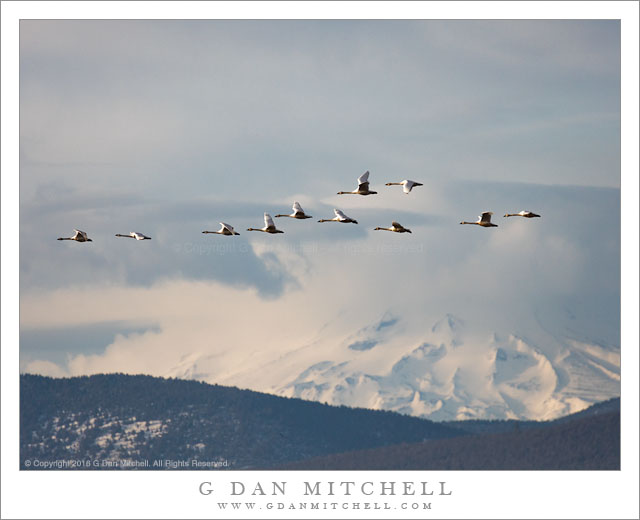
Tundra Swans, Mount Shasta
Tundra swans fly in front of distant cloud-shrouded Mount Shasta

Tundra Swans, Mount Shasta. Klamath Basin, California. February 12, 2016. © Copyright 2016 G Dan Mitchell – all rights reserved.

Tundra swans fly in front of distant cloud-shrouded Mount Shasta

Mount Shasta is one of those special mountains that stands alone and above all around it. In land that rarely exceeds a few thousand feet in elevation, this peak soars to over 14,000′, only a bit shorter than Mount Whitney, the tallest peak in the Lower 48 States. While Mount Whitney is nestled into a very high section of the Sierra Crest, along with other peaks and ridges of nearly the same height, nothing near Shasta is remotely near as tall. Its bulk soars above the rest of the landscape, especially when it is covered in winter snows — and the clouds that build over its summit can make it seem even larger. As we like to point out, the peak is so big that it makes its own weather.

The peak is clearly visible from this area of the Klamath Basin, and it is the first thing to catch the morning light. While out in this immense valley photographing tundra swans I noticed that some flocks along the far side of the valley were passing in front of the peak, and I started tracking them to see if any would cross the mountain at the right elevation. As I saw a flock far to my northwest, I would begin to track it along the horizon, hoping that it would pass in front of the peak and be high enough to clear the lower and darker mountains, yet not so high as to be far above the peak.


G Dan Mitchell is a California photographer and visual opportunist. His book, “California’s Fall Color: A Photographer’s Guide to Autumn in the Sierra” is available from Heyday Books and Amazon.
Blog | About | Flickr | Twitter | FacebookGoogle+ | 500px.com | LinkedIn | Email


All media © Copyright G Dan Mitchell and others as indicated. Any use requires advance permission from G Dan Mitchell.
Tundra Swans, Winter Sky

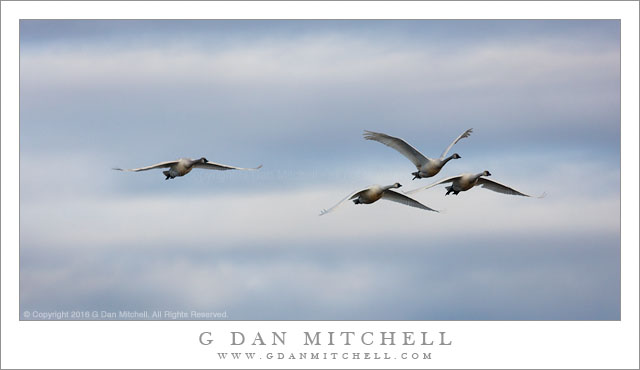
Tundra Swans, Winter Sky
Tundra swans against a cloud-covered winter sky

Tundra Swans, Winter Sky. Klamath Basin, California. February 12, 2016. © Copyright 2016 G Dan Mitchell – all rights reserved.

Tundra swans against a cloud-covered winter sky

I photographed my first tundra swans a few years back, when I was just getting interesting in photographing the migratory birds of the Pacific Flyway. Actually, it was quite literally the first time I did this sort of photography. On the basis of a chance encounter with a friend who just happened to mention a place where sandhill cranes could be found, I decided this sounded as interesting as anything else on my agenda, and off I went, to a place where I was stunned to find a sky filled with birds, almost none of which I recognized, much less could name. Later when I shared one of the photographs of a line of birds flying above me, someone said, “hey, those are tundra swans.” If you say so! Somehow, possibly because of their relative scarcity where I photograph, these birds intrigued me.

Earlier this month I made another bird photography trip, also more or less on a the basis of a whim, though perhaps a little bit more informed this time and with some significant experience under my belt. Yet, arriving in this place, I really did not know what I would find — but I was very happy to discover that it was a major stopping place for these beautiful birds. Ironically I “saw” some early in the morning but didn’t recognize them. Later, during the “boring light” hours of the day I found a big group in a pond, and later that day I photographed them again. There are probably many ways to photograph them, but one seems to be to go where the birds will fly over — and that’s pretty much what I did here. I simply figured out that they were taking a certain route across a valley, and then I put myself under that spot and waited.


G Dan Mitchell is a California photographer and visual opportunist. His book, “California’s Fall Color: A Photographer’s Guide to Autumn in the Sierra” is available from Heyday Books and Amazon.
Blog | About | Flickr | Twitter | FacebookGoogle+ | 500px.com | LinkedIn | Email


All media © Copyright G Dan Mitchell and others as indicated. Any use requires advance permission from G Dan Mitchell.