This is another one of those posts “borrowed” from something I wrote in a discussion somewhere else on the web, in which some folks were debating the relative value of two versions of a photograph, one of which was more or less “straight from the camera,” and the other had been modified in post in a number of the usual ways. Here, with a bit of editing, is my stream of consciousness reply to that thread:
The boundaries are difficult and subjective. The “no alterations” people are denying how photography actually works with the possible (and arguable) exception of certain types of documentary and journalism photography. I know it isn’t news to most reading this, but photography is not an objectively truthful medium. In the end, I’m less interested in some hopeless attempt to literally recreate the subject than I am in what the photograph tells me about the artist behind the camera.
Specifically in landscape photography, an attempt to “reproduce” the objective reality of the original scene by eschewing “manipulation” is going to produce something in almost all cases that is not an honest or accurate recreation of the subject we saw as we made the photograph – even if that is what we were interested in. The nature of the subject and our perception of it is never wholly visual – it is bound up in a web of senses evoked by sound, the movement of air, warmth or cold, and much more. In order to somehow evoke something closer to what we felt when we saw the original subject – and that is what we are interested in, right? – we must strive for something other than a limited pseudo-true visual reproduction.
There are boundaries, but even they are not absolute. For example, many would call the classic landscape photographs more “truthful” than some of today’s color-manipulated images. But what could be less realistic than a black and white photograph? I’ve never been out on a day when it was black and white outside! On the other hand, a photographer who makes a claim to believable portrayal of the subject and then pumps up the contrast and saturates the color into Thomas Kincaid territory is going to encounter some issues about the honesty of his/her work.
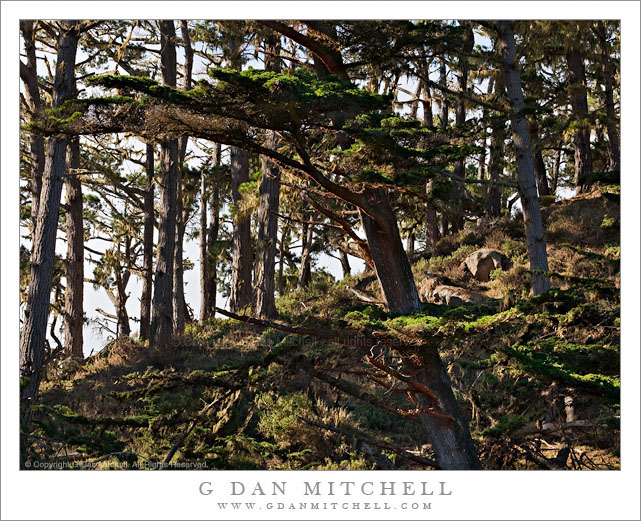
Winter light on the Monterey Pine forest growing on a hillside at Point Lobos State Reserve.
The photograph is the color version of the same scene that I recently posted in a black and white rendition. My initial reaction to the image, and the idea I had in the back of my mind when I photographed it, was that it would be black and white. I wanted to “abstract” the dense shapes and textures of the trees and ground plants and rocks, and I sometimes think that the intrinsically unreal quality of black and white can work for that. However, when I worked up the photograph in color I started to like it, too, though in a different way. At least in the small versions that I looked at on the screen, the color version creates a bit more separation among objects in the scene and seems to have a bit more depth. I guess I won’t know until I make prints!
I have often looked at the straight and upright trees on this rocky prominence as I walked past on a trail that passes by just beyond the left side of the frame. This formation sits between two coves at Point Lobos and rises to a high point (to the right of the photograph) before dropping abruptly to steep rocks and then the sea. From the trail you look up the slope toward the high point and through these trees. But I could never quite see a composition. On this winter day the light was a bit unusual. There was a bit of haze and mist in the air, though not a lot – if I stood with the sun at my back I could not really see it, but if I faced into the sun it was apparent. In any case, even though this was photographed during the harsh light midday time period, the light was softened at least a bit, but still a bit stark from side lighting, the shadows among the trees, and the bright and cloudy sky beyond. It is difficult to find a clear line of sight to this grove that isn’t either very, very far away or else right inside of it. I looked around for a bit and finally found a place not far away along the trail from which I could shoot between tree branches.
This photograph is not in the public domain and may not be used on websites, blogs, or in other media without advance permission from G Dan Mitchell.
For the past few years photographer and blogger Jim M. Goldstein has been collecting and sharing an annual list of online photographers’ “best of the year” posts. (More and more of us make this an annual event around the time of the New Year – I posted my 2010 Favorites list a couple weeks ago.)
Today, after what must have been a very complex organizational task, Jim posted his Best Photos of 2010 list. It now includes the work of over 160 photographers – yes, I’m in the list – and if you take the time to follow his links you’ll find a wide range of photography including some stunning and compelling work. If you have some free time (or your boss isn’t looking… :-), wander on over to his link and enjoy!
Photographer and visual opportunist. Daily photos since 2005, plus articles, reviews, news, and ideas.
Manage Consent
To provide the best experiences, we use technologies like cookies to store and/or access device information. Consenting to these technologies will allow us to process data such as browsing behavior or unique IDs on this site. Not consenting or withdrawing consent, may adversely affect certain features and functions.
Functional
Always active
The technical storage or access is strictly necessary for the legitimate purpose of enabling the use of a specific service explicitly requested by the subscriber or user, or for the sole purpose of carrying out the transmission of a communication over an electronic communications network.
Preferences
The technical storage or access is necessary for the legitimate purpose of storing preferences that are not requested by the subscriber or user.
Statistics
The technical storage or access that is used exclusively for statistical purposes.The technical storage or access that is used exclusively for anonymous statistical purposes. Without a subpoena, voluntary compliance on the part of your Internet Service Provider, or additional records from a third party, information stored or retrieved for this purpose alone cannot usually be used to identify you.
Marketing
The technical storage or access is required to create user profiles to send advertising, or to track the user on a website or across several websites for similar marketing purposes.