Canon 24-70mm f/2.8 L II vs. 24-70mm f/4L IS vs. 24-105mm f/4 L IS (and more?)

Anyone who spends any time in photography forums discussing Canon lenses has seen this topic come up regularly: the comparisons between the 24-70 and 24-105mm L zoom options. If you follow this subject you are familiar with posts asking which of these lenses is “best” or claiming that one or another is great and the others are poor, and with the ensuing debates. Rather than re-writing what I have to say about this every time the subject comes up, I thought I would post once here and then link back to this article.

(Update 1/4/13: Things have changed in significant ways since I first posted this review back in 2011 – primarily with the introduction of two newer Canon 24-70mm L zooms. I have made a few updates to this post to reflect those changes. I have now had the opportunity to use the updated Canon EF 24-70mm f/2.8L II lens. It is also a very fine lens and a great performer. In addition, there is now a Canon EF 24-70mm f/4.0L IS USM lens as well, and the Canon 24-105mm f/4L F/4.0L IS lens is still available. Canon shooters have an over-abundance of good lenses that cover the 24mm to whatever-mm focal length range at this point. All three of these current lenses are excellent options and the functional differences among them now are the primary basis for selecting one over the others. If you need f/2.8 and are OK with a smaller focal length range and not having IS, the 24-70mm f/2.8 could well be your choice. If you can get along without f/2.8, are OK with the smaller focal length range, would like IS, can make use of semi-macro capabilities and want a smaller lens, then the 24-70mm f/4 IS lens can be a great option. If you don’t need f/2.8,  but do value image stabilization and a significantly larger focal length range, the 24-105 is a wonderful choice. )

(Update 1/8/15: And now there is yet another lens in this general category from Canon, the EF 24-105mm f/3.5-5.6 IS STM Lens. I have incorporated some information about this option below.)

Continue reading Canon 24-70mm f/2.8 L II vs. 24-70mm f/4L IS vs. 24-105mm f/4 L IS (and more?)
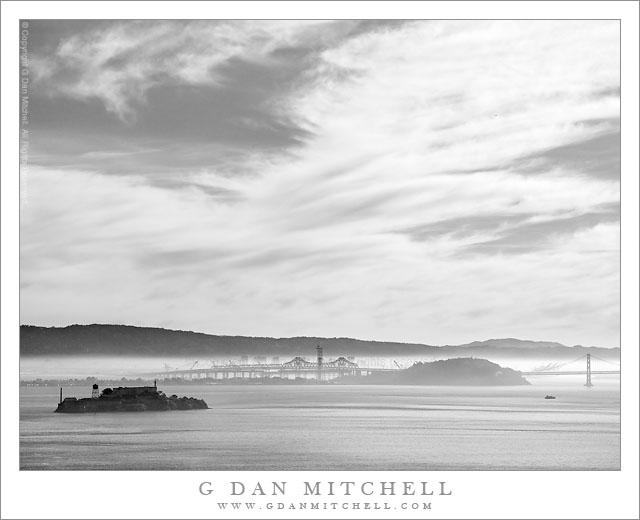
Alcatraz, Treasure Island, East Bay Hills

Alcatraz, Treasure Island, East Bay Hills

Alcatraz, Treasure Island, East Bay Hills. San Francisco Bay, California. February 5, 2011. © Copyright G Dan Mitchell – all rights reserved.

Black and white photograph of San Francisco Bay with Alcatraz, Treasure Island, and the East Bay Hills beneath a morning winter sky.

On this early February day the rough plan was to head up across the Golden Gate Bridge before dawn, shoot a bit from high in the Marin Headlands as the sun rose, and then continue on to most likely shoot at Muir Woods. However, I ended up spending at least two hours shooting from the headlands, and by the time I finished I knew that the tourist hordes would be arriving at Muir Woods, so I only did a bit of additional shooting from the hills before heading back home.

This photograph was made just before I left the Marin Headlands, near the last turn before the road crosses highway 101 near the Golden Gate. It is a familiar location and I’ve photographed from here many times in the past. I don’t always stop, but if something is a bit special or unusual about the conditions I will. That was the case today as someone unusual weather conditions had left the bay mostly clear, but with a thin layer of fog over Oakland and other areas along the east side of the San Francisco Bay – and impressive high clouds were floating above. Alcatraz Island is at the left, Treasure Island and the San Francisco-Oakland Bay Bridge are in the center, and beyond that the tops of buildings in downtown Oakland are visible against the backdrop of the East Bay hills.

G Dan Mitchell Photography | Flickr | Twitter | Facebook | Email
Text, photographs, and other media are © Copyright G Dan Mitchell (or others when indicated) and are not in the public domain and may not be used on websites, blogs, or in other media without advance permission from G Dan Mitchell.

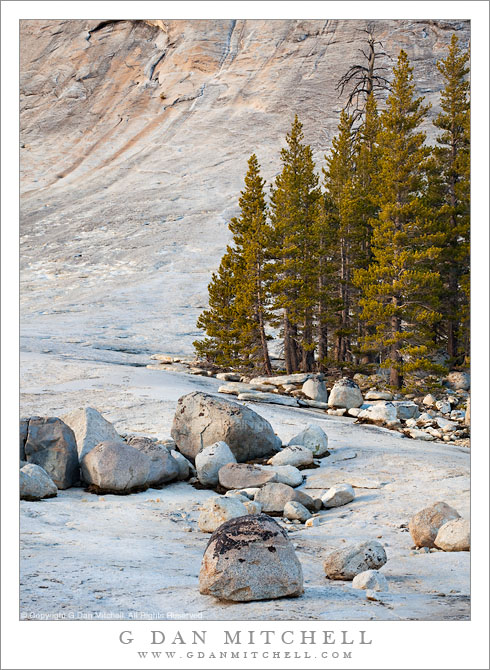
Glacial Erratics and Trees, Lembert Dome

Glacial Erratics and Trees, Lembert Dome

Glacial Erratics and Trees, Lembert Dome. Yosemite National Park, California. June 5, 2010. a© Copyright G Dan Mitchell – all rights reserved.

Glacial erratics and trees at the base of Lembert Dome, Tuolumne Meadows, Yosemite National Park.

This photograph was made last spring in early June, when I drove over Tioga Pass on a quick one-day jaunt right around the time that the road was re-opened for the season after its annual winter closure. The road opened a bit later than usual in 2010 due to above average and late snow fall, and when I crossed there was as much or more snow than I recall seeing up there.

This was one of my marathon drive days. I started well before dawn in the San Francisco Bay Area and arrived in Yosemite in the very early morning and without any concrete plan – except that the ideas of visiting waterfalls and possibly getting up to Tioga Pass were on my mind. I did stop near the Valley first, where I made a series of photographs of Cascade Creek in virtually full flow. After doing this and making a very brief visit to the Valley, I decided to visit the high country along Tioga Pass road. I went just over the pass before turning back. There was so much snow still around that in most places it still looked much more like winter than like early June.

I finally started heading back to the west, as my plan was to return late to the SF Bay Area. As I left the pass and started down toward Tuolumne Meadows the light began to get “interesting” as the sun dropped lower in the west and some high clouds occasionally softened the light. As I drove past Lembert Dome I thought of photographing these glacial erratics that sit on the apron at the bottom of the dome before making one last stop to photograph snow-covered Tuolumne Meadow in the day’s last light.

G Dan Mitchell Photography | Flickr | Twitter | Facebook | Email
Text, photographs, and other media are © Copyright G Dan Mitchell (or others when indicated) and are not in the public domain and may not be used on websites, blogs, or in other media without advance permission from G Dan Mitchell.

Review: “Light & Land” by Michael Frye

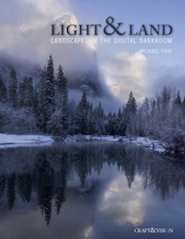
Over the past few weeks I have had the chance to go through Michael Frye’s new ebook, “Light and Land: Landscapes in the Digital Darkroom.” Many are no doubt already aware of Michael’s reputation from his photography, his workshops, and his other publications including his “Photographer’s Guide to Yosemite” and “Digital Landscape Photography: In The Footsteps of Ansel Adams and the Masters.” I have the .pdf version of “Light and Land”, and I understand that an iPad app version may also be available.

Light and Land - Michael Frye

It is typical for photographic “how to” books to focus on specific techniques, and to be organized around a presentation of these techniques – perhaps with a section on curves, a section on black and white conversion, and so forth. This approach has its place, especially for certain types of learners and at certain points in the learning process. It is important to understand the basic techniques and operations that are available in the “digital darkroom” of such programs as Photoshop, Lightroom and so forth. That said, the bigger and more important issue is how to call upon these techniques creatively and effectively and appropriately in order to make photographs. Not all “how to” books do an effective job of illustrating this.

Michael’s “Light & Land” takes a different approach, and one that more accurately and realistically reflects the thought process of a photographer who is calling upon this arsenal of techniques in the service of creating beautiful photographs.  He writes:

“The digital darkroom gives us tremendous control over our images. We can make them lighter, darker, add contrast, change the color balance, increase saturation, turn a color photograph into black and white, remove telephone poles, blend exposures with HDR, combine ten images to capture infinite depth of field, or put a winged elephant in the sky.

But what do we do with these choices?” Continue reading Review: “Light & Land” by Michael Frye