
All posts by G Dan Mitchell

G Dan Mitchell, photographer and visual opportunist focusing on the Pacific coast, the Sierra Nevada, redwood forests, California oak/grasslands, California deserts, urban landscapes, night photography and more. Posting daily photographs since 2005, along with articles, reviews, news, and ideas.

DSLR & Mirrorless: Flexibility and Adaptability

(Note: This is one of those occasional posts adapted from something I originally wrote elsewhere. This one came from an online discussion of the relative merits of DSLRs and mirrorless cameras and their abilities to work with various lenses and photographic subjects. I have edited the original slightly for its re-use here.)

With all of the recent (justifiable!) interest in new mirrorless camera developments from Sony, there are factors that may persuade some photographers to go slow on giving up DSLRs for mirrorless. (It may also convince them to do what I did — I augmented my DSLR system with a second mirrorless system.) As good as mirrorless cameras are becoming, in particular the full frame Sony A7r and newer A7rII, they have their pluses and minuses when it comes to real-world photography. They can do some things quite well – there are advantages in some cases to the electronic viewfinders, Sony sensors provide state-of-the-art dynamic range, the bodies are compact, and more. They do some things less well — native lenses are few, other lenses require adapters, the autofocus systems are slower than DSLRs, there are still latency issues with the viewfinders, and so on.)

In this context, I recently realized that one of the nice things about the new Canon EF 100-400mm f/4.5-5.6L IS II Lens and the newer Canon bodies (like my 5Ds R, which is very similar to the 5Ds)  is that they now autofocus (AF) quite well at f/8. The 100-400 len’s maximum f/5.6 aperture at the long end is no longer a barrier to getting 560mm out of the lens by adding the TC.

I’ve only tried the combination on one occasion so far, when the opportunity to photograph wildlife came up on a recent photography venture along the California coast. I put the 100-400 version II and the Canon 1.4x TC on my 5DsR and photographed two wildlife subjects, elephant seals lounging on a beach and pelicans doing everything from flying past to landing to sitting still. (For those who want more information than I can provide here, I wrote about the initial results in a another article.)

While I do not recommend that people whose primary photographic focus is birds in flight rush out and get a 5Ds or 5Ds R, a 100-400 v2, and a 1.4x TC as their primary setup, it does work decently and in some cases extremely well.  Most importantly, it means that my primary landscape photography setup and can also work very effectively with non-landscape subjects, including wildlife — a task that will severely challenge the best current mirrorless options.
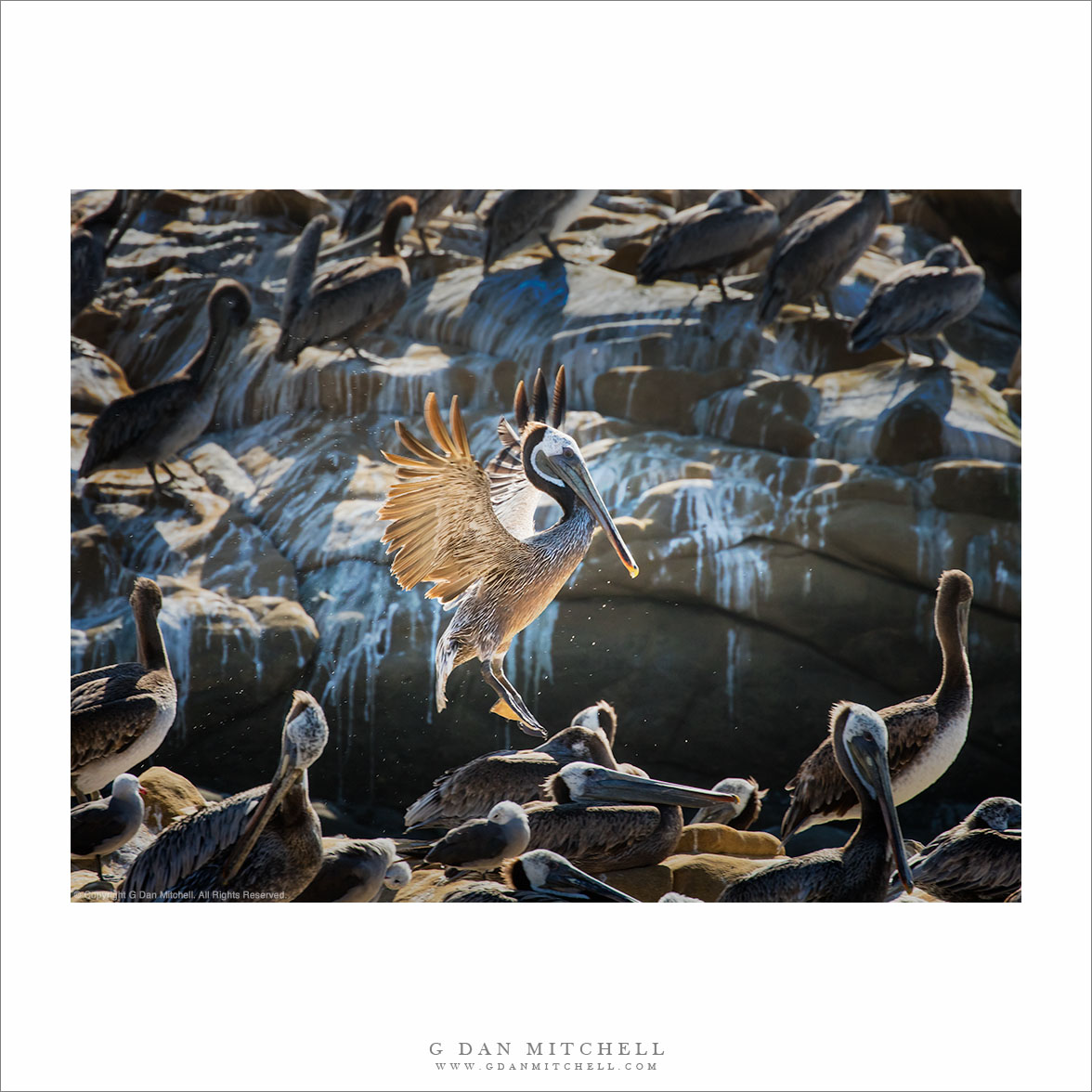
The Landing
“The Landing” — A brown pelican joins the flock on a rock along the Pacific coast of California

The combination focuses well and provides good resolution, even with moving subjects — though, obviously, not as well as using something like a 1Dx with a 300mm f/2.8 prime. It is good enough that I can track birds in flight and catch sharp photographs of them in motion.

Continue reading DSLR & Mirrorless: Flexibility and Adaptability →

Children in Striped Hoodies

Children in Striped Hoodies
Two children in striped hoodies walk along a San Francisco street at night

Children in Striped Hoodies. San Francisco, California. July 25, 2015. © Copyright 2015 G Dan Mitchell – all rights reserved.

Two children in striped hoodies walk along a San Francisco street at night

This is yet another photograph that I don’t actually recall making! Sometimes when shooting street I think I work so quickly and spontaneously that I simple capture an image and move on to the next one without imbedding the specific experience in my memory. This almost certainly was one of those very quickly made photographs, and I only made two exposures of these subjects before moving on to something else.

There is a lot in this photograph, some of which I was likely considering in the moment when I made the photograph and some of which may have been more or less a happy accident. I’m pretty certain that I was attracted to the fact that the two kids were both wearing hoodies with horizontal stripes — perhaps someone’s mother or father had just gone shopping for the two of them? A wonderful bonus was the child on the right (big sister?) putting her arm gently on the shoulder of the other child — her younger brother? Then there are the other bits of color — the blue form on the left (which houses an automated carnival-like figure) and the wildly painted lamp-post on the right. And, yes, there is something a bit disconcerting about seeing two young children alone on the nighttime streets of a big city — at least to this photographer who brought up three such young children.


G Dan Mitchell is a California photographer and visual opportunist. His book, “California’s Fall Color: A Photographer’s Guide to Autumn in the Sierra” is available from Heyday Books and Amazon.
Blog | About | Flickr | Twitter | Facebook | Google+ | 500px.com | LinkedIn | Email


All media © Copyright G Dan Mitchell and others as indicated. Any use requires advance permission from G Dan Mitchell.

A Photograph Exposed: One Subject, Two Compositions

(“A Photograph Exposed” is a series exploring some of my photographs in greater detail. A companion article looks at post processing issues related to the same subject.)

Landscape photographs depend on many things: good fortune to be in the right place at the right time, experience that helps predict when and where to find “right place at the right time,” sensitivity and experience that help you recognize the potential in a scene, being able to think beyond the intrinsic beauty of a scene to consideration of how it might make a photograph, an intuitive sense of “what is right” visually, the ability to apply some objective thought on top of the intuition, and other things in a list that is too long to recount completely.

I would like to share some of the thinking that went into photographing one particular scene earlier this summer.

Island and Trees, Tuolumne River
“Island and Trees, Tuolumne River” — Trees grow on a small ,rocky island in the Tuolumne River, Yosemite National Park

Back in mid-July I experienced a special evening in the Tuolumne Meadows Sierra Nevada of Yosemite National Park. It was special for many reasons — some photographic and some not, but even the non-photographic reasons helped put my mind and my senses in the right place to make photographs. I had arrived and set up camp, taken care of camp chores, and finally headed out for late-afternoon and evening photography. I pulled off the road to take a look at a possible subject, and by remarkable coincidence found myself parked behind two good friends who were there for much the same reason. We joined forces and headed of to a nearby area that seemed promising. In an even more remarkable coincidence, partway there two more friends showed up, also there for the same purpose! Something about hiking off into a beautiful landscape with like-minded friends seems to heighten my awareness.

We followed the Tuolumne River and soon its angle of descent began to increase slightly as its channel narrowed and became more rocky.

Continue reading A Photograph Exposed: One Subject, Two Compositions →

The Landing

The Landing
“The Landing” — A brown pelican joins the flock on a rock along the Pacific coast of California

This photograph has appeared here at my website and in subsequent social media posts already, but merely as an example in a post I shared about some slightly technical matters related to a camera I use. (More on that in a moment.) Since I feel like the photograph stands not only as an example of how a lens and a camera work, but also as a photograph, this time I’m sharing it for the latter reason. We had spent a couple of days in the Monterey and Big Sur area, photographing along that spectacular coastline, and now we were headed home. We decided to work our say north along the coast, eventually turning inland just south of San Francisco.

Just before that homeward turn we passed a small, rocky island just a few yards off the actual coast, and I realized that it was covered with many scores of brown pelicans. I love photographing these birds, and it is somewhat unusual to see so many in one place, so we stopped and walked out to the bluff to make some photographs. The light was challenging since it was coming from almost directly behind the birds — but in this case that worked well as there is a light fringe around the bird, some light comes through its wing feathers, and additional light reflects back up from surf and rocks as this pelican lands. Oh, and that technical article? I made this photograph with a pretty unusual “birding” setup — the 50.6MP Canon EOS 5Ds R with a 100-400mm zoom lens with a 1.4x teleconverter attached!


G Dan Mitchell is a California photographer and visual opportunist. His book, “California’s Fall Color: A Photographer’s Guide to Autumn in the Sierra” (Heyday Books) is available directly from him.

G Dan Mitchell: Blog | Bluesky | Mastodon | Substack Notes | Flickr | Email


All media © Copyright G Dan Mitchell and others as indicated. Any use requires advance permission from G Dan Mitchell.