G Dan Mitchell, photographer and visual opportunist focusing on the Pacific coast, the Sierra Nevada, redwood forests, California oak/grasslands, California deserts, urban landscapes, night photography and more. Posting daily photographs since 2005, along with articles, reviews, news, and ideas.
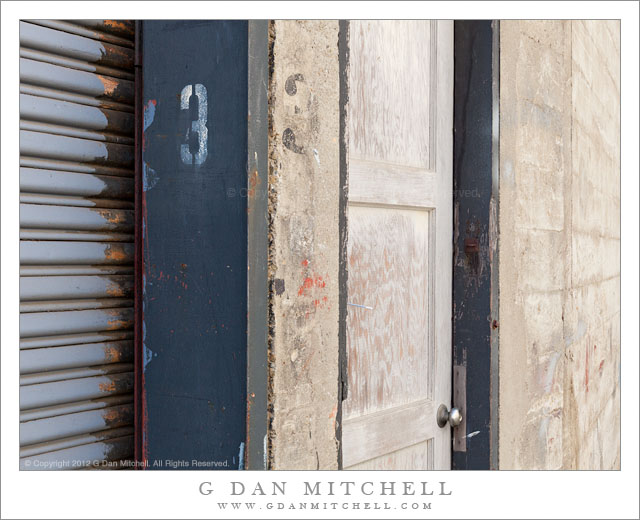
A loading dock door (#3) and a dilapidated and worn side door in a concrete wall, San Francisco.
There is not a whole lot to write about this photograph, except that it is another in a sequence of photographs that I made in a small alley off of the Embarcadero in San Francisco, an alley that extends between buildings toward the waterfront and which has often been locked up when I have walked by there previously. Since it and several similar alley ways were open on this morning, I took the opportunity to wander into them and photograph some of the old buildings that sit on these waterfront piers, focusing mostly on small details.
G Dan Mitchell is a California photographer whose subjects include the Pacific coast, redwood forests, central California oak/grasslands, the Sierra Nevada, California deserts, urban landscapes, night photography, and more. Blog | About | Flickr | Twitter | Facebook | Google+ | 500px.com | LinkedIn | Email
The full moon rises through thin clouds above sandstone towers, Arches National Park.
This was a very challenging evening for photography, but I’m happy with some of the results nonetheless. We had gone into Arches National Park and made it to the first big group of arches and other formations not far from what I recall was identified as Balancing Rock. Not far from here there is an impressive amphitheater of red rock sandstone, and all through this area a truly astonishing number of arches of various forms and sizes may be found. Since it was late in the day, we figured we would stake out our ground for golden hour and dusk shots right around here.
However, there were a few challenges. First, we were arriving at this spot for the very first time, with no previous research, and it was basically time to start shooting right about now! There was little to no time for scouting, so I headed up a trail towards a likely looking area of sandstone to see what I could find as the sunset approached. I soon discovered a second issue, or perhaps realized that an issue I had known about was going to be more challenging than I had hoped – it was very windy! As the light dims this becomes more of a problem as exposures necessarily lengthen. At some point, there is virtually no tripod that is steady enough, even when weighted, to hold a camera and lens rock steady in a near gale. I have some tricks up my sleeve though, and eventually I searched out some camera positions that were sheltered by rock towers and walls. By this time, the sun had dropped below the horizon and I was now shooting it twilight, which can provide some of the most beautiful light of the day when the right sort of “glow” occurs. It turned out that the full moon was just rising, though not over the main, iconic formations. There is usually a narrow window of exposure opportunity for photographing the moon. The moon is hard to shoot effectively in full daylight, but after dark it is far too bright for the ambient light – so one ideal is to shoot it in this time right around dusk when there is just the right balance of moon light and ambient light. Lucky for me, high thin clouds moved across the sky to the east and moderated the brightness of the full moon, allowing me to continue shooting in darker conditions so that I could make this exposure of the moon rising above nearby sandstone formations.
G Dan Mitchell is a California photographer whose subjects include the Pacific coast, redwood forests, central California oak/grasslands, the Sierra Nevada, California deserts, urban landscapes, night photography, and more. Blog | About | Flickr | Twitter | Facebook | Google+ | 500px.com | LinkedIn | Email
Recently I read a post in a photography forum in which a poster asked for advice concerning selection of a back-up camera body. If you do a lot of photography, eventually you will have gear fail on you. The last time this happened to me, my EOS 5D developed a shutter problem with no prior warning. In the middle of a night photography shoot the camera simply stopped working. I had no backup camera at that point, so my shoot was over – after driving nearly two hours to the location and making two exposures I packed up and drove two hours back home. If you shoot in remote locations, as I often do, or if you find yourself in other situations in which being unable to shoot isn’t an option, you need a backup camera strategy. (You might also want to consider how you would deal with a lens failure, too, though there are more ways to work around that possibility if you usually carry more than one lens.)
Rather than re-writing the whole thing, what follows is the text of my reply to that forum poster – with just a few contextual edits here and there. Note that I refer to Canon products, since that is what I use, but that equivalents from other manufacturers could replace those I mention.
(The original poster’s message/question is not included here, but he was essentially musing about whether to use an existing camera as a “backup” body, buy a second copy of one of his current cameras, or use some other strategy.)
I wrote, more or less…
This gets at what I regard as the primary question here: “What is the role of the back-up camera in the [your] shooting?”
I see that the Canon EOS 5D Mark III Digital Camera Kit with Canon 24-105mm f/4L IS USM AF Lens is back in stock at site-sponsor B&H Photo. The camera was recently announced, but initially was very hard to find – and then became virtually impossible to find while Canon was dealing with some inevitable first-batch issues. But it sounds like those issues have now been resolved, and the camera is again becoming available.
The 5D3 is in some ways very similar to the previous model, the 5D2. The MP count is only very slightly higher – and the small increase won’t have any practical effect on still photographs. Whether a full-frame DSLR has 21MP or 22MP, in the hands of a skillful photographer it will be capable of producing photographs that can be printed quite large. The 5D3 does build in the 5D2 and it offers real improvements – to mention two, the new camera has an upgraded auto-focus system and a significantly higher frame rate. Features like these expand the camera’s useful to encompass a wider range of photographic subjects and situations.
I use the 24-105mm f/4 L IS zoom that is include in this bundle. For most people looking for a first lens for this camera, the 24-105 is likely to be the best option. It provides excellent image quality, image-stabilization, and a usefully large focal-length range. For many types of photography it can be sufficient all by itself.
G Dan Mitchell is a California photographer whose subjects include the Pacific coast, redwood forests, central California oak/grasslands, the Sierra Nevada, California deserts, urban landscapes, night photography, and more. Blog | About | Flickr | Twitter | Facebook | Google+ | 500px.com | LinkedIn | Email
Photographer and visual opportunist. Daily photos since 2005, plus articles, reviews, news, and ideas.
Manage Consent
To provide the best experiences, we use technologies like cookies to store and/or access device information. Consenting to these technologies will allow us to process data such as browsing behavior or unique IDs on this site. Not consenting or withdrawing consent, may adversely affect certain features and functions.
Functional
Always active
The technical storage or access is strictly necessary for the legitimate purpose of enabling the use of a specific service explicitly requested by the subscriber or user, or for the sole purpose of carrying out the transmission of a communication over an electronic communications network.
Preferences
The technical storage or access is necessary for the legitimate purpose of storing preferences that are not requested by the subscriber or user.
Statistics
The technical storage or access that is used exclusively for statistical purposes.The technical storage or access that is used exclusively for anonymous statistical purposes. Without a subpoena, voluntary compliance on the part of your Internet Service Provider, or additional records from a third party, information stored or retrieved for this purpose alone cannot usually be used to identify you.
Marketing
The technical storage or access is required to create user profiles to send advertising, or to track the user on a website or across several websites for similar marketing purposes.