“Desert Gold Field” — Late afternoon light on field of desert gold wildflowers in southern Death Valley.
A day or two ago I thought that I was finished with the photographs from our late-February visit to Death Valley. But I decided to make another pass at the raw files from the trip, and I found a few more photographs that I think help fill out the story of this trip. (Update: Since I wrote that I have found even more!) The highlights — and my primary photographic targets — were the exceptional wildflower bloom and Lake Manly. Here’s another of the wildflower photographs, one which illustrates the extent of some of the larger fields of color.
If you visit this spot during most of the year you might not notice much vegetation at all. Aside from a few bushes, it would mainly give the appearance of a gentle gravel slope. But in February the desert gold plants were taking full advantage of the season’s above-normal rainfall, and some places like this one were more or less carpeted with colorful flowers.
“Four Desert Star Flowers” — Four tiny desert star (monoptilon bellioides) flowers, Death Valley.
The desert star flower has become a bit of a… star here at the blog recently. It is one of the small flowers that you might easily overlook in Death Valley, but once you spot them they are abundant, poking up just above the ground, often in small groups. They are pretty flowers, but you have to get down close to the ground to appreciate them.
Big fields of wildflower color get the attention of visitors to Death Valley in a year like this, when earlier rains produced an impressive wildflower bloom. At the end of February we saw whole hillsides covered with desert gold and phacelia, and sand verbena covered the ground in some low places. But a closer look reveals a world of other small and inconspicuous flowers like the desert star.
“Wildflowers, Playa, and Mountains” — Desert gold blooms on gravel hills backed by Death Valley playa and desert mountains.
This was one of the first photographs I made on our late-February visit to Death Valley National Park. It was literally the first time I took the camera out after arriving, and the second exposure I made. We had entered the Valley, crossed it, and were starting our drive toward Beatty, Nevada. I felt that the scene encapsulated the scale of this valley and the surrounding desert mountains, and the patch of desert gold flowers was the icing on the cake.
When arriving at a location after a very long drive, it can be tempting to just set up camp or go to the hotel and crash. But I prefer to take the camera out and at least “prime the pump” by making a few photographs. That helps get things going, and marks my switch to photographer mode for the rest of the visit.
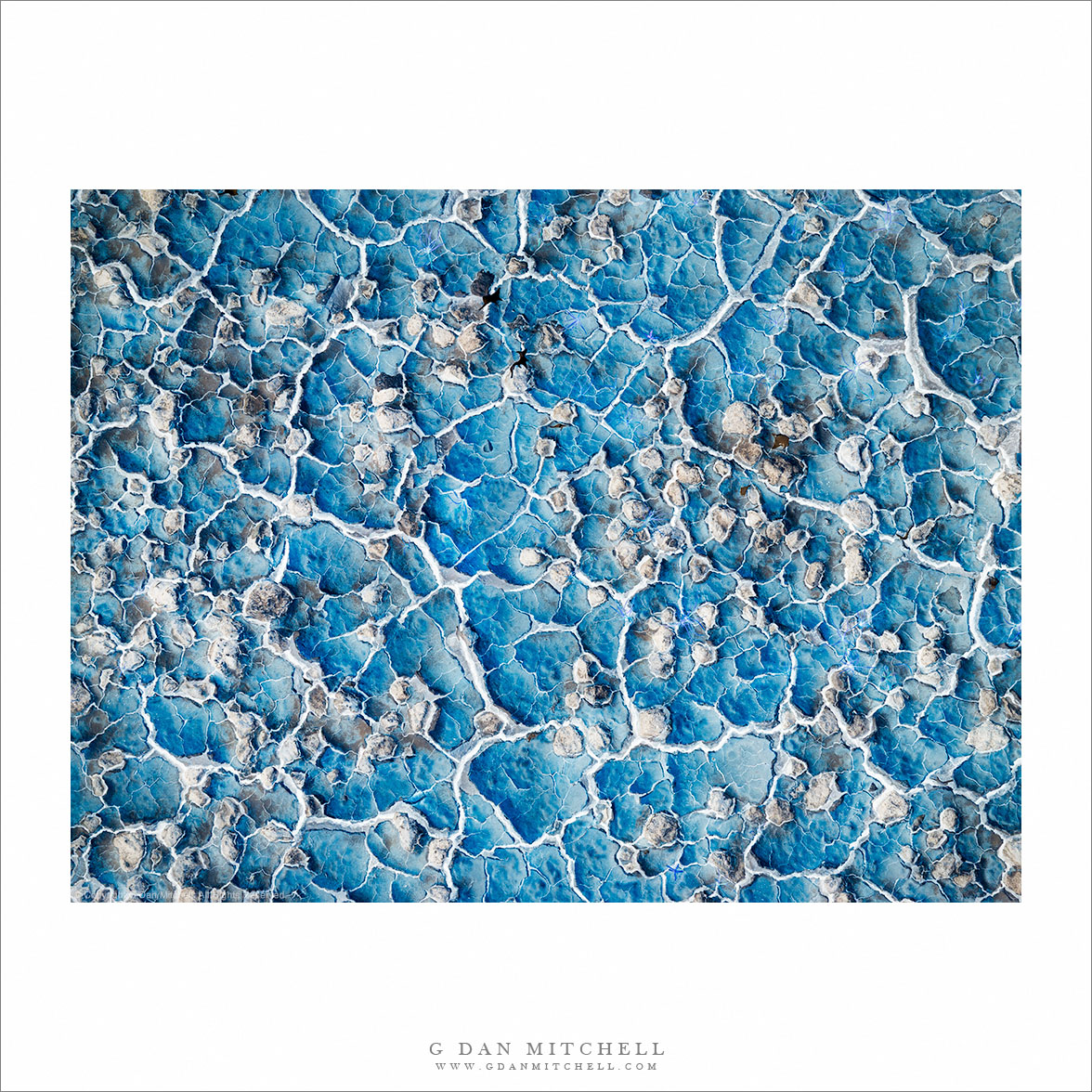
“Blue Playa” — Intensely blue dry mud on Death Valley’s hidden “Blue Playa.”
I have photographed in Death Valley National Park for almost three decades. I have heard whispered rumors of this remarkable “Blue Playa” for years, but no one would share anything definite about it. All I knew was that somewhere in a remote and seldom-visited area of this vast park there was purportedly a small playa featuring astonishingly colorful soil which, in the right lighting conditions, is so blue that it rivals the color of a clear sky. This has been on my mind for years.
Since those who know weren’t talking, it was clear that I’d have to do some sleuthing. All I knew was that the place is remote, surrounded by difficult mountains, and not terribly large. Out of respect for the feature — and concern about potential damage should the location become widely known — I’m going to omit specific details. But here’s as much of the story as I can share publicly.
Photographer and visual opportunist. Daily photos since 2005, plus articles, reviews, news, and ideas.
Manage Consent
To provide the best experiences, we use technologies like cookies to store and/or access device information. Consenting to these technologies will allow us to process data such as browsing behavior or unique IDs on this site. Not consenting or withdrawing consent, may adversely affect certain features and functions.
Functional
Always active
The technical storage or access is strictly necessary for the legitimate purpose of enabling the use of a specific service explicitly requested by the subscriber or user, or for the sole purpose of carrying out the transmission of a communication over an electronic communications network.
Preferences
The technical storage or access is necessary for the legitimate purpose of storing preferences that are not requested by the subscriber or user.
Statistics
The technical storage or access that is used exclusively for statistical purposes.The technical storage or access that is used exclusively for anonymous statistical purposes. Without a subpoena, voluntary compliance on the part of your Internet Service Provider, or additional records from a third party, information stored or retrieved for this purpose alone cannot usually be used to identify you.
Marketing
The technical storage or access is required to create user profiles to send advertising, or to track the user on a website or across several websites for similar marketing purposes.