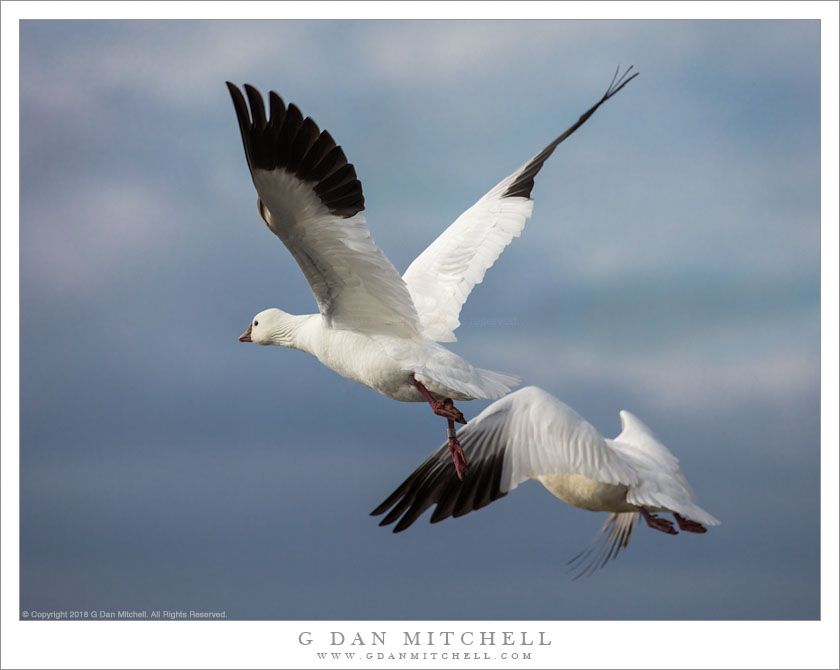
First, I do know how to make sharp photographs of birds, too… ;-)
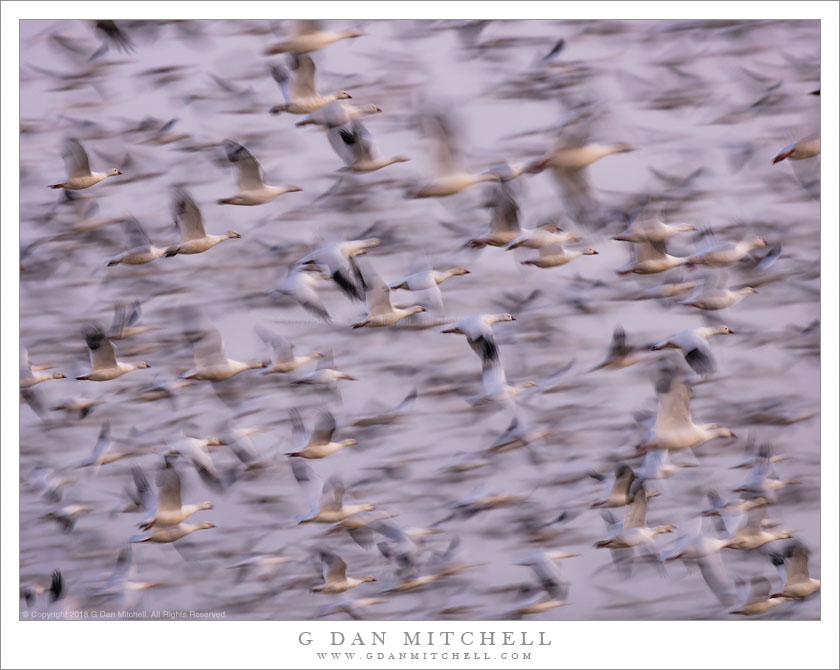
There are many things I can’t really explain about winter bird populations. But as I have watched them (and listened to their remarkable sound) from Washington to California, I am starting to at recognize a few more patterns. At times some birds become increasingly active, and at the end of the day, as light fades, there may be opportunities to depict the motions of individual birds and flocks in a different way — rather than trying to stop motion I just go with longer shutter speeds, pan with groups as they fly by, and let the motion blur take over. Frankly, in many ways I think that this confusing blur may better evoke the wild actions of these evening flocks.
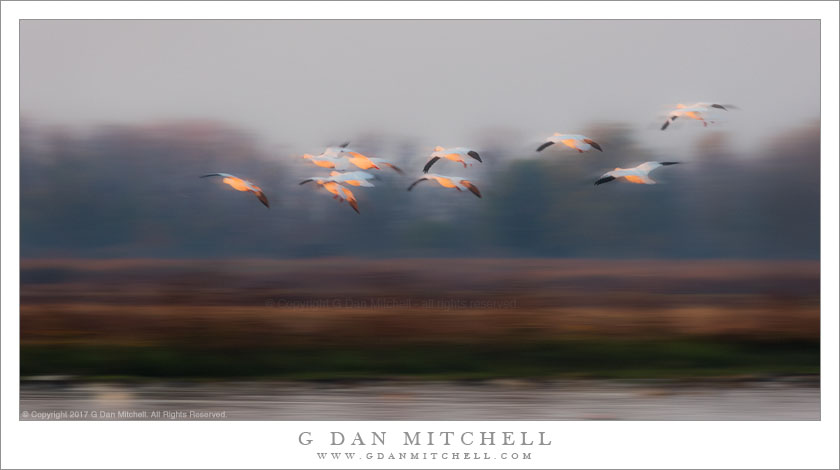
A small group of geese takes flight in evening light
There are many ways to photograph birds: sharp images of birds filling the frame that reveal the details of color and shape and feathers, landscape photographs that show them in the worlds they inhabit, shots that capture them social groups ranging form groups of a few individuals up to flocks of many thousands, captures of them engaging in particular behaviors, and much more. (I’m occasionally amused by discussions of “the way” to photograph birds of or “the right” equipment to do this.)
This flock of geese suddenly took to the air as the very last golden hour light shone across this hazy landscape, and the birds were partially illuminated by the colors of the warm sunset light, but against the less vibrant colors of the local surroundings. A sharp-edged photograph was a possibility, but here I think the abstracting blur of camera motion and fast-flying birds may better suggest the feeling of the scene.
There is something primal about being among these migratory birds, at least if you stop to ponder. They come to my part of the world every winter, settling in to wetland areas in California. But the opposite end of their remarkable migration is along the arctic shorelines of northern Canada, an annual migration that is astonishing to imagine. (Wikipedia tells me that the majority of the world’s Ross’s geese nest in the arctic tundra of the Queen Maud Gulf Migratory Bird Sanctuary.) To spend time with them is to become open to a world that is not the human world, one in which we are temporary visitors and in which they are the permanent residents.
Getting close to such birds requires a lot of patience and persistence. The first problem is managing to be in the places they frequent when they are actually there, and these could be almost anywhere. I’ve gone to such places only to find no geese or, perhaps more frustrating, spot a cloud of thousands of geese in the air a mile or more in the distance and at a location I can’t go to. Once you do find them, you can only get so close and then you must wait for them to come to you — either as the flock moves across the land or as they fly. Sometimes, with luck and a bit of prediction, you find yourself quite close, at which point you move slowly and quietly and hope to sustain the experience. On this afternoon a flock settled onto a levee across which my route travelled. I moved slowly into a close position and then waited, occasionally moving just a bit closer if it seemed that the flock wasn’t alerted by my presence. I made many photographs of them on the ground, and then — as always happens — they began to depart, suddenly lifting into the air in groups.
Photographer and visual opportunist. Daily photos since 2005, plus articles, reviews, news, and ideas.
Manage Consent
To provide the best experiences, we use technologies like cookies to store and/or access device information. Consenting to these technologies will allow us to process data such as browsing behavior or unique IDs on this site. Not consenting or withdrawing consent, may adversely affect certain features and functions.
Functional
Always active
The technical storage or access is strictly necessary for the legitimate purpose of enabling the use of a specific service explicitly requested by the subscriber or user, or for the sole purpose of carrying out the transmission of a communication over an electronic communications network.
Preferences
The technical storage or access is necessary for the legitimate purpose of storing preferences that are not requested by the subscriber or user.
Statistics
The technical storage or access that is used exclusively for statistical purposes.The technical storage or access that is used exclusively for anonymous statistical purposes. Without a subpoena, voluntary compliance on the part of your Internet Service Provider, or additional records from a third party, information stored or retrieved for this purpose alone cannot usually be used to identify you.
Marketing
The technical storage or access is required to create user profiles to send advertising, or to track the user on a website or across several websites for similar marketing purposes.

 G Dan Mitchell is a California photographer and visual opportunist. His book, “California’s Fall Color: A Photographer’s Guide to Autumn in the Sierra” is available from Heyday Books and Amazon.