
Category Archives: Photographs: Nature

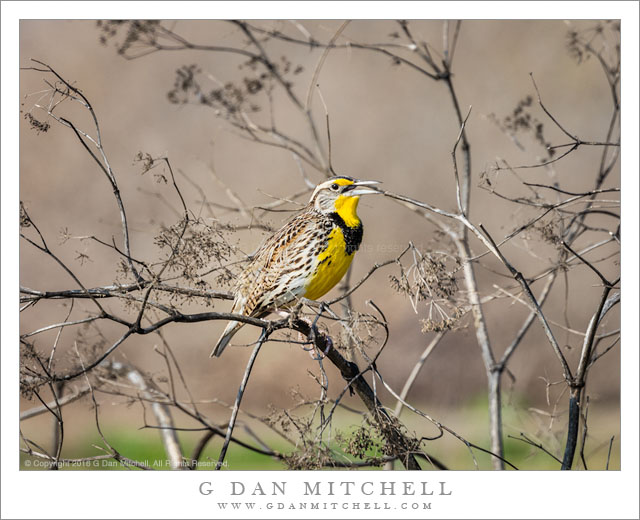
Western Meadowlark

Western Meadowlark
Western Meadowlark perched in San Joaquin Valley branches

Western Meadowlark. San Joaquin Valley, California. February 15, 2016. © Copyright 2016 G Dan Mitchell – all rights reserved.

Western Meadowlark perched in San Joaquin Valley branches

I’m going to indulge my bird photograph collection interest and share what is really just a photograph of another little bird! This beautiful little bird was a side attraction I found during a recent visit to the California Central Valley to mainly photograph geese and cranes, plus the odd heron and egret.

Photographing the larger birds is an experience that often vacillates between moments of wildly photographing as birds fly above, or as huge flocks take to the sky, and then long periods of not doing much at all — waiting for birds, trying to figure out where the birds are, moving to another location to find birds, and so forth. But I’ve found that when I keep my eyes open I find interesting things that aren’t what I was initially looking for. That was the case with this yellow western meadowlark, which was standing in some brush alongside a perimeter road at a wildlife refuge and which I just happened to spot while passing by.


G Dan Mitchell is a California photographer and visual opportunist. His book, “California’s Fall Color: A Photographer’s Guide to Autumn in the Sierra” is available from Heyday Books and Amazon.
Blog | About | Flickr | Twitter | FacebookGoogle+ | 500px.com | LinkedIn | Email


All media © Copyright G Dan Mitchell and others as indicated. Any use requires advance permission from G Dan Mitchell.
Bald Eagle

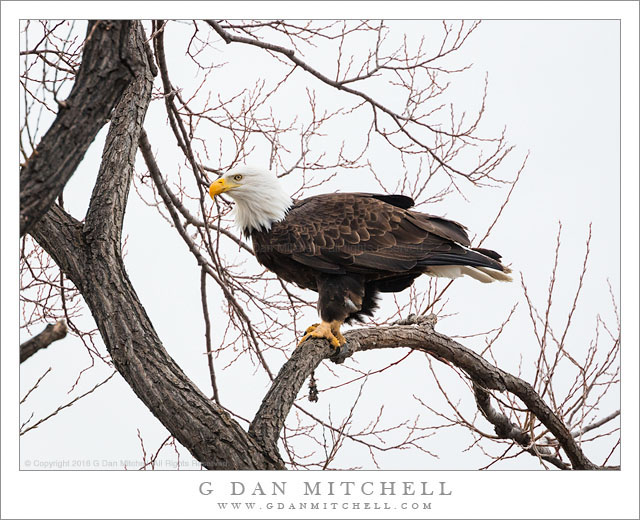
Bald Eagle
A bald eagle perches in a tree

Bald Eagle. Klamath Basin, California. February 13, 2016. © Copyright 2016 G Dan Mitchell – all rights reserved.

A bald eagle perches in a tree.

I rarely see bald eagles in my home territory in the San Francisco Bay Area, so seeing them when I travel is a special treat. This area of the Klamath Basin that I visited in mid-February is known for them — in fact there is one refuge in the area that is off-limits to humans, specifically so that these magnificent birds can flourish without being disturbed. As I was out in a refuge on afternoon and driving along a levee I spotted a group of people stopped ahead. I slowed down and approached slowly, not wanting to disturb whatever they say, and I soon saw the very big eagles nest up in one of the trees. Soon I saw that there were two eagles in the tree, and I made some initial photographs.

I returned to the area again the next evening, this time with a better organized plan. Sure enough, both eagles were again out and about in the are of their nest, alternating between perching in the nest and heading out to hunt. At one point this eagle returned from a hunt, but instead of going to the nest and sharing its prize, the bird perched on a branch a few hundred feet from where its partner was in the next and it proceeded to feast on something it had caught. This provided an excellent opportunity to get a relatively close (with a long telephoto) and unobstructed view of the bird. After eating, the eagle tore some trigs and small branches from the tree and flew off to carry them back to the nest — as if to say, “Sorry, no food. But I did bring something nice for the house.”


G Dan Mitchell is a California photographer and visual opportunist. His book, “California’s Fall Color: A Photographer’s Guide to Autumn in the Sierra” is available from Heyday Books and Amazon.
Blog | About | Flickr | Twitter | FacebookGoogle+ | 500px.com | LinkedIn | Email


All media © Copyright G Dan Mitchell and others as indicated. Any use requires advance permission from G Dan Mitchell.
Geese, Field, Twilight

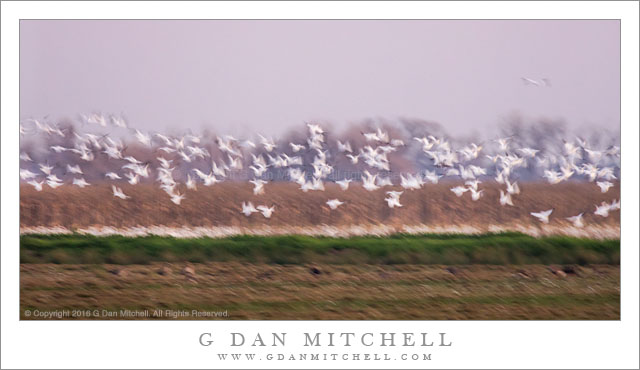
Geese, Field, Twilight
Ross’s geese fly above winter fields at twilight

Geese, Field, Twilight. San Joaquin Valley, California. February 15, 2016. © Copyright 2016 G Dan Mitchell – all rights reserved.

Ross’s geese fly above winter fields at twilight

The edges of the day are the most magical times in these Central Valley wetlands — from the thick morning tule fog that hides everything from sight and mutes sound, to the hazy evening twilight as the light decreases and takes on the dusk colors. A huge flock of geese was mostly settled in on this newly mown corn field, but every so often they would suddenly take flight and pass back and forth above the fields before settling down once again.

By the time this group flew past the light was failing quickly. I had a long lens on my camera, hardly the right thing for sharp photographs in deep twilight, and even pushing my ISO left me with very low shutter speeds. At this point, rather than fight, I go with the long shutter speeds and have a few final minutes working with the long exposure blur, tracking the flock but letting their motion and the background blur into abstract forms.


G Dan Mitchell is a California photographer and visual opportunist. His book, “California’s Fall Color: A Photographer’s Guide to Autumn in the Sierra” is available from Heyday Books and Amazon.
Blog | About | Flickr | Twitter | FacebookGoogle+ | 500px.com | LinkedIn | Email


All media © Copyright G Dan Mitchell and others as indicated. Any use requires advance permission from G Dan Mitchell.
Tundra Swans, Mount Shasta

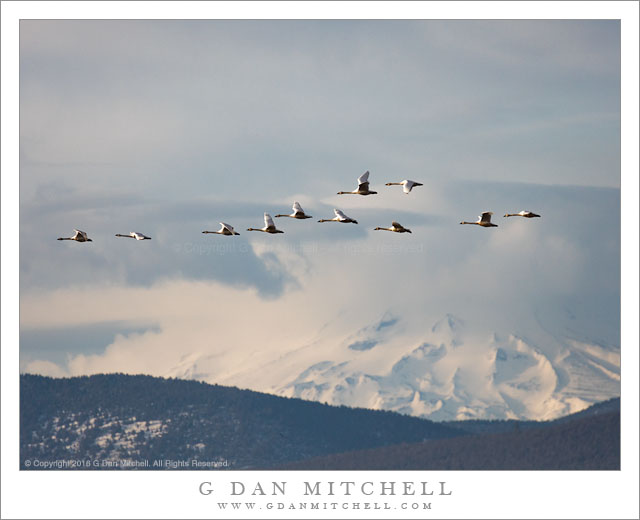
Tundra Swans, Mount Shasta
Tundra swans fly in front of distant cloud-shrouded Mount Shasta

Tundra Swans, Mount Shasta. Klamath Basin, California. February 12, 2016. © Copyright 2016 G Dan Mitchell – all rights reserved.

Tundra swans fly in front of distant cloud-shrouded Mount Shasta

Mount Shasta is one of those special mountains that stands alone and above all around it. In land that rarely exceeds a few thousand feet in elevation, this peak soars to over 14,000′, only a bit shorter than Mount Whitney, the tallest peak in the Lower 48 States. While Mount Whitney is nestled into a very high section of the Sierra Crest, along with other peaks and ridges of nearly the same height, nothing near Shasta is remotely near as tall. Its bulk soars above the rest of the landscape, especially when it is covered in winter snows — and the clouds that build over its summit can make it seem even larger. As we like to point out, the peak is so big that it makes its own weather.

The peak is clearly visible from this area of the Klamath Basin, and it is the first thing to catch the morning light. While out in this immense valley photographing tundra swans I noticed that some flocks along the far side of the valley were passing in front of the peak, and I started tracking them to see if any would cross the mountain at the right elevation. As I saw a flock far to my northwest, I would begin to track it along the horizon, hoping that it would pass in front of the peak and be high enough to clear the lower and darker mountains, yet not so high as to be far above the peak.


G Dan Mitchell is a California photographer and visual opportunist. His book, “California’s Fall Color: A Photographer’s Guide to Autumn in the Sierra” is available from Heyday Books and Amazon.
Blog | About | Flickr | Twitter | FacebookGoogle+ | 500px.com | LinkedIn | Email


All media © Copyright G Dan Mitchell and others as indicated. Any use requires advance permission from G Dan Mitchell.