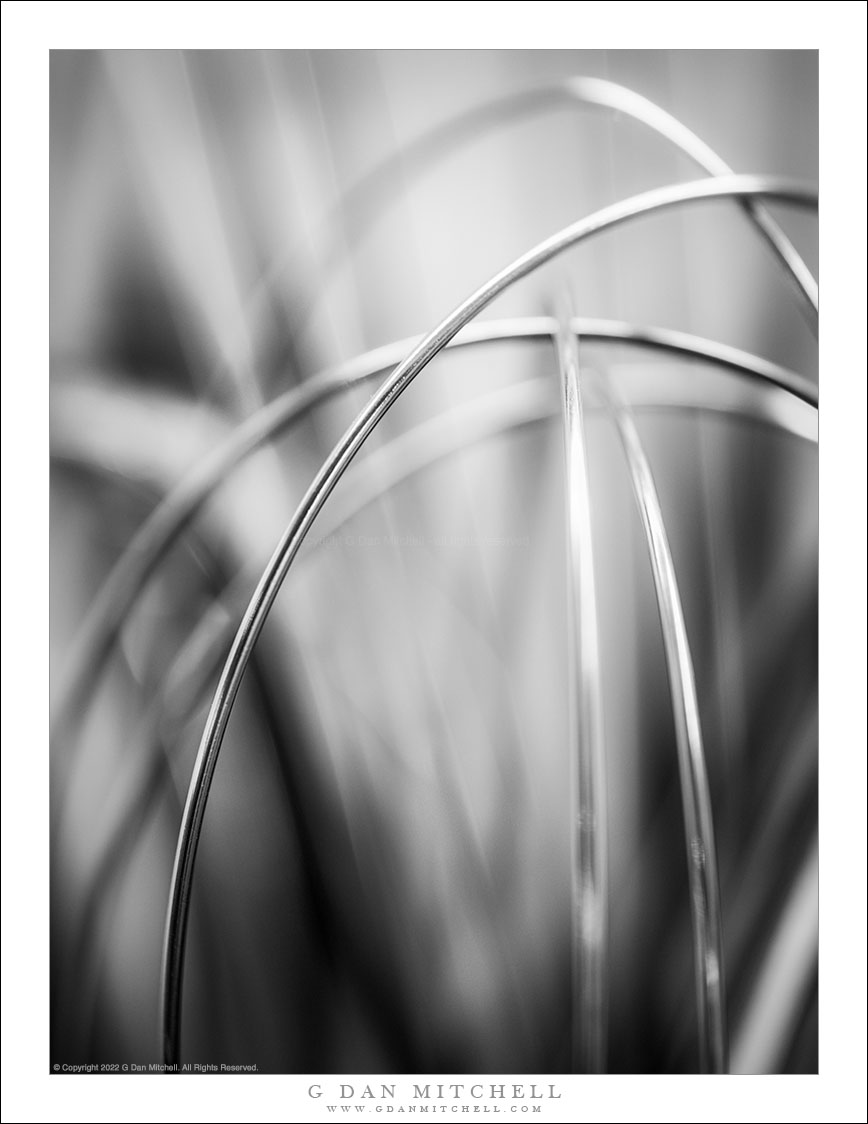
“Kitchen Tools #1” — Close up photograph of kitchen implements.
Indeed, I made more than one photograph in the kitchen this week. Will this be a new stylistic direction in my photography? Stay tuned and find out! Like yesterday’s photograph, this subject was on the kitchen counter. I needed something to test out a new camera with a macro lenses, no tiny bugs were handy, so here we are.
As I pondered these two kitchen photographs it stuck me that the patterns, especially with all of the soft blur in the images, reminded me of some close-up photograph s I have made of grasses and similar plants.
G Dan Mitchell is a California photographer and visual opportunist. His book, “California’s Fall Color: A Photographer’s Guide to Autumn in the Sierra” (Heyday Books) is available directly from him.
When looking for subjects to test (otherwise know as “get to know”) a new camera or lens, it is amazing what things one can find to photograph! This week I’m trying to get up to speed on a new camera — more about that below — and how it works with some lenses I already have. On this evening I slapped a macro lens on the thing and headed to the kitchen to photograph… a whisk, blender blades, coffee cups, and others stuff that was lying around.
It is important to me to both understand objectively how my camera equipment functions and to develop an intuitive familiarity with it. The former helps me make smart decisions, and the latter is very important in the field, where I don’t want to get stuck wondering how the gear works. In this case, the new equipment is a Fujifilm X-T5 that I got to upgrade from the XPro2 that I’ve been using for my “small camera” photography for the past few years. For this photograph and a few others like it I put the Fujifilm 80mm macro on the camera.
G Dan Mitchell is a California photographer and visual opportunist. His book, “California’s Fall Color: A Photographer’s Guide to Autumn in the Sierra” is available from Heyday Books, Amazon, and directly from G Dan Mitchell.
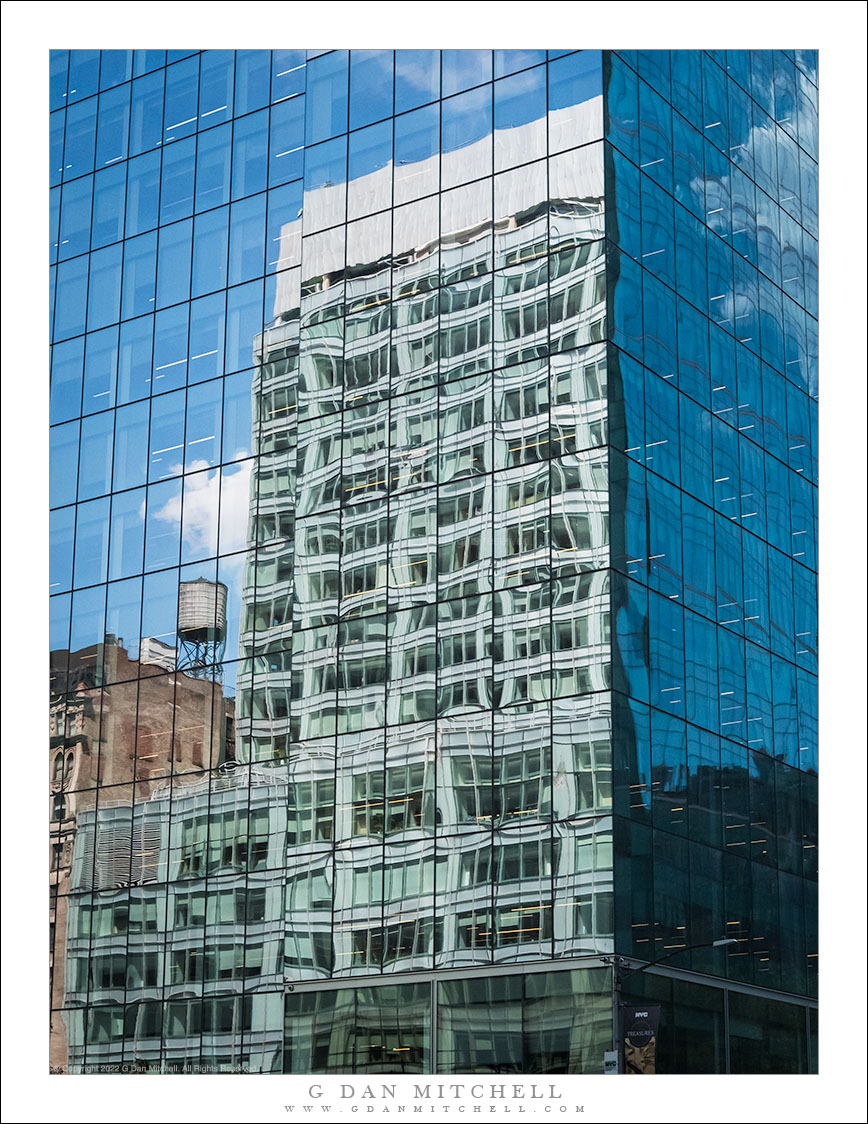
The glass surface of a New York building reflects and distorts its surroundings.
Scenes like this are, of course, common in big urban centers that are filled with tall, modern buildings. This one comes from Manhattan. One striking difference between many new buildings and those from a much earlier era is that today the surfaces are often nearly 100% windows and, as such, the buildings are extremely reflective. A few years ago it occurred to me how odd it is that what we see when we look at these buildings today is mostly not the buildings at all. The building is essentially invisible beyond the slender outlines of frames between windows. The “surface” we see is composed of other things — sky, clouds, other buildings — that are distorted by the qualities of the reflective surface. (I have an idea for a photo project: Remove all of the reflective surfaces from images of these buildings, leaving only the minimal structural elements that are actually visible.)
These buildings are one reason that I often refer to these places and photographs of them as “urban landscapes. There is a continuum in landscape photography. At one end lies subjects that are entirely “natural” — or at least seem to be so. Somewhere in between we enter the realm of historic landscape paintings, in which it was common to include the human presence. Continue along that trajectory far enough, and it is possible to see cities as being just a different sort of landscape, and that way of seeing leads to different ways of photographing them.
G Dan Mitchell is a California photographer and visual opportunist. His book, “California’s Fall Color: A Photographer’s Guide to Autumn in the Sierra” is available from Heyday Books, Amazon, and directly from G Dan Mitchell.
Support structures under the Henry Hudson Parkway, Manhattan.
While things in New York City are not as grim as they were during the height of the pandemic, nor as bad as when we visited during the Omicron surge last winter, things are not yet completely back to normal. A lot better, yes. But when we visited in August the effects were still clear. People were back in the streets, but the crowds weren’t nearly as dense as before. And we still hesitated to go to some of the more crowded places that we enjoyed previously. So, on this afternoon we found ourselves killing time between a couple of planned events, so we took a walk over to and along a section of the Hudson River shoreline.
In this location sidewalks, paths, and stairs can take you down from the city itself of a riverside walkway and park, so we headed on down to join the others out for a walk, a run, or a bike ride. As the path descended it approached the base of this old structure that supports the parkway running along the waterfront. In a world of modern, sweeping and curving reinforced concrete structures, it is fun and interesting to come across older steel structures like this one.
G Dan Mitchell is a California photographer and visual opportunist. His book, “California’s Fall Color: A Photographer’s Guide to Autumn in the Sierra” is available from Heyday Books, Amazon, and directly from G Dan Mitchell.
Photographer and visual opportunist. Daily photos since 2005, plus articles, reviews, news, and ideas.
Manage Consent
To provide the best experiences, we use technologies like cookies to store and/or access device information. Consenting to these technologies will allow us to process data such as browsing behavior or unique IDs on this site. Not consenting or withdrawing consent, may adversely affect certain features and functions.
Functional
Always active
The technical storage or access is strictly necessary for the legitimate purpose of enabling the use of a specific service explicitly requested by the subscriber or user, or for the sole purpose of carrying out the transmission of a communication over an electronic communications network.
Preferences
The technical storage or access is necessary for the legitimate purpose of storing preferences that are not requested by the subscriber or user.
Statistics
The technical storage or access that is used exclusively for statistical purposes.The technical storage or access that is used exclusively for anonymous statistical purposes. Without a subpoena, voluntary compliance on the part of your Internet Service Provider, or additional records from a third party, information stored or retrieved for this purpose alone cannot usually be used to identify you.
Marketing
The technical storage or access is required to create user profiles to send advertising, or to track the user on a website or across several websites for similar marketing purposes.