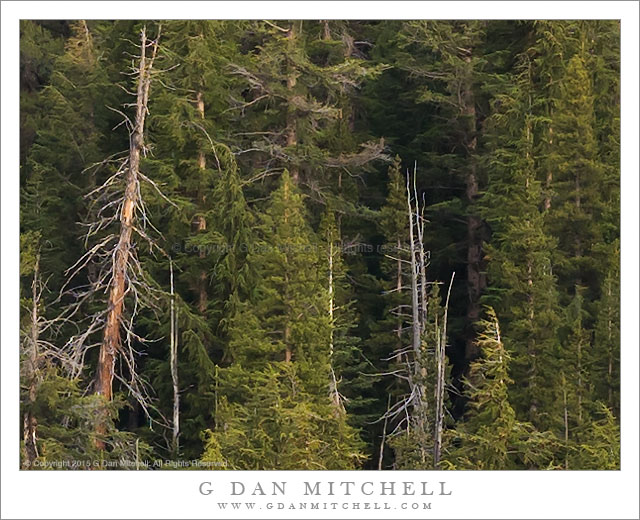
The Canon 5Ds R — Dynamic Range Examples

Updated August 13, 2015 to add a second dynamic range adjustment example.

Ongoing development and refinement of digital camera technology continues to improve cameras and the technical quality of the images they produce. Color accuracy improves, dynamic range expands, sensor resolution increases, AF accuracy gets better, and so on.

The Canon EOS 5Ds and the Canon EOS 5Ds R continue this process. Their most notable feature is the 50.6 megapixel (MP) sensor, currently the highest sensor photo site density available on full frame digital cameras. (Nikon and Sony both produce 36MP sensor cameras using Sony sensors, and Sony has introduced a camera with a 42MP sensor. Note that the differences between 36MP, 42MP, and 50.6MP are less than you might expect.)

When it comes to dynamic range — the ability of the sensor to record a wide range of luminosity levels from very bright to quite dark in a single exposure — Sony is the current champion, and cameras using their sensors have the largest available dynamic range among comparable cameras. (Some MF cameras have more dynamic range capability than any current full frame camera. )

(All current digital cameras capture images with more dynamic range than we can display on monitors or in prints — the display media cannot keep up with the capture technology. Consequently, the primary advantage of greater dynamic range comes in post-production, where the photographer will find more useful scene data in darker areas that can be “pushed” or otherwise recovered while maintaining useful image quality.)

If you can get more dynamic range without giving up anything else, there is no reason not to have it. In marginal situations, that extra bit of dynamic range might enable you to get a bit more image data in a single exposure, while a photographer with a camera providing less dynamic range is a bit more likely to have to use exposure bracketing or HDR techniques (which combine multiple images in post-production), use a graduated neutral density filter, or possibly find ways to suppress noise in shadow areas of scenes with very wide dynamic range. That said, all current high quality digital cameras capture a wide dynamic range — much larger, for example, that was possible with typical film media. (Note, however, that no currently available full frame camera can capture in a single exposure the largest dynamic range scenes that you may encounter.)

With all of that in mind, I thought I’d share a couple examples of files from the Canon 5Ds R that have been pushed quite a bit. Continue reading The Canon 5Ds R — Dynamic Range Examples
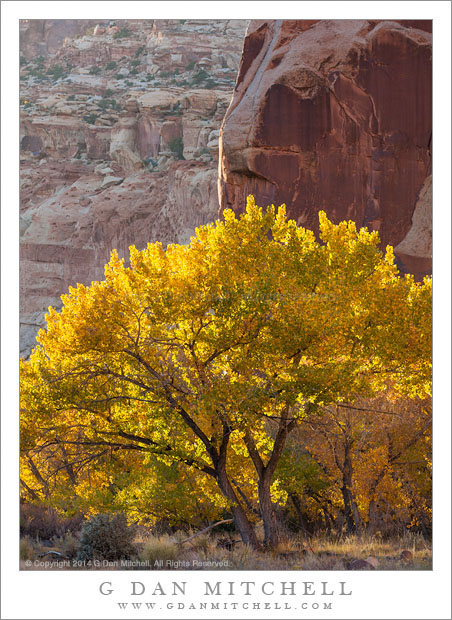
Cottonwood Tree, Evening

Cottonwood Tree, Evening
The day’s last light catches the autumn leaves of a cottonwood tree, Capitol Reef National Park, Utah

Cottonwood Tree, Evening. Capitol Reef National Park, Utah. October 22, 2014. © Copyright 2014 G Dan Mitchell – all rights reserved.

The day’s last light catches the autumn leaves of a cottonwood tree, Capitol Reef National Park, Utah

I made a long trip to Utah to photograph last fall, mostly photographing in the southwest and south-central part of the state. At times I worked alone, exploring slot canyons, washes, and back roads at my leisure. Later I met up with various other folks: photographers from California and Utah, relatives who were also visiting the state, and eventually members of my family. It may surprise some people to hear that I was almost completely unaware of the beauties of southern Utah until recently. (My family had passed through the state many times when I was young, but always through empty, arid regions that did not appeal to me then. Somehow they never showed me the spectacular red rock country, and consequently I thought of Utah as an empty and arid place.)

During the first week of the trip, after several days on my own, I met up with my friend and fellow California photographer David Hoffman in Capitol Reef National Park, where we camped and explored and photographed for several days. This day began with a spectacular and somewhat unexpected sunrise above the Waterpocket Fold, included a long drive on gravel roads to a more remote region of the park, and concluded along the road through the park with early evening photography just before we returned to camp. This section of the road passes though a valley lined with red rock walls, and it is filled with cottonwood and other trees. Late October is prime time for cottonwood color, and this scene of a backlit cottonwood below vertical sandstone cliffs seems representative of this time of year in this place.

(I taking a weekend break from posting my recent Sierra Nevada photographs — they will return on Monday.)


G Dan Mitchell is a California photographer and visual opportunist. His book, “California’s Fall Color: A Photographer’s Guide to Autumn in the Sierra” is available from Heyday Books and Amazon.
Blog | About | Flickr | Twitter | FacebookGoogle+ | 500px.com | LinkedIn | Email


All media © Copyright G Dan Mitchell and others as indicated. Any use requires advance permission from G Dan Mitchell.

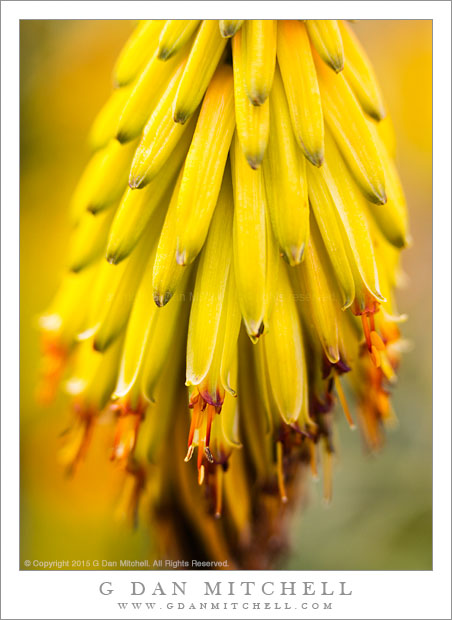
Aloe Flowers

Aloe Flowers
Yellow aloe blossom

Aloe Flowers. Mendocino Coast Botanical Gardens. Fort Bragg, California. July 5, 2015. © Copyright 2015 G Dan Mitchell – all rights reserved.

Yellow aloe blossom

I’m not the primary flower photographer around here — that would be Patty Emerson Mitchell, with whom I visited the Mendocino Coast Botanical Gardens earlier this month. For me the flower photography is often a sort of experimental process and a chance to “play” at a sort of photography that I don’t do all that much. It was a sunny day (tough for flower photography!) but there was plenty of shade (good for flower photograph!) though there was a bit of wind (not so good!), which made me look for protected spots (good!) like this one, where I found these spectacular aloe blooms.

(I’m taking a brief break this weekend from posting my recent Sierra Nevada photographs — those will resume on Monday.)


G Dan Mitchell is a California photographer and visual opportunist. His book, “California’s Fall Color: A Photographer’s Guide to Autumn in the Sierra” is available from Heyday Books and Amazon.
Blog | About | Flickr | Twitter | FacebookGoogle+ | 500px.com | LinkedIn | Email


All media © Copyright G Dan Mitchell and others as indicated. Any use requires advance permission from G Dan Mitchell.

The Canon EOS 5Ds R — Resolution Examples

… and the EF 100-400mm f/4.5-5.6L IS II lens.

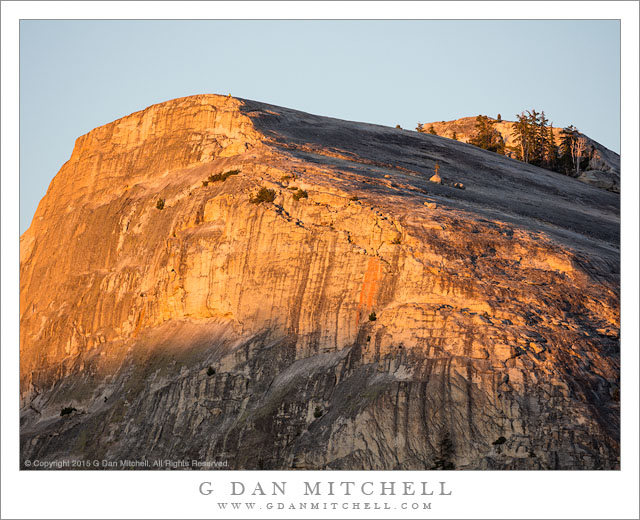
A few days ago I spent four days in the high Sierra making photographs. At the end of one evening I made a photograph that isn’t intended to have any particular aesthetic value, but which was intended as a test of something about my new camera, a Canon EOS 5Ds R.* So I pointed it up at the top of this nearby granite dome just as the last light washed over its summit.

The technical information about the photograph:

First, the resulting photograph — which is, I will be the first to admit, not a stunning example of photographic art!

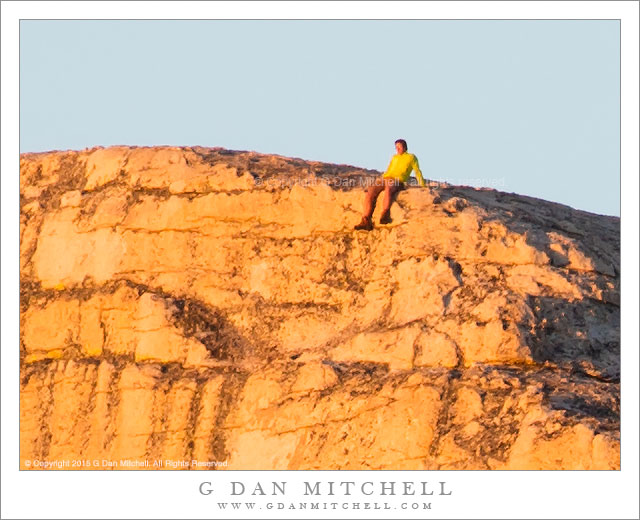
Lembert Dome Sunset Watcher
A lone person watches the Sierra sunset from the summit of Lembert Dome

Next a crop from the same photograph showing a little surprise at the edge of the precipice. This is the same photograph, but this time a 100% magnification crop of a 600 x 450 pixel section. (You’ll have to click on the photos to see the 600 x 450 versions, since the design of this website slightly downsizes photos posted at that size.)

Lembert Dome Sunset Watcher (crop)
A lone person watches the Sierra sunset from the summit of Lembert Dome

If you are wondering where this guy is in the full image, he is just below the right summit of the peak, slightly to the left of the start of the large shadow.

I’ll share some other examples later that are better optimized to show the resolution potential of this camera — photographs using something closer to the diffraction-limited aperture, focal lengths not at the extreme long end, with a lens that has even better resolution potential, and with a subject that is not so far away. (The distance introduces atmospheric elements that reduce resolution.)

Not bad, I’d say.

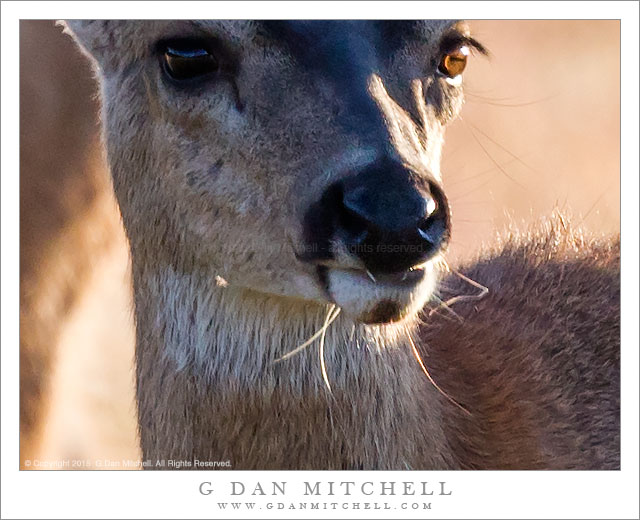
Added later:  Someone asked how the 5Ds R handles the fine details of feathers. I’m sorry to say that I have not photographed birds yet — that is more of winter thing for me. However, while making landscape photographs this past week, deer wandered into several of my scenes and I went ahead and photographed them. The following 100% magnification crop (actual pixel size) was also made using the EOS 100-400 f/4.5-5.6L IS II at 400mm, f/5.6, IS and AF on, ISO 100. The critter was in shadow, and exposure has been pushed here roughly a full stop. (Click the image to see the original 600 x 450 pixel image — the version on this page is slightly downsized.)

Deer — 100% magnification crop at 600 x 450
5Ds R, EOS 100-400mm f/4.5-f.5L IS II @ 400mm, f/5.6, 1/200, ISO 100, AF and IS in us

And one more example, also a 100% magnification crop: Canon EOS 5Ds R, ISO 100, 1/13 second, f/8, EF 100-400mm f/4.5-5.6L IS II @ 105mm

100% Magnification Crop — 5Ds R & 100-400 v2 lens
Canon EOS 5Ds R, ISO 100, 1/13 second, f/8, EF 100-400mm f/4.5-f5.6L IS II lens @ 105mm

5Ds and 5Ds R Articles:

  • Links to the Canon EOS 5Ds and the Canon EOS 5Ds R in this article go to site-sponsor B&H photography with whom I have an affiliate relationship. When you purchase through these links your price is the same, but a small percentage is returned to help support this website.

Mentioned in this article:

© Copyright 2015 G Dan Mitchell – all rights reserved.


G Dan Mitchell is a California photographer and visual opportunist. His book, “California’s Fall Color: A Photographer’s Guide to Autumn in the Sierra” is available from Heyday Books and Amazon.
Blog | About | Flickr | Twitter | FacebookGoogle+ | 500px.com | LinkedIn | Email


All media © Copyright G Dan Mitchell and others as indicated. Any use requires advance permission from G Dan Mitchell.

Photographer and visual opportunist. Daily photos since 2005, plus articles, reviews, news, and ideas.