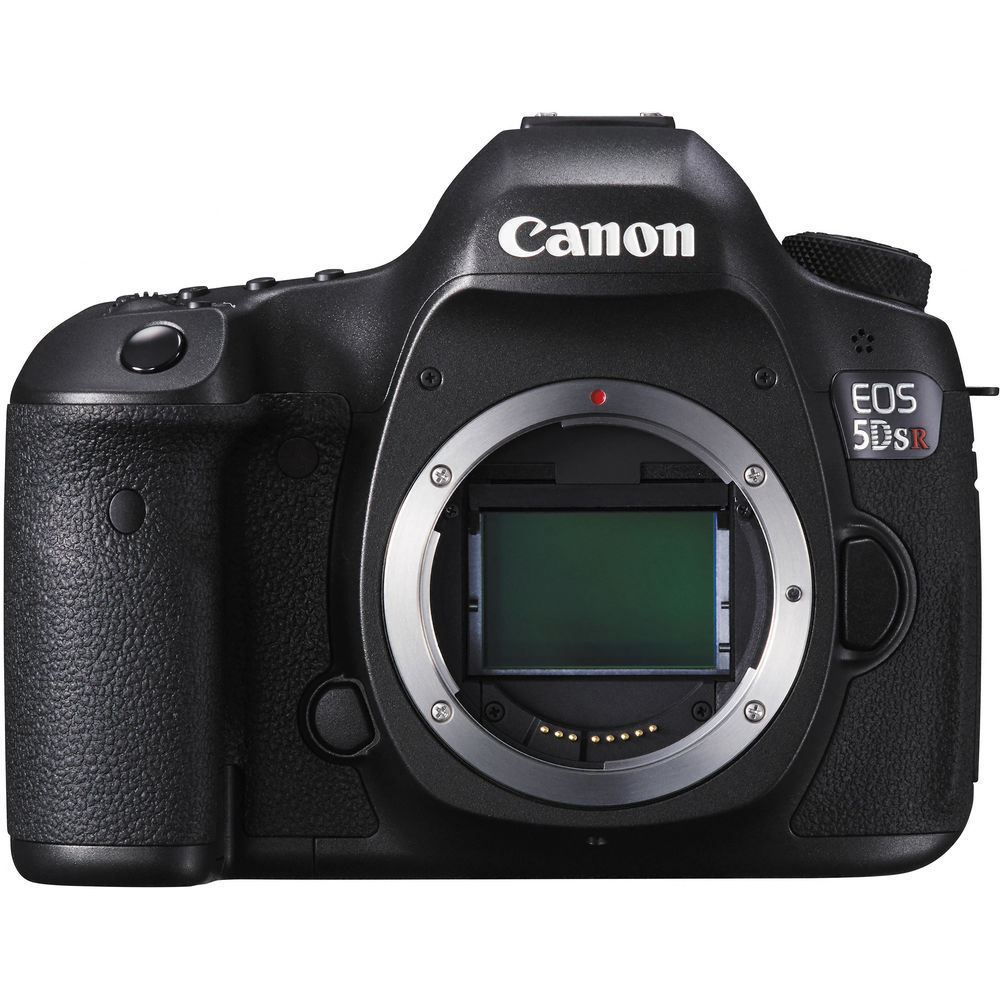
If you are a Canon-using photographer you are almost certainly aware that Canon has released two new DSLR cameras in the 5D series, the 5DS and the 5DS R models. Both provide approximately 50 megapixels (MP) of sensor resolution along with some other improvements. The cameras seem to be an excellent next evolutionary step for Canon photographers who can use the additional resolution.
Canon EOS 5Ds DSLR
I have the 5DS R model and I’ve had the chance to photograph with it twice as of this date. I have been asked to share my thoughts on the camera, but it is still a bit too early for me to write a full report — I want to make more photographs with it and I want to make some very large prints from the files first. Meanwhile I can share a few things: Continue reading Canon EOS 5DsR Quick Update→
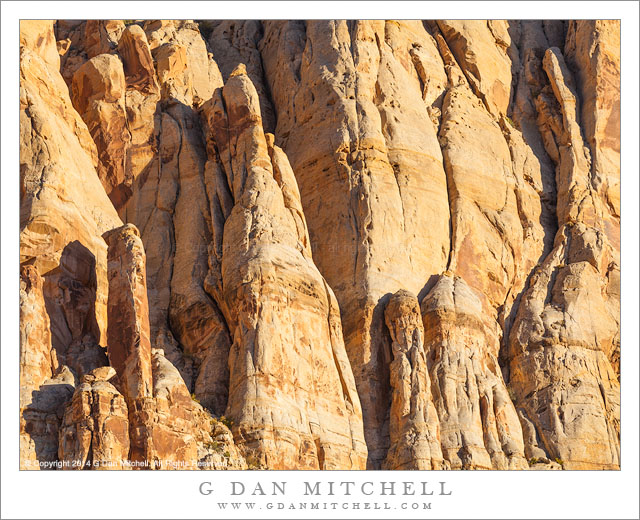
Early evening light on the face of a rugged and weathered sandstone cliff, Capitol Reef National Park
Recently I have been thinking about where we find subjects for photographs and about the fact that they are everywhere — I could say that you don’t always have to seek out particularly “special” places, or I might instead say that if you look closely enough almost any place can be special in some way. I do understand the interest in creating photographs of recognizable subjects and perhaps even the challenge of trying to make such photographs stand out in some way. But for me it is far more interesting to use the camera as a means of focusing more closely on what I can find wherever I am, and then trying to clear away obstacles to seeing these subjects in my own way.
Late in the day we had stopped along a section of roadway in Capitol Reef National Park. We knew, of course, that red rock sandstone cliffs and autumn trees were there, but most of all we stopped because the light was so fascinating. We simply walked along the road and looked, and almost everywhere we looked we found something that seemed like it might be worthy of a photograph. There was so much to see in this small area that as fast and furiously as we photographed, we felt like the light was passing too quickly. The subject of this photograph is a rough and weathered by of sandstone cliff that I happened to notice as I looked up from another subject I had been photographing.
Earlier today I came across a question someone asked about “typical landscape photography settings.” I think their goal was to determine whether to make settings manually or automate them, what sort of initial settings might be useful, what techniques might be employed in typical situations, and so on. That covers a lot of ground, and there is a ton of room for variation depending on your goals and idea of what landscape photography is and is not.
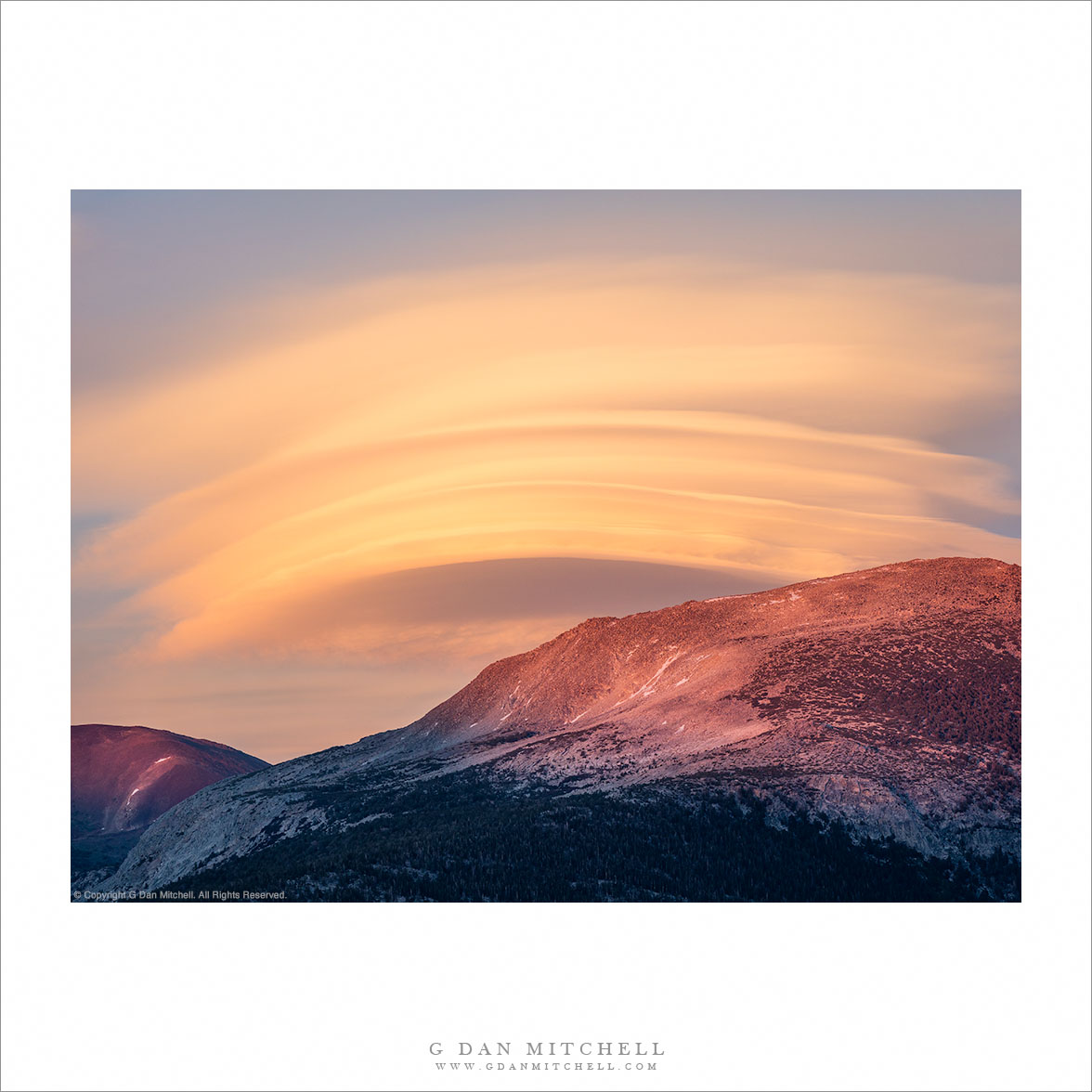
“Lenticular Clouds and Ridge” — A series of lenticular clouds build above the Sierra Nevada crest at sunset
In fact, at first the question seemed so broad and general that I wasn’t going to reply. However, rather than ignoring the question, I decided to offer a quick summary of some of the general techniques I may employ when making a landscape photograph. And since I had already written it I thought it might be useful to share it here, too.
(Of course, I have to acknowledge that this doesn’t address the most important things about landscape photography, namely how to approach the landscape, how to “see” the landscape as an esthetic subject, and how to go beyond mere technique to focus on the image itself and what it can express. That is another post. Or chapter. Or book. Or two. Or more.)
So, on to the short “answer,” or at least to my reply…
Everyone has their own approach to landscape photography, but most folks I know photograph landscape using manual settings and manually focusing using live view. My typical starting point includes the following:
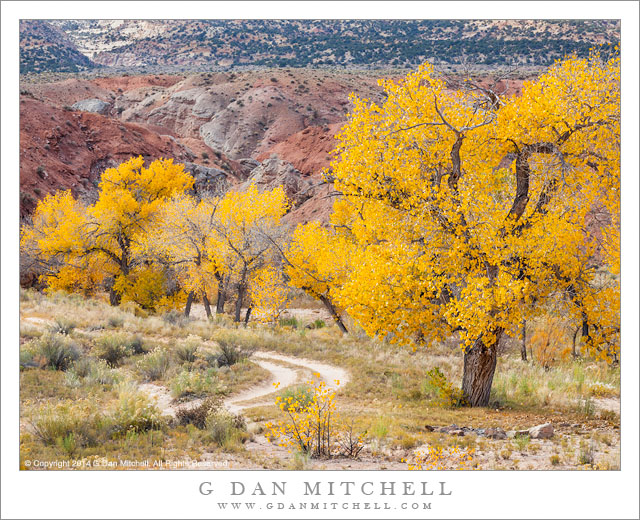
A gravel road passes cottonwood trees in fall color, Capitol Reef National Park, Utah
By the time I made this photograph, the day almost seemed to be winding down. We had gotten up before dawn and made our way to the start of a long gravel road, where we paused to photograph as the sun came up. It was one of those almost unplanned moments — no specific landscape in mind, but there was the rising sun, so we stopped and found that we could photograph a range of subjects in that light. Then we headed on down this road, eventually arriving at one of our possible goals, where we took a hike to a high place with a panoramic view.
By now it was getting on toward the middle of the day — mostly the non-shooting hours for photographers in many cases — so we headed back the way we came. As we drove we came to this flat with good-sized cottonwood trees spread along a small gravel road heading off toward the uplifted terrain of Capitol Reef National Park. The autumn color of these trees was irresistible… so we didn’t resist! We stopped, got out, photographed for a while , and then were back on the road.