
New Canon EF 16-35mm f/4L IS Lens Announced

Without a whole lot of fanfare, today Canon announced a new EF 16-35mm f/4L IS wide angle zoom. While actual copies are apparently not yet “in the wild,” judging by reports and information from Canon and elsewhere, it sounds like a lens with some very interesting possibilities.

Canon 16-35mm f/4L IS

At first blush, one might imagine that it is simply a less expensive version of the EF 16-35mm f/2.8L II lens that has been out for some time now. (That is a fine lens for many purposes, notably for full frame shooters doing handheld ultra-wide photography in low light.) It shares the same focal length range, but the maximum aperture is not quite as large. (There is a similar relationship between the EF 24-70mm f/2.8L II and the less expensive EF 24-70mm f/4L IS.)

However, the new lens has some distinctive features that set it apart from the f/2.8 16-35, and also from the venerable 17-40mm f/4 L.

  • Unlike either of the two ultra-wide alternatives, this lens is equipped with image-stabilization (IS). Some presume that IS would not be useful in a wide angle lens, but there are a number of situations in which the extra 3-4 stops of low light handheld shooting capability will come in handy. It is also likely to appeal to those shooting DSLR video.
  • The MTF charts (a way of graphically representing lens performance) for the new lens look very good. While the existing 16-35mm and 17-40mm Canon ultra-wide lenses have been very important to many photographers, they are not known for outstanding resolution, especially in the corners. The charts for the new lens indicate that it should be significantly sharper overall, and especially in the corners and at the largest apertures.
  • It may seem like a small thing, but the new lens uses the common 77mm diameter filter threads—the same that are found on a number of other L lenses, including the f/2.8 70-200mm zooms. (The previous f/2.8 16-35mm lens uses a larger 82mm diameter.) For photographers who already have 77mm filters—including some who might consider moving to this lens from an existing 17-40mm lens—this is a factor to consider.
  • The price is actually quite good. The lens is not cheap at a projected list price of $1199. However, by comparison to some similar recent Canon lens releases this is not bad at all, especially when you consider that it is an IS lens.

Who may want this lens? I suspect that quite a few landscape photographers and those shooting similar subjects will like this lens more than the older 17-40mm L lens. I’ve used the 17-40 for a long time and it is a very useful lens, especially for shooting at smaller apertures from the tripod with a full frame camera. However, the new lens seems to improve on its performance in significant ways, particularly in the area of corner performance. In addition, while most of us really think of the 17-40 as pretty much just a landscape lens, the improved wide-open performance and image stabilization will extend the usefulness of this lens in low and for handheld photography.

I’m impressed enough with early reports that I’m giving serious consideration to picking one up myself. The lens is not yet available for purchase, but you can pre-order a copy from B&H. At the moment, I’m “that close” to doing so!

G Dan Mitchell is a California photographer and visual opportunist whose subjects include the Pacific coast, redwood forests, central California oak/grasslands, the Sierra Nevada, California deserts, urban landscapes, night photography, and more.
Blog | About | Flickr | Twitter | FacebookGoogle+ | 500px.com | LinkedIn | Email

Text, photographs, and other media are © Copyright G Dan Mitchell (or others when indicated) and are not in the public domain and may not be used on websites, blogs, or in other media without advance permission from G Dan Mitchell.
Desert Mountains, Rain

Desert Mountains, Rain

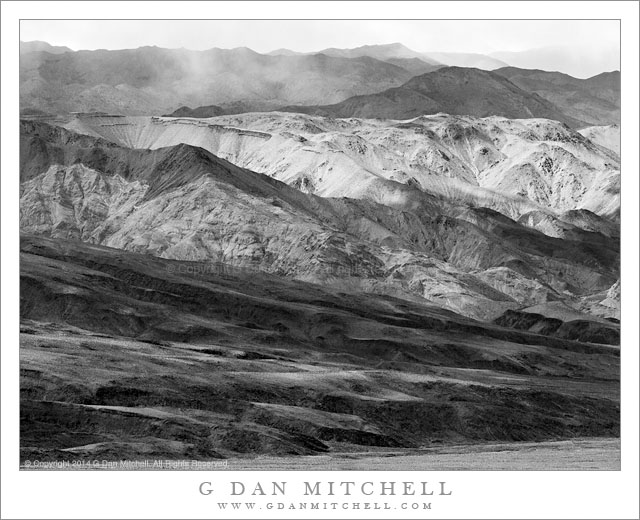
Desert Mountains, Rain. Death Valley National Park, California. April 2, 2014. © Copyright 2014 G Dan Mitchell – all rights reserved.

Afternoon rain falls on peaks beyond a rising series of rugged desert mountain ridges, Death Valley National Park

This turned out to be a surprisingly and almost ridiculously productive day of photography, which was not at all what I expected as the day began nor at any number of times later in the day. Much of what happened was unplanned and the result of discovering things and of reacting intuitively to changing conditions. Prior to getting up before dawn to head to out first shooting location, my description of what I hoped would happen on this day or even of what I expected would happen would have had little in common with how it evolved. I have related some of the details of the earlier parts of the day already—sunrise light cut short by an incoming storm, the surprise discovery of abundant high desert mountain wildflowers, a snow storm, a first visit to an old historic site, and more—so I’ll just briefly mention the later part of the day. The winter storm, that brought some rain and snow to Death Valley National Park mountains, finally broke up, leaving a few showers high up in the mountains along with brilliant light coming through gaps in the thinning clouds, and these conditions lasted right on into the evening.

I made this photograph in the late afternoon. There was still plenty of rain or snow among the peaks, though the air was much clearer below and, indeed, some light was beginning to come through the clouds. Here I had a clear view across a portion of the valley, over the alluvial material at the base of the Cotton Mountains, and on up across the layered ridges toward the cloud-shrouded higher peaks. I had an idea for this as a photograph, but the light was difficulty and I knew that significant work in post would be required. Indeed, while this might seem like a simple natural landscape, the final version here is the result of significant work done after the fact in the digital darkroom.

G Dan Mitchell is a California photographer and visual opportunist whose subjects include the Pacific coast, redwood forests, central California oak/grasslands, the Sierra Nevada, California deserts, urban landscapes, night photography, and more.
Blog | About | Flickr | Twitter | FacebookGoogle+ | 500px.com | LinkedIn | Email

Text, photographs, and other media are © Copyright G Dan Mitchell (or others when indicated) and are not in the public domain and may not be used on websites, blogs, or in other media without advance permission from G Dan Mitchell.
Spring Flooding, Tuolumne Meadows

Spring Flooding, Tuolumne Meadows

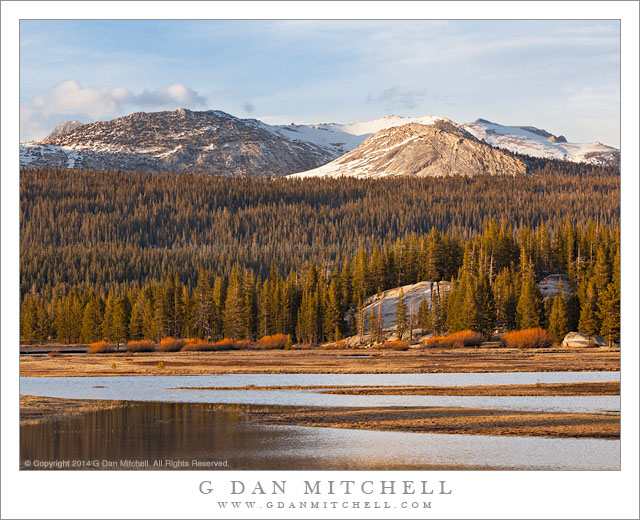
Spring Flooding, Tuolumne Meadows. Yosemite National Park, California. May 4, 2014. © Copyright 2014 G Dan Mitchell – all rights reserved.

The Tuolumne River overflows its banks on a spring evening, Tuolumne Meadows

This is another, slightly different view of a scene that I shared recently, photographed at Tuolumne Meadows on the weekend when Tioga Pass Road over the Sierra crest opened for the 2014 season. As is my habit, I broke free and made it up there to celebrate the beginning of a new high country season. It was a quick trip—a 21 hour 550 mile drive that took me across the range to the Mono Lake area and some nearby sights on the “east side.” Later in the day I reversed course and headed back up to Tioga Pass and began my homeward trip, stopping to spend a good part of the evening in Tuolumne Meadows, where strong wind blew as the golden hour light began to develop.

This scene is full of things that I know well. I have visited the general area of Tuolumne Meadows since I was a child and my father took me and one of my brothers up there on the first camping trip that I can remember. Every spring (or early summer in wet years) when I return I look for this area of the meadow where the Tuolumne River overflows its banks and produces a temporary lake, even in a very dry year like this one. On a number of occasions I have hiked on a trail that crosses from right to left just below the bright granite peak in the upper left, heading for a pass below Ragged Peak and then on to Young Lakes, which lie just beyond that highest ridge. (Just below and to the left of the granite peak lies a beautiful area of subalpine meadow with scattered rocks and extensive fields of lupine.) On this evening there were few people in the meadow, as the campground was not yet open and not many people were still up here so late in the day, so I was able to wait quietly for the clouds and the light to line up just right.

G Dan Mitchell is a California photographer and visual opportunist whose subjects include the Pacific coast, redwood forests, central California oak/grasslands, the Sierra Nevada, California deserts, urban landscapes, night photography, and more.
Blog | About | Flickr | Twitter | FacebookGoogle+ | 500px.com | LinkedIn | Email

Text, photographs, and other media are © Copyright G Dan Mitchell (or others when indicated) and are not in the public domain and may not be used on websites, blogs, or in other media without advance permission from G Dan Mitchell.

Mining Relic, Death Valley

Mining Relic, Death Valley
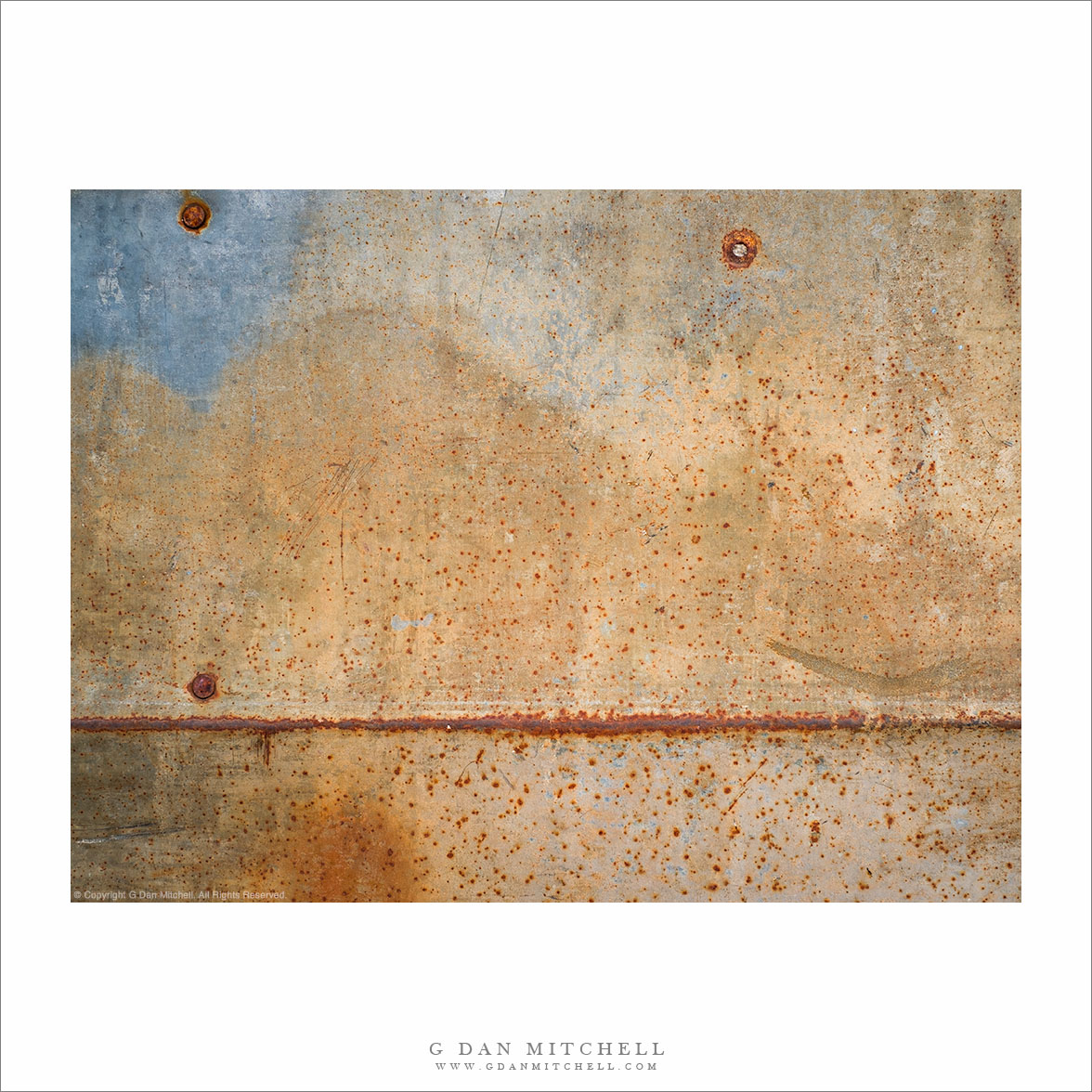
“Mining Relic, Death Valley” — A piece of rusted and weathered metal from an abandoned mining site, Death Valley National Park

Between having our sunrise light interrupted by an incoming storm (though it was not a compete washout) and retreating from the road past the charcoal kilns in heavily falling snow, we stopped for a while at the old Harrisburg site, where Harris and Aguereberry ran a mine for a number of years. (They reportedly didn’t get rich, but they also avoided going bust—the story is that they extracted enough ore to make it work.)

Calling the place “Harrisburg” is over-selling it! There is a small cluster of cabins—three, to be precises—tucked up into a slight indentation at the base of a low hill in a high, broad Panamint Range valley.The mine is found at the far end of the hill and around its far side, and a variety of mining detritus litters the landscape: remnants of old rails leading into the mine, some impressive scaffolding, lots of rusted stuff, an old abandoned vehicle. As we poked around near the mine I found this old hunk of weathered sheet metal hanging from some wooden structures.


Leave a comment or question using the form. (Click the title to see the full article and to comment if you are viewing it on the home page.)

G Dan Mitchell is a California photographer and visual opportunist. His book, “California’s Fall Color: A Photographer’s Guide to Autumn in the Sierra” (Heyday Books) is available directly from him. Blog | Bluesky | Mastodon | Substack Notes | Flickr | Email

All media © Copyright G Dan Mitchell and others.

Photographer and visual opportunist. Daily photos since 2005, plus articles, reviews, news, and ideas.