
Oak Trees, Snow, Clouds

Oak Trees, Snow, Clouds
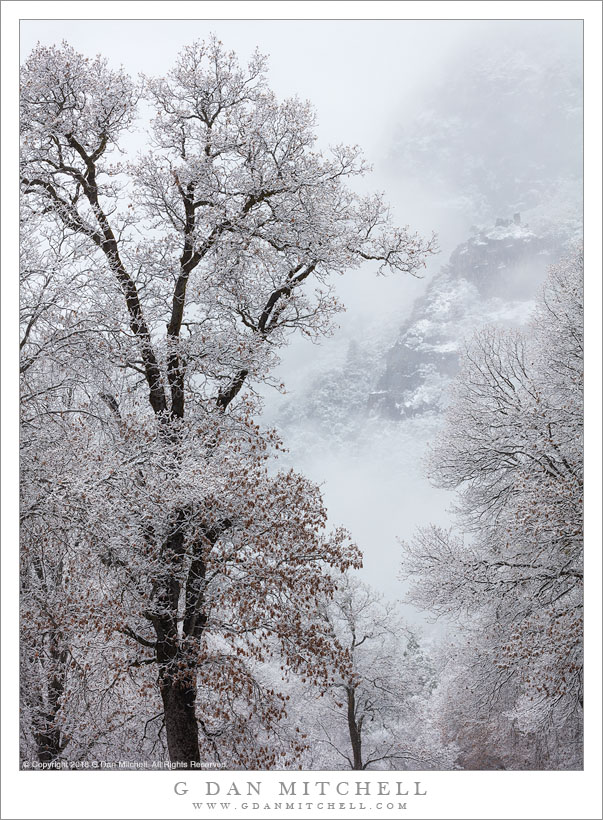
Tall winter oak trees silhouetted against granite cliffs and snow-storm clouds

Oak Trees, Snow, Clouds. © Copyright 2018 G Dan Mitchell – all rights reserved.

Tall winter oak trees silhouetted against granite cliffs and snow-storm clouds

Recently I spent a few more days in Yosemite, mostly in Yosemite Valley, working on my Yosemite Renaissances artist-in-residence project. We have settled on a theme for the exhibit, which will open on June 2, with a June 9 public reception. Since the timeline extended, I’ve decided to go beyond winter images and instead look at the transition from winter to spring. Hence, the title: “Transitions: Winter To Spring.” A group of friends and fellow photographers will also be part of the exhibit, and I’ll share more information very soon.

This week probably (though you can never be totally certain) marked the final real winter weather of the season in the Valley. A quick weather front swept through with surprising amounts of precipitation over a brief period, and it was cold enough for snow in the Valley. The snow wasn’t deep, but the cold temperatures allowed it to cover everything, including these lovely old black oak trees, photographed here against the background of clouds and mist and some of the rocky walls of The Valley.


G Dan Mitchell is a California photographer and visual opportunist. His book, “California’s Fall Color: A Photographer’s Guide to Autumn in the Sierra” is available from Heyday Books and Amazon.
Blog | About | Flickr | Twitter | FacebookGoogle+ | LinkedIn | Email


All media © Copyright G Dan Mitchell and others as indicated. Any use requires advance permission from G Dan Mitchell.
Kit Fox Hills, Amargosa Range

Kit Fox Hills, Amargosa Range
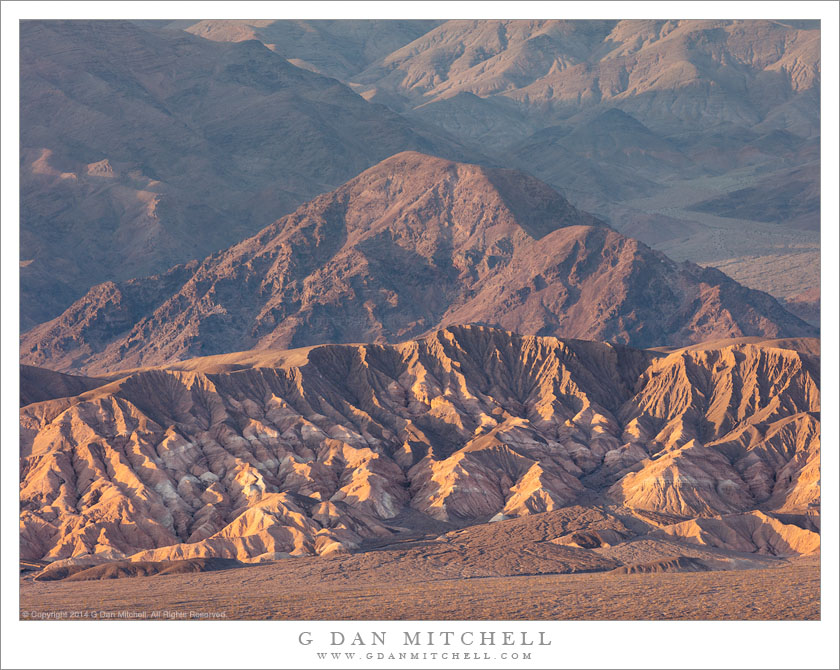
Amargosa Range mountains rise behind the Kit Fox Hills, Death Valley

Kit Fox Hills, Amargosa Range. © Copyright 2018 G Dan Mitchell – all rights reserved.

Amargosa Range mountains rise behind the Kit Fox Hills, Death Valley

These low, deeply eroded, and colorful (in the right light) Death Valley hills lie at the western base of the Amargosa Range near the start of the road heading north toward the Scotty’s Castle area. I recently read that they may be the remnants of an old earthquake fault along the eastern side of Death Valley, marking a division between the rising mountains and the sediment-filled valley. I have walked along the base of these hills, though I still need to find the time to more extensively explore their rugged and eroded landscape.

Late in the day they intercept almost the very last sunlight to reach the valley floor before sunset. With that in mind, I have photographed them many times, often from a good distance away across the valley. That was the case on this evening, when I found a spot elevated above the valley floor and climbed to its summit to watch the late-day light. It was one of those evenings when the light was unpredictable. There were clouds to the west above the Cottonwood mountains, which can turn out to be either a good thing or a bad thing. The clouds may light up at sunset and the minutes just after… or they may simply block the sun and “turn out the lights” on sunset photography. It looked like the latter might turn out to be the case as I watched the sun descend toward a band of thicker clouds. But there was a small gap between the base of the clouds and the top of the mountains, and the sunlight shone through this gap for a few minutes, casting beautiful soft light on these hills.


G Dan Mitchell is a California photographer and visual opportunist. His book, “California’s Fall Color: A Photographer’s Guide to Autumn in the Sierra” is available from Heyday Books and Amazon.
Blog | About | Flickr | Twitter | FacebookGoogle+ | LinkedIn | Email


All media © Copyright G Dan Mitchell and others as indicated. Any use requires advance permission from G Dan Mitchell.
Conifer Bark

Conifer Bark
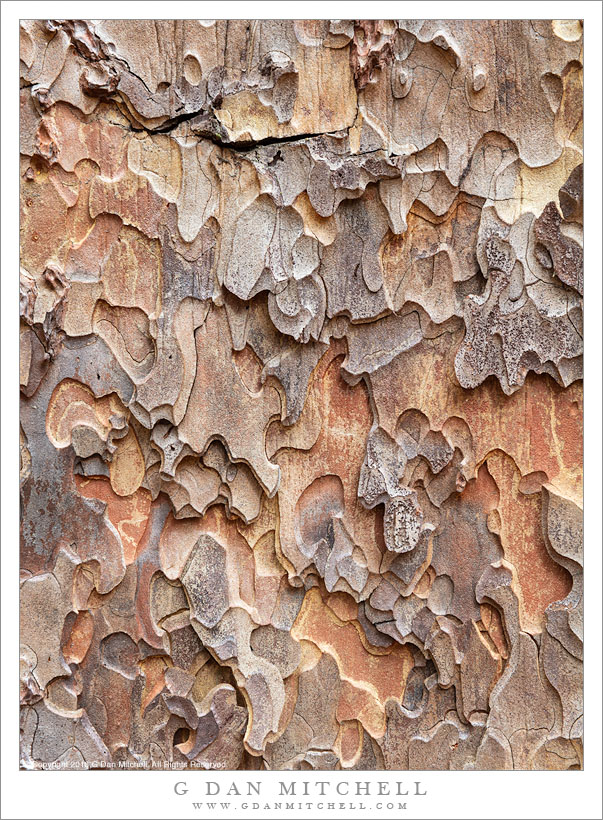
Close-up of conifer tree bark, Yosemite Valley

Conifer Bark. © Copyright 2018 G Dan Mitchell – all rights reserved.

Close-up of conifer tree bark, Yosemite Valley

I’ve spent a total of perhaps a bit more than a week-and-a-half in Yosemite so far this season, beginning back in late February when I spent an unusually cold and snowy week mostly in Yosemite Valley photographing various aspects of the winter landscape. (An artist-in-residency through the Yosemite Renaissance was an important reason for that visit.) I was back again this past week, mostly thinking that I would be experience the “spring” half of the annual winter to spring transition — but once again arriving to snowy conditions. Yet the signs of spring were everywhere, too. Annual plants are poking up, here and there one can find a few early wildflowers, the dogwoods are just starting to leaf out, and the waterfalls are running strongly.

We often think of the “landscape” as being the immense scale of things in the natural world. But the grand landscape is the sum of many small components, and landscape photography has long paid attention to them individually, too. In a place like Yosemite, with its iconic big features, you might have to remind yourself to go look for the small things. One one recent day with so-so midday light, I put on my camera pack, grabbed my tripod, and just wandered slowly off into the forest, stopping frequently to consider my surroundings. Near the farthest point on this walk, I left the trail and walked into the forest and, for no particular reason, came upon a tree that seemed not all that different from all of the surrounding trees until I looked a bit closer and saw these remarkable bark patterns.


G Dan Mitchell is a California photographer and visual opportunist. His book, “California’s Fall Color: A Photographer’s Guide to Autumn in the Sierra” is available from Heyday Books and Amazon.
Blog | About | Flickr | Twitter | FacebookGoogle+ | LinkedIn | Email


All media © Copyright G Dan Mitchell and others as indicated. Any use requires advance permission from G Dan Mitchell.
Death Valley, Mountains, Morning

Death Valley, Mountains, Morning
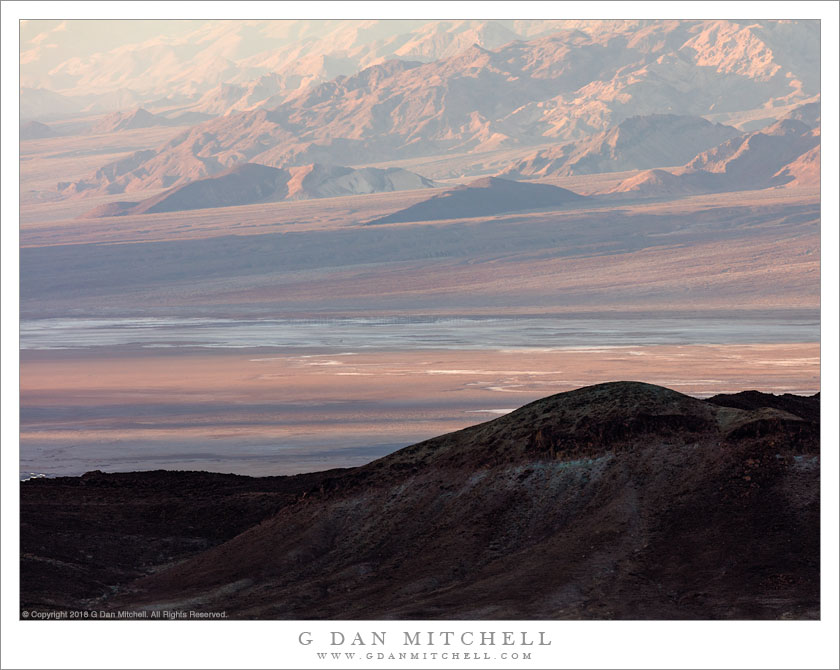
Morning light on Death Valley and the base of the Panamint Mountain Range

Death Valley, Mountains, Morning. © Copyright 2018 G Dan Mitchell – all rights reserved.

Morning light on Death Valley and the base of the Panamint Mountain Range

A few recent photographs here have focused on the intimate landscapes of Death Vally canyons. This one leaves the canyon and moves out into the open, looking from the eastern mountains across valley to the base of the Panamint range on the other side. We had driven up in to these mountains in the morning after first photographing dawn from the valley. Here we could watch the morning light traverse the valley — in the photograph it still had not made it to the low hills below our position.

At about the time of my first visits to Death Valley I had also made my first trips to Alaska. It may seem odd, given their different climates, but it struck me that the two places have a lot in common. Most of all, in both places I experiences huge spaces and immense quiet and stillness in ways that I had not really known before. (I rarely experience this in the Sierra, even above timberline, since the distances are smaller and somewhere in the landscape there will be a tree.) In Death Vally, it is hard to make sense of the scale of the landscape. The combination of huge distances, tremendously large features, and a dearth of objects of known size conspire to confuse us. Look across flats to a barren mountain and its valleys, it might seem that you could just walk there. You could, perhaps, but it might take many days.


G Dan Mitchell is a California photographer and visual opportunist. His book, “California’s Fall Color: A Photographer’s Guide to Autumn in the Sierra” is available from Heyday Books and Amazon.
Blog | About | Flickr | Twitter | FacebookGoogle+ | LinkedIn | Email


All media © Copyright G Dan Mitchell and others as indicated. Any use requires advance permission from G Dan Mitchell.

Photographer and visual opportunist. Daily photos since 2005, plus articles, reviews, news, and ideas.