
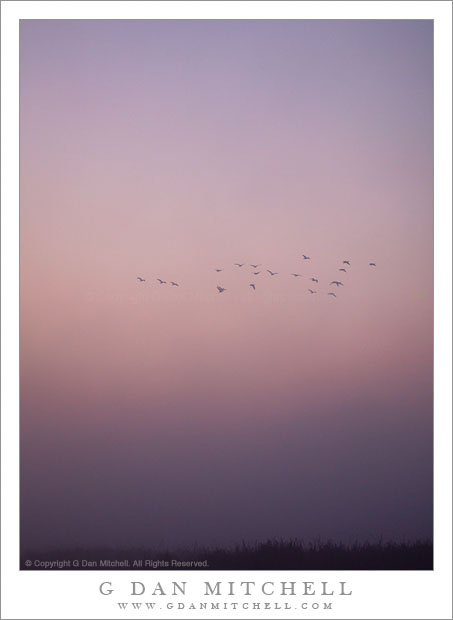
Birds, Fog, First Light

Birds, Fog, First Light
Birds fly above pre-dawn fog at first light

Birds, Fog, First Light. February 15 2016. Central Valley, California. © Copyright 2016 G Dan Mitchell – all rights reserved.

Birds fly above pre-dawn fog at first light

If you think to hard about photography, things can quickly become quite confusing. Why do we make photographs? I have some ideas, but I’m not certain. (They involve searching for ideals, in the classic sense, along with dealing with the inexorable march of time, but it is a long story.) We often focus on the practical matters, partly because it is necessary but also because it is easier. Where should I go? What lens should I use? What are the right settings? What is the best subject? What is the ideal time? What if I come back empty handed? Am I on the right track? And much more.

But occasionally there are perfect moments of clarity, both mental and visual. In my experience, they almost always come as a surprise, though there are ways to increase the likelihood of encountering them. They may come when one is alone or in the company of others. These ephemeral experiences of near perfection may be found in mountains, along the ocean, in a city, almost anywhere if you are looking. Cold, a long drive, waking in darkness — they seem a small price for a few seconds of birds against a softly colored sky in the moments before dawn


G Dan Mitchell is a California photographer and visual opportunist. His book, “California’s Fall Color: A Photographer’s Guide to Autumn in the Sierra” is available from Heyday Books and Amazon.
Blog | About | Flickr | Twitter | FacebookGoogle+ | 500px.com | LinkedIn | Email


All media © Copyright G Dan Mitchell and others as indicated. Any use requires advance permission from G Dan Mitchell.
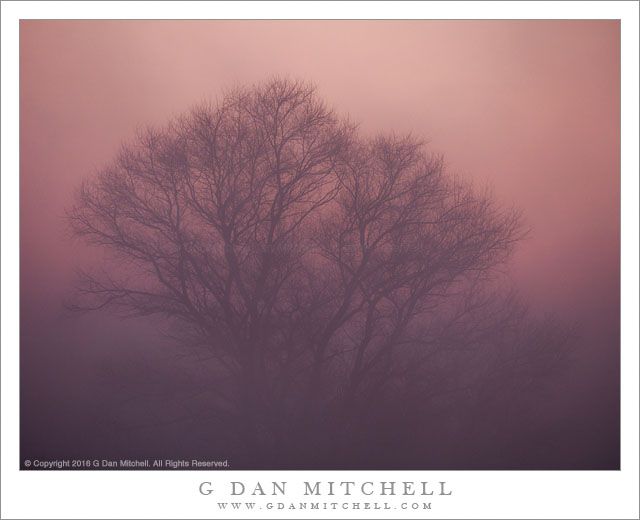
A Tree, Fog, Dawn Light

A Tree, Fog, Dawn Light
Thick winter tule fog obscures a wetland tree at dawn, San Joaquin Valley

A Tree, Fog, Dawn Light. Central Valley, California. February 4, 2016. © Copyright 2016 G Dan Mitchell – all rights reserved.

Thick winter tule fog obscures a wetland tree at dawn

This photograph belongs to a portion of my work that I think of as (to be non-poetic) the “barely there” photographs — subjects of low contrast, sometimes high key, and soft focus that attempt to evoke a mood and which perhaps allow the viewer to imagine what might be there. The photographs often feature fog or other kinds of atmospheric effects, and may be as much about light and color and form as anything.

This was likely the first photograph that was even possible on this morning. The fog was extremely thick, to the point that even nearby objects were obscured. Earlier the opacity of the atmosphere had been matched by the darkness of the light. But subtle and ephemeral things can happen at the boundaries of light on days like this, and as the sky above the fog began to lighter the fog began to glow with the colors of incipient sunrise light and objects like this tree began to be visible in the soft and colorful light.


G Dan Mitchell is a California photographer and visual opportunist. His book, “California’s Fall Color: A Photographer’s Guide to Autumn in the Sierra” is available from Heyday Books and Amazon.
Blog | About | Flickr | Twitter | FacebookGoogle+ | 500px.com | LinkedIn | Email


All media © Copyright G Dan Mitchell and others as indicated. Any use requires advance permission from G Dan Mitchell.
Canon EOS 5DsR/5Ds: My Experience

These days I use the Canon EOS 5DsR for much of my photography — particularly my landscape, nature, wildlife, and long-exposure night photography. Since people often ask me about the camera, I have decided to offer this write-up. I’ll try to cover some things about the camera that work well for me, acknowledge one or two very small issues, and consider the kinds of photographers for whom it (or its near-twin, the Canon EOS 5Ds)  might be a great choice. (This isn’t the first time I’ve written about aspects of this camera’s performance, and I have included a list of some of my other posts near the end of this article.)

The 5Ds and 5DsR are both 51 megapixel (MP) full frame DSLR bodies from Canon. They currently provide the highest sensor resolution available from a full frame digital camera and, as such, are targeted to photographers who need particularly high image resolution and who will photograph and post-process in ways that provide this. The 5DsR cancels the effect of the anti-aliasing filter found in the 5Ds — more on that subject below.

It is probably fair to say that the main attraction of these cameras is that high-resolution sensor, a fact that might lead some photographers to ask whether or not they will be able to take advantage of the high-resolution. Compared to earlier 5D-series cameras, the 5Ds/5DsR provide some other improvements, too. The autofocus (AF) system has been updated, noise handling is very good, and the  camera produces high dynamic range files that can be pushed and pulled quite a bit in post. Some updates have been made to the hardware and software interface of the camera, too.

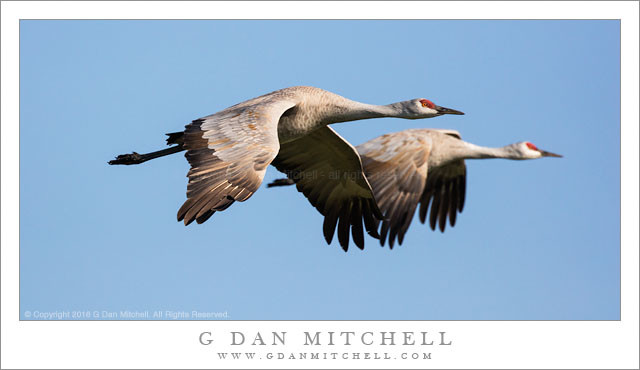
Two Sandhill Cranes in Flight
A pair of lesser sandhill cranes in flight above California’s San Joaquin Valley

Sensor Resolution

There is no question that these cameras can produce very high-resolution images. Photographers who work carefully and who make very large prints will be pleased. I have made test prints equivalent to 30″ x 45″ prints that look very good and it is possible to go even larger. However, before you jump at the highest resolution full frame camera purely on the basis of higher resolution, you should ask yourself a few serious questions.

Continue reading Canon EOS 5DsR/5Ds: My Experience

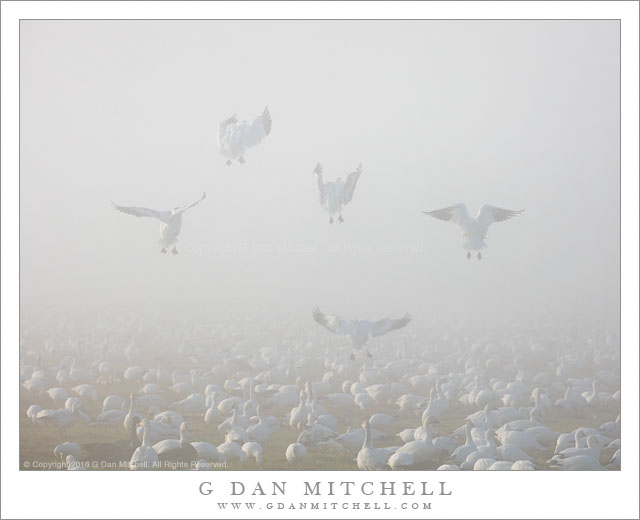
Joining the Flock

Joining the Flock
Ross’s geese descend through tule fog to join the flock

Joining the Flock. Central Valley, California. February 15, 2016. © Copyright 2016 G Dan Mitchell – all rights reserved.

Ross’s geese descend through tule fog to join the flock

The drive to this location in mid-February was, in many ways, very typical. We were up before 4:00 am and quickly on the road in the darkness. An hour and a half later we turned on to the rural roads, and the first predawn color was coming to the sky — and, yes, it was still fairly clear. Soon, however, we began to drive through fog banks so thick that we had to slow, with visibility measured in feet. What had been a highway-speed drive quickly changed to a 15mph crawl as we watched intently for obstacles or other vehicles.

We arrived at our destination, still in very thick tule fog, and got out to get organized for photography.  As we drove a gravel road around the area we occasionally caught glimpses of small birds near the route, but the only evidence of larger birds was their distant cries. Eventually we arrived at a spot where we could hear more birds, and occasionally a few would fly close enough that we could see them momentarily. But they remained out of sight as we waited. Eventually a slight breeze began to shift the fog a bit and the flock became barely visible, though light from the rising sun produced a luminous glow. These five Ross’ geese dropped through the fog toward the flock below, with shapes that might make one think of angel wings.


G Dan Mitchell is a California photographer and visual opportunist. His book, “California’s Fall Color: A Photographer’s Guide to Autumn in the Sierra” is available from Heyday Books and Amazon.
Blog | About | Flickr | Twitter | FacebookGoogle+ | 500px.com | LinkedIn | Email


All media © Copyright G Dan Mitchell and others as indicated. Any use requires advance permission from G Dan Mitchell.
Photographer and visual opportunist. Daily photos since 2005, plus articles, reviews, news, and ideas.