
Tag Archives: arid

The Manifold, Detail

The Manifold, Detail, Death Valley
“The Manifold, Detail” — Close photograph of a section of the Manifold formation, Death Valley National Park.

Even though this photograph only shows a very small area of a much larger formation, there’s a good chance that those of you familiar with Death Valley will recognize it. The feature is called “The Manifold,” and it features ribs of soft, light-colored material stretching out from beneath a layer of darker material. For this photograph I narrowed the angle of view to only include a very small part of the larger feature.

The geology of these “badlands” features some very soft material that is easily eroded. The different colors were laid down as layers a very long time ago, and since then they have been tilted and distorted. It is hard to imagine a better place to visualize the effect that flowing water has on this desert landscape.


G Dan Mitchell is a California photographer and visual opportunist. His book, “California’s Fall Color: A Photographer’s Guide to Autumn in the Sierra” (Heyday Books) is available directly from him.

G Dan Mitchell: Blog | Bluesky | Mastodon | Substack Notes | Flickr | Email


All media © Copyright G Dan Mitchell and others as indicated. Any use requires advance permission from G Dan Mitchell.

At the Edge of the Salt Flats

At the Edge of the Salt Flats, Death Valley National Park.
“At the Edge of the Salt Flats” — Panamint mountains tower above as a small wash runs to the edge of the salt flats, Death Valley.

During my late-February visit to Death Valley National Park I spent two early mornings photographing this location. It is generally most interesting at dawn, when the morning light shines on the distant Panamint Mountains, so I was there well before sunrise. In order to find ideal locations here you really have to scout ahead of time. On the first of the two visits I slightly missed my target location in the darkness. I still got photographs, but before my return on the last morning of my trip, I checked it one more time and determined that following this runoff gully would get me where I needed to be.

There was another benefit from following the little gully. The soil on the higher ground to either side is quite soft and walking on it leaves obvious footprints. In many places the bottom of the gully is covered with small rocks, and it is easier (on me and the landscape1) to walk on this harder surface. Distances here are deceiving. If you started at sunrise (and could find a route) it would take you an entire, long day just to get the base of those mountains.


G Dan Mitchell is a California photographer and visual opportunist. His book, “California’s Fall Color: A Photographer’s Guide to Autumn in the Sierra” (Heyday Books) is available directly from him.

G Dan Mitchell: Blog | Bluesky | Mastodon | Substack Notes | Flickr | Email


All media © Copyright G Dan Mitchell and others as indicated. Any use requires advance permission from G Dan Mitchell.
Desert Holly Plant, Dry Wash

Desert Holly Plant, Dry Wash, Death Valley
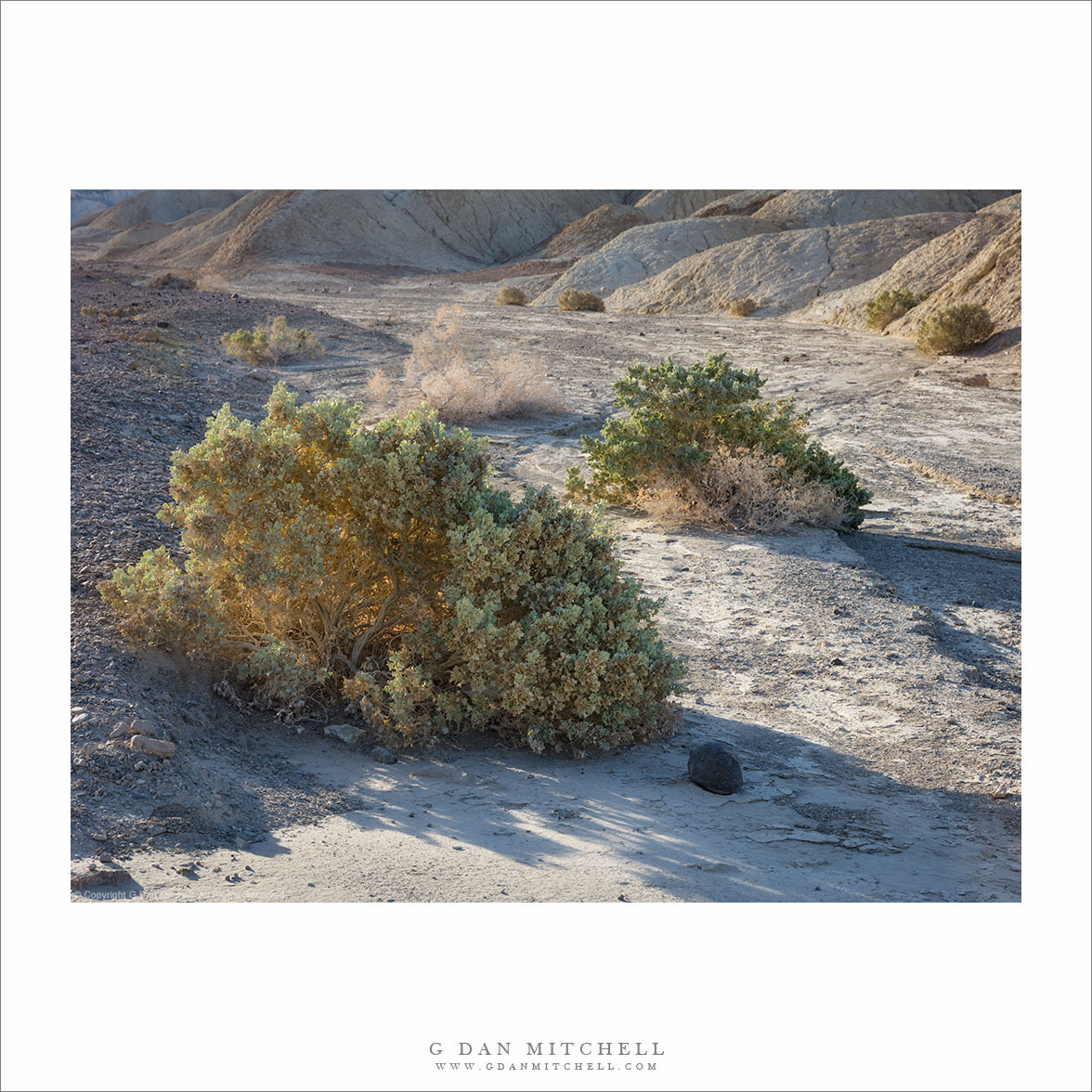
“Desert Holly Plant, Dry Wash” — A dormant desert holly plant in a desert wash, Death Valley.

This photograph comes from one of the more arid, inhospitable-looking locations in Death Valley National Park. The soil here is not conducive to much plant life, and few plants manage to eke out an existence. One that does is the desert holly. When it gets enough water it sports lovely gray-green foliage, but when the heat and aridity become too much the plant goes dormant and turns brown/tan.

These plants are growing along the edges of a desert wash, which makes sense given that any sufficient runoff will move down this stream bed and leave behind a bit more moisture for the plants growing there. Washes like this, though often with a more gravelly surface, are everywhere this park, and they frequently provide passage into mountains.


G Dan Mitchell is a California photographer and visual opportunist. His book, “California’s Fall Color: A Photographer’s Guide to Autumn in the Sierra” (Heyday Books) is available directly from him.

G Dan Mitchell: Blog | Bluesky | Mastodon | Substack Notes | Flickr | Email


All media © Copyright G Dan Mitchell and others as indicated. Any use requires advance permission from G Dan Mitchell.
Gullies in Soft Light #2

Gullies in Soft Light #2
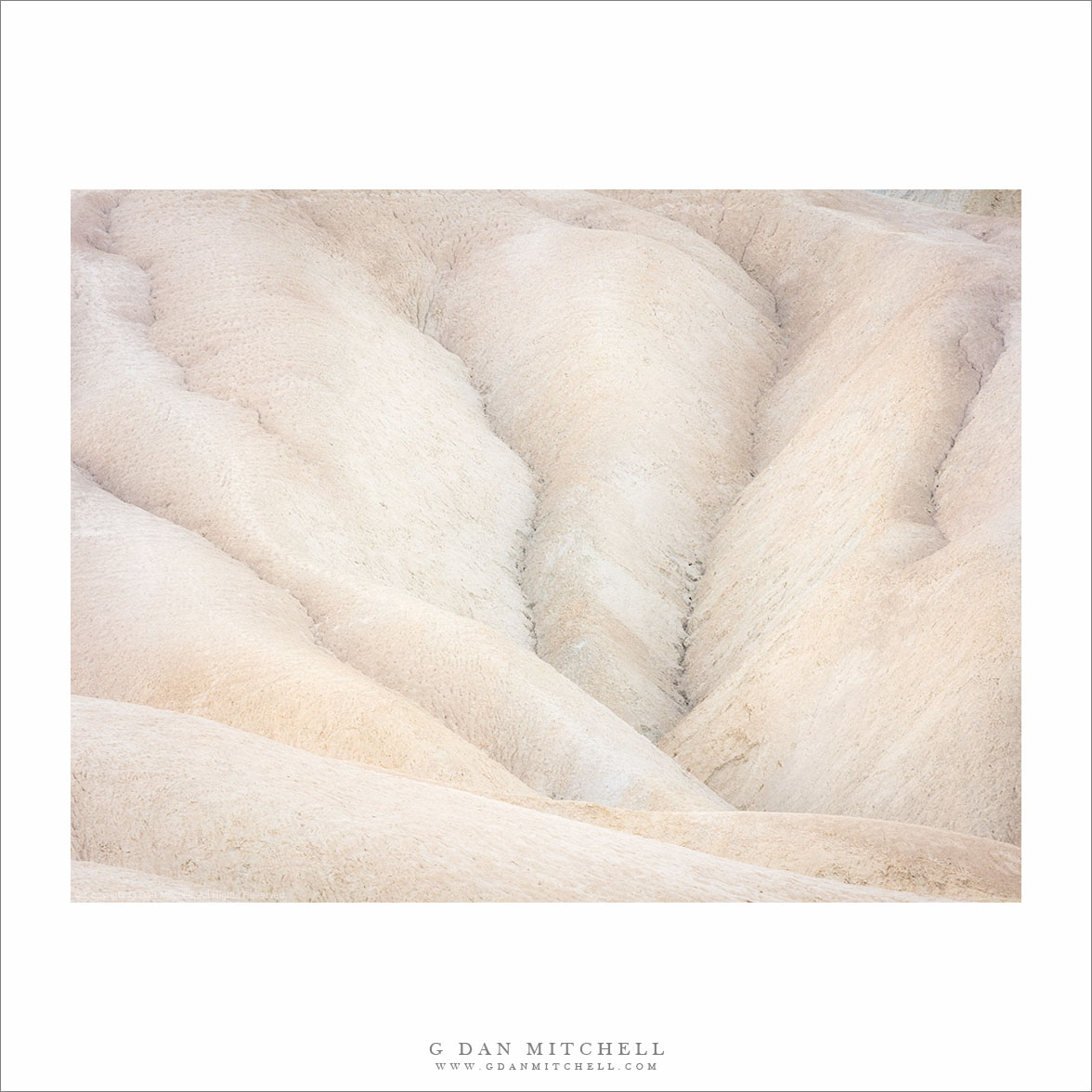
“Gullies in Soft Light #2” — Eroded gullies and ridges in soft light, Zabriskie Point.

In the right light (and perhaps with a certain amount of post-processing) the geological patterns in a place like this can be drawn out and emphasized. But most of the time they are rather subtle, with pastel colors and low levels of contrast. This is especially true early and late in the day when the formations are not in direct sunlight. In this series of photographs from Zabriskie Point I decided to embrace the low contrast light and allow subtleties of shape, texture, and color to predominate.

Previously I mentioned that I ended up here because in the predawn twilight I thought I saw the potential for a spectacular sunrise sky. You cannot predict such things with certainty, and this time the colors did not develop as I hoped. Since I was there and set up to make photographs, I decided to use a long lens and focus on smaller details of this area’s landscape.


Leave a comment or question using the form. (Click the title to see the full article and to comment if you are viewing it on the home page.)

G Dan Mitchell is a California photographer and visual opportunist. His book, “California’s Fall Color: A Photographer’s Guide to Autumn in the Sierra” (Heyday Books) is available directly from him. Blog | Bluesky | Mastodon | Substack Notes | Flickr | Email


All media © Copyright G Dan Mitchell and others.