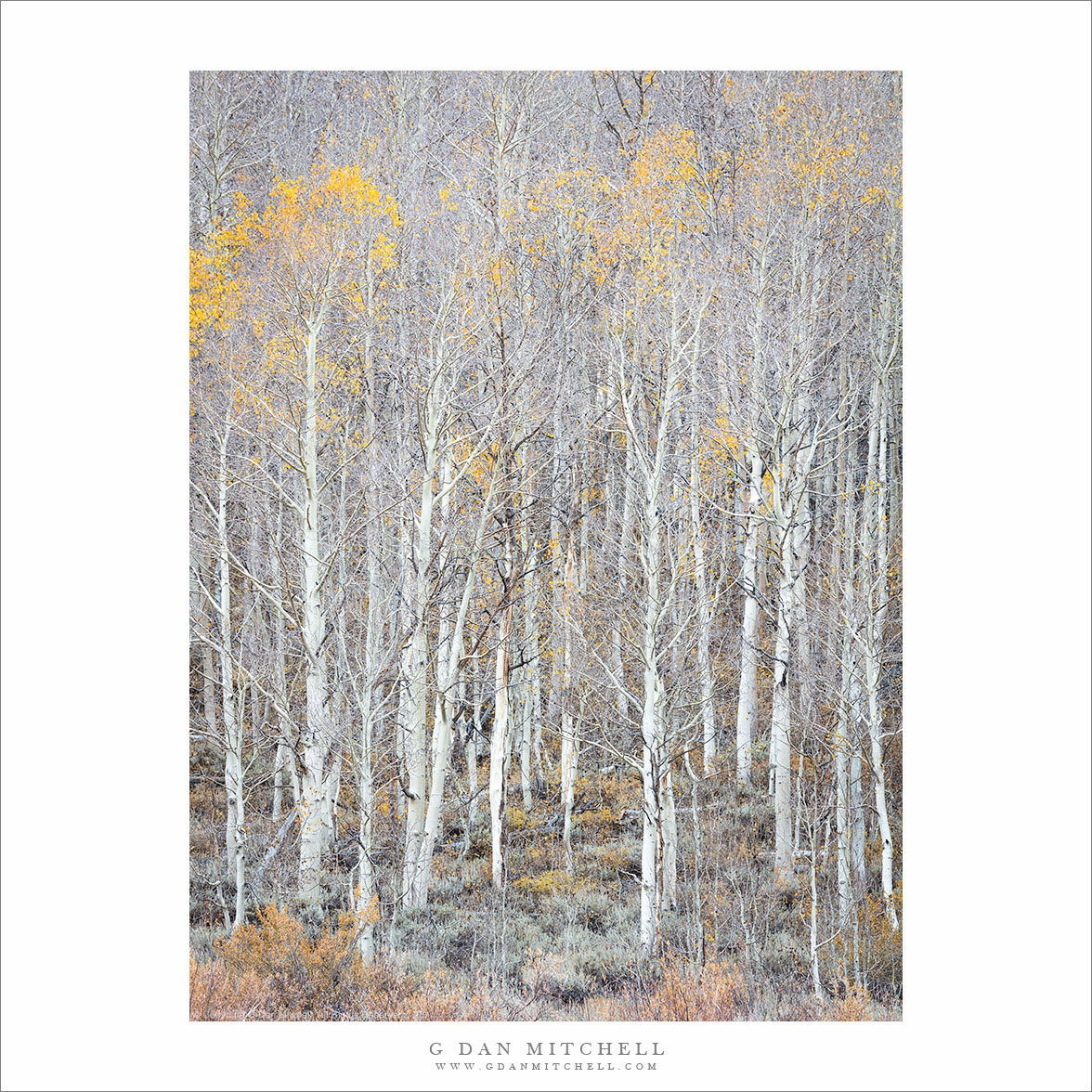
“Aspen Thicket” — A dense aspen thicket, with few remaining leaves.
One of the advantages of returning to the same subjects over the years is that this gives your vision for them time to evolve. Here I speak not just of aspens in general, but of this particular grove of trees. Some years ago, while photographing a different nearby subject, a large grove further up the hillside caught my attention. It posed two challenges. First, getting close to the grove would be extremely difficult. Second, it always seemed to have lost its leaves when the other trees I came to see were at their color peak.
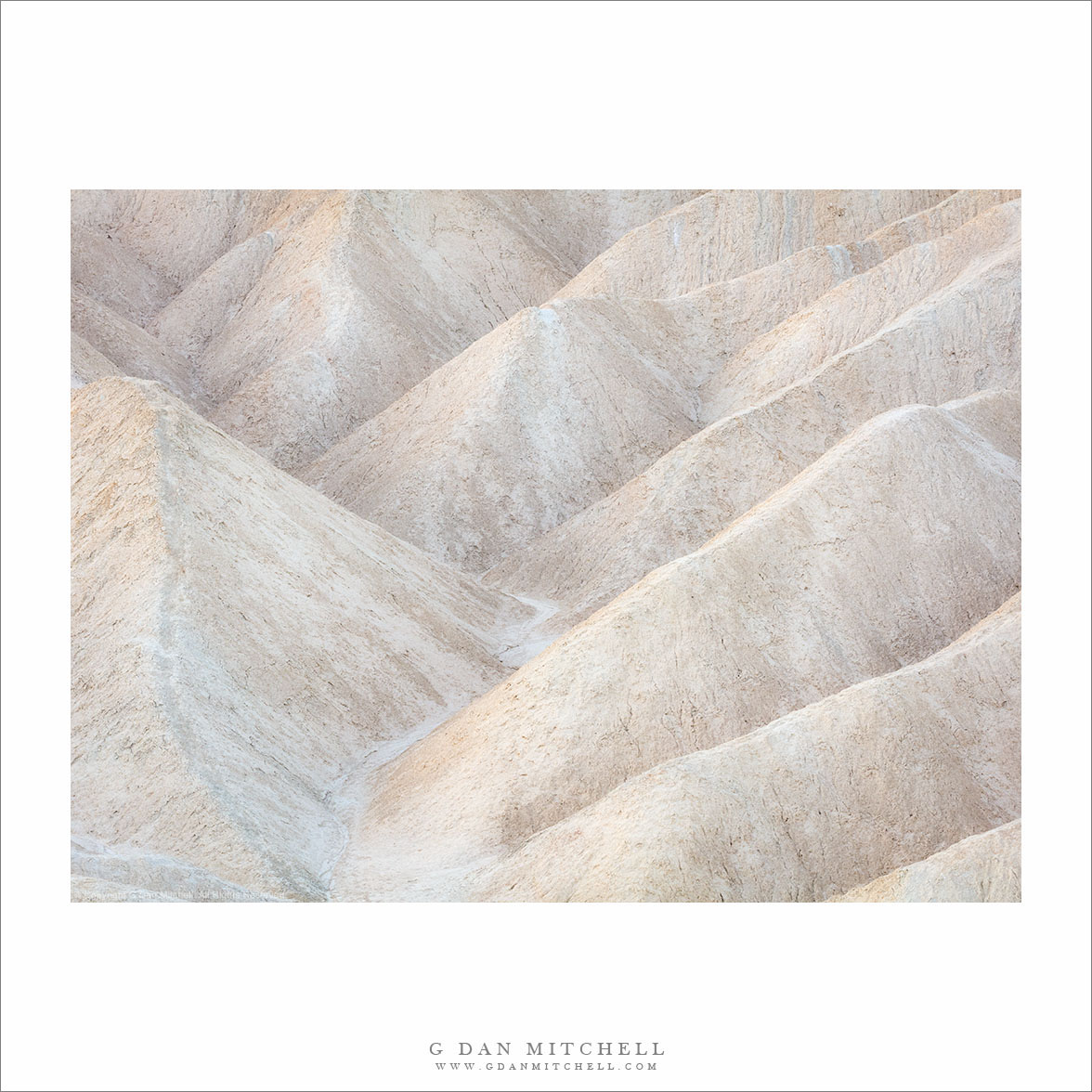
“Gullies in Soft Light” — Eroded gullies and ridges in soft light, Zabriskie Point.
These badlands formations, where soft layers have been eroded by water, can be difficult to photograph. Those difficulties can lead to ethical questions for photographers. The issue is that the range of colors and luminosity in these formations is very limited — the color is basically a light tan and the difference between the light and dark areas is small, at least in soft light. One choice is to enhance that contrast and coloration during the post-processing phase, and that can create some impressive images… though this can depart radically from the actual appearance of the landscape. Here I decided to go with the low contrast and soft colors instead.
To repeat a story I’ve previously related, almost by accident I ended up here to photograph a subject that ultimately did not develop as I had hoped. So I turned my attention to other things nearby, including these formations. I photographed them rather early, before the direct sunlight arrived. This meant that the contrast was even more subdued, as the soft light was from the early morning open sky — directional, but only subtly so.
Join the discussion — leave a comment or question. (Comments are moderated and may not appear immediately. Links in comments may be removed.) Cancel reply
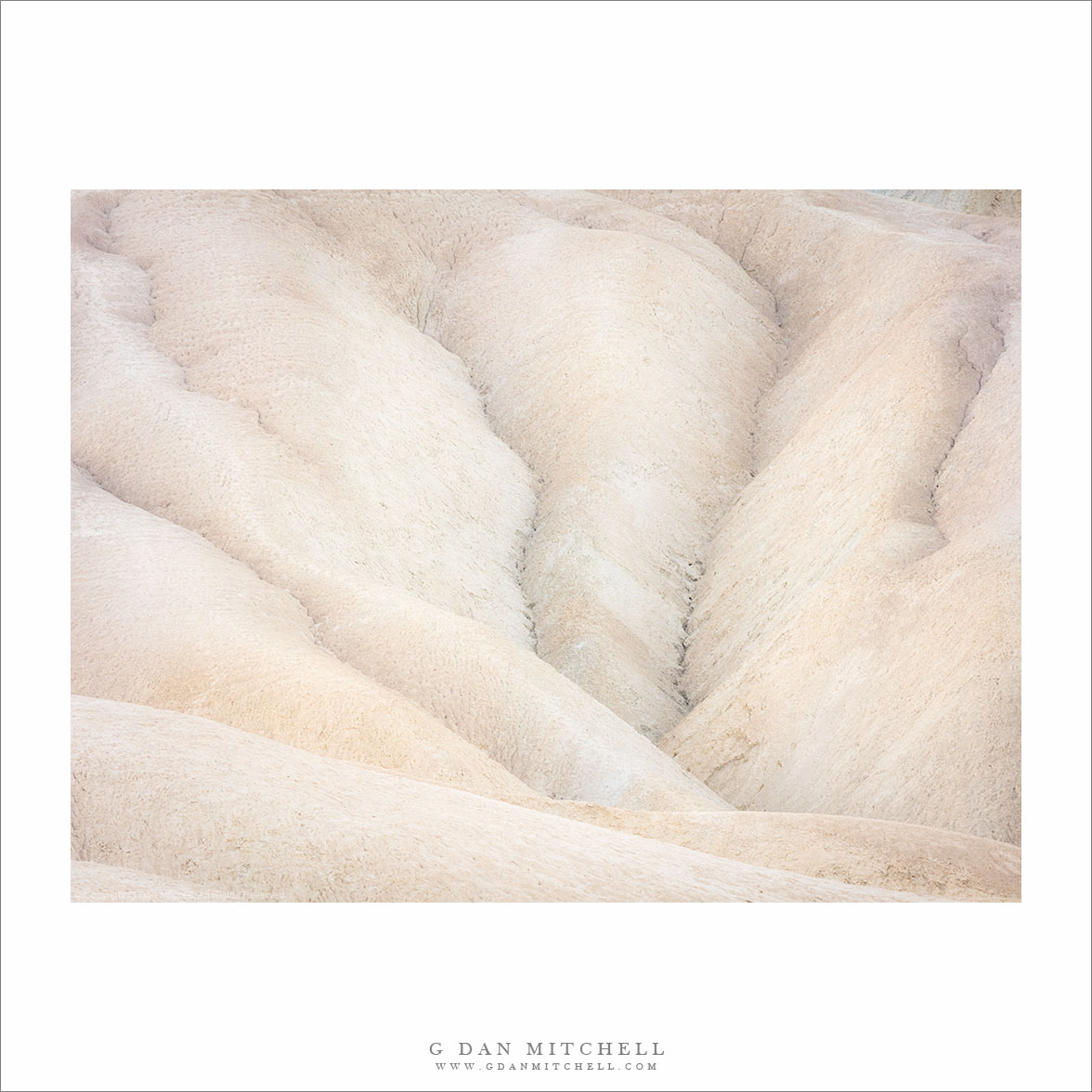
“Gullies in Soft Light #2” — Eroded gullies and ridges in soft light, Zabriskie Point.
In the right light (and perhaps with a certain amount of post-processing) the geological patterns in a place like this can be drawn out and emphasized. But most of the time they are rather subtle, with pastel colors and low levels of contrast. This is especially true early and late in the day when the formations are not in direct sunlight. In this series of photographs from Zabriskie Point I decided to embrace the low contrast light and allow subtleties of shape, texture, and color to predominate.
Previously I mentioned that I ended up here because in the predawn twilight I thought I saw the potential for a spectacular sunrise sky. You cannot predict such things with certainty, and this time the colors did not develop as I hoped. Since I was there and set up to make photographs, I decided to use a long lens and focus on smaller details of this area’s landscape.
“Winter Plants” —Dormant winter plants await spring alongside a Central Valley road.
I like to photograph in California’s Central Valley during the dark and foggy part of the year — roughly from November through the first half of March. (There are some distinctly non-dark days during this period, too.) With the exception of grasses, which start to green up in California during the winter, this is largely a season of dormant plants. As I pass through these wetland areas I’m always intrigued by the forms of these plants, especially when backed by or reflected by the water.
I was out there to photograph birds, but during quieter moments I turned my attention to these plants. Most of them don’t make for good photographs — they have busy backgrounds, they are too thick, or their shapes just aren’t quite right. But every so often I find a specimen that has managed to take on a graceful, even flowing shape.
G Dan Mitchell is a California photographer and visual opportunist. His book, “California’s Fall Color: A Photographer’s Guide to Autumn in the Sierra” is available from Heyday Books, Amazon, and directly from G Dan Mitchell.
Photographer and visual opportunist. Daily photos since 2005, plus articles, reviews, news, and ideas.
Manage Consent
To provide the best experiences, we use technologies like cookies to store and/or access device information. Consenting to these technologies will allow us to process data such as browsing behavior or unique IDs on this site. Not consenting or withdrawing consent, may adversely affect certain features and functions.
Functional
Always active
The technical storage or access is strictly necessary for the legitimate purpose of enabling the use of a specific service explicitly requested by the subscriber or user, or for the sole purpose of carrying out the transmission of a communication over an electronic communications network.
Preferences
The technical storage or access is necessary for the legitimate purpose of storing preferences that are not requested by the subscriber or user.
Statistics
The technical storage or access that is used exclusively for statistical purposes.The technical storage or access that is used exclusively for anonymous statistical purposes. Without a subpoena, voluntary compliance on the part of your Internet Service Provider, or additional records from a third party, information stored or retrieved for this purpose alone cannot usually be used to identify you.
Marketing
The technical storage or access is required to create user profiles to send advertising, or to track the user on a website or across several websites for similar marketing purposes.


Join the discussion — leave a comment or question. (Comments are moderated and may not appear immediately. Links in comments may be removed.)