Tag Archives: badlands

Fractal Landscape

Fractal Landscape, Death Valley National Park
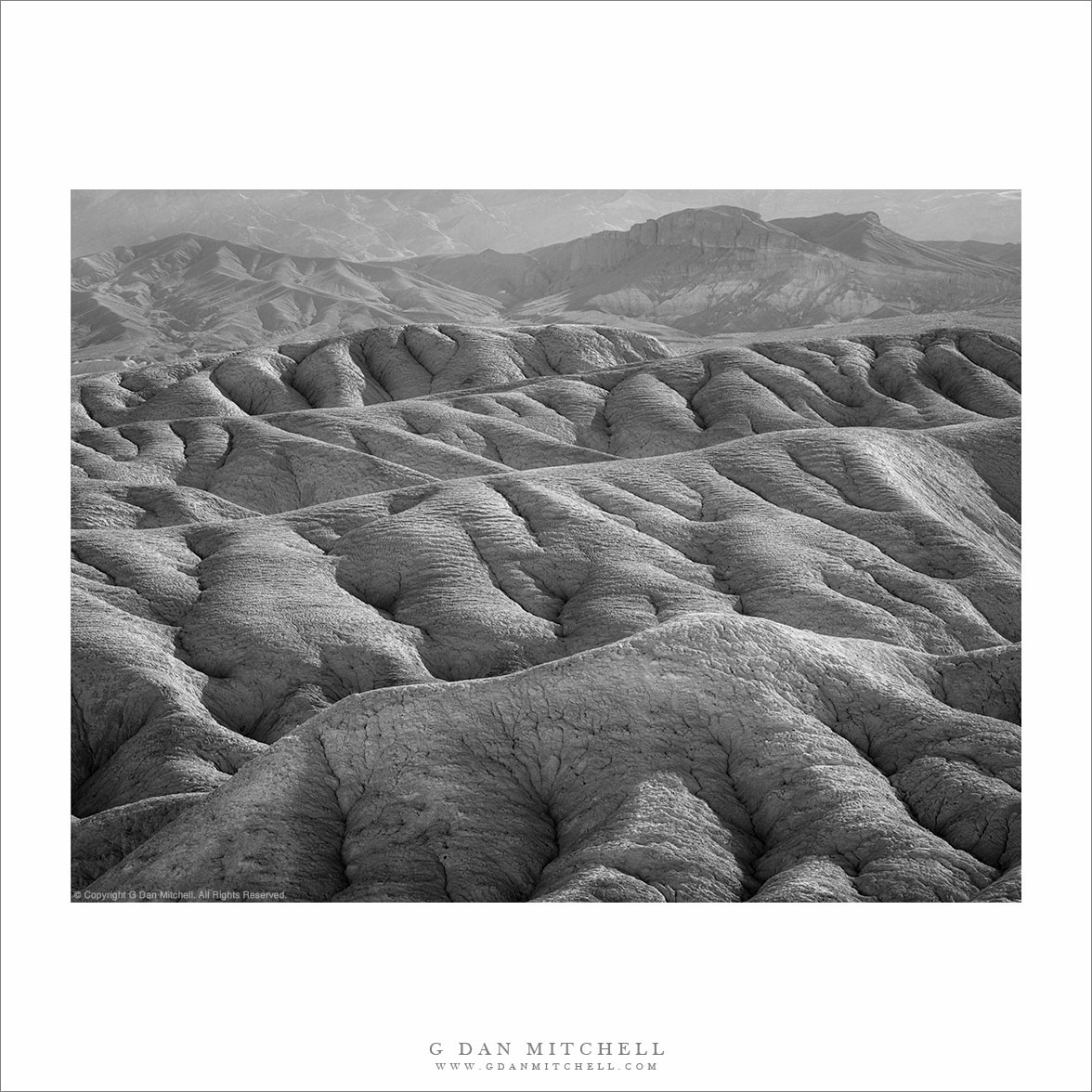
“Fractal Landscape” — A Death Valley landscape of layers of eroded ridges.

This view has intrigued me for years. At one popular Death Valley National Park location, one comes upon it quickly and often briefly. Because it is the coda of visits to this area that has many other attractions, it is easy to overlook it. It is harder to photograph than it seems that it should be — there are some compositional challenges, and unless the light is right the scene can have very low contrast and tricky colors.

The variety of pattens and details in the scene is remarkable. The first four ridges are low and consist of soft, easily eroded material. The more distant ridge is far away, across an intervening valley, and its details are almost always muted by haze. The foreground formations are deeply eroded and cut by gullies — which might seem like an odd thing at first when you consider that you are in an extremely hot and arid desert.


G Dan Mitchell is a California photographer and visual opportunist. His book, “California’s Fall Color: A Photographer’s Guide to Autumn in the Sierra” (Heyday Books) is available directly from him.

G Dan Mitchell: Blog | Bluesky | Mastodon | Substack Notes | Flickr | Email


All media © Copyright G Dan Mitchell and others as indicated. Any use requires advance permission from G Dan Mitchell.
Gullies in Soft Light #2

Gullies in Soft Light #2
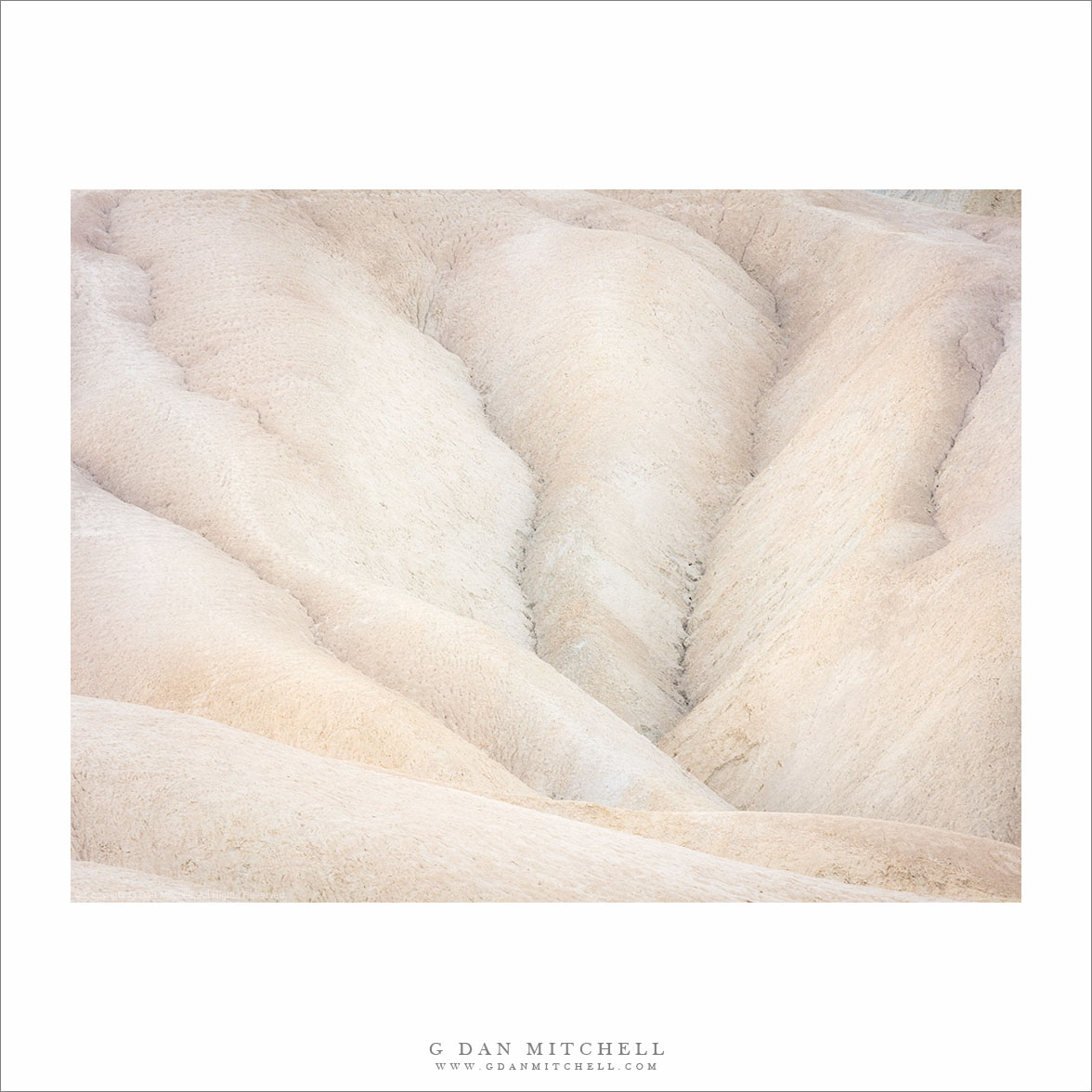
“Gullies in Soft Light #2” — Eroded gullies and ridges in soft light, Zabriskie Point.

In the right light (and perhaps with a certain amount of post-processing) the geological patterns in a place like this can be drawn out and emphasized. But most of the time they are rather subtle, with pastel colors and low levels of contrast. This is especially true early and late in the day when the formations are not in direct sunlight. In this series of photographs from Zabriskie Point I decided to embrace the low contrast light and allow subtleties of shape, texture, and color to predominate.

Previously I mentioned that I ended up here because in the predawn twilight I thought I saw the potential for a spectacular sunrise sky. You cannot predict such things with certainty, and this time the colors did not develop as I hoped. Since I was there and set up to make photographs, I decided to use a long lens and focus on smaller details of this area’s landscape.


Leave a comment or question using the form. (Click the title to see the full article and to comment if you are viewing it on the home page.)

G Dan Mitchell is a California photographer and visual opportunist. His book, “California’s Fall Color: A Photographer’s Guide to Autumn in the Sierra” (Heyday Books) is available directly from him. Blog | Bluesky | Mastodon | Substack Notes | Flickr | Email


All media © Copyright G Dan Mitchell and others.

Badlands Gullies, Morning

Badlands Gullies, Morning — Death Valley
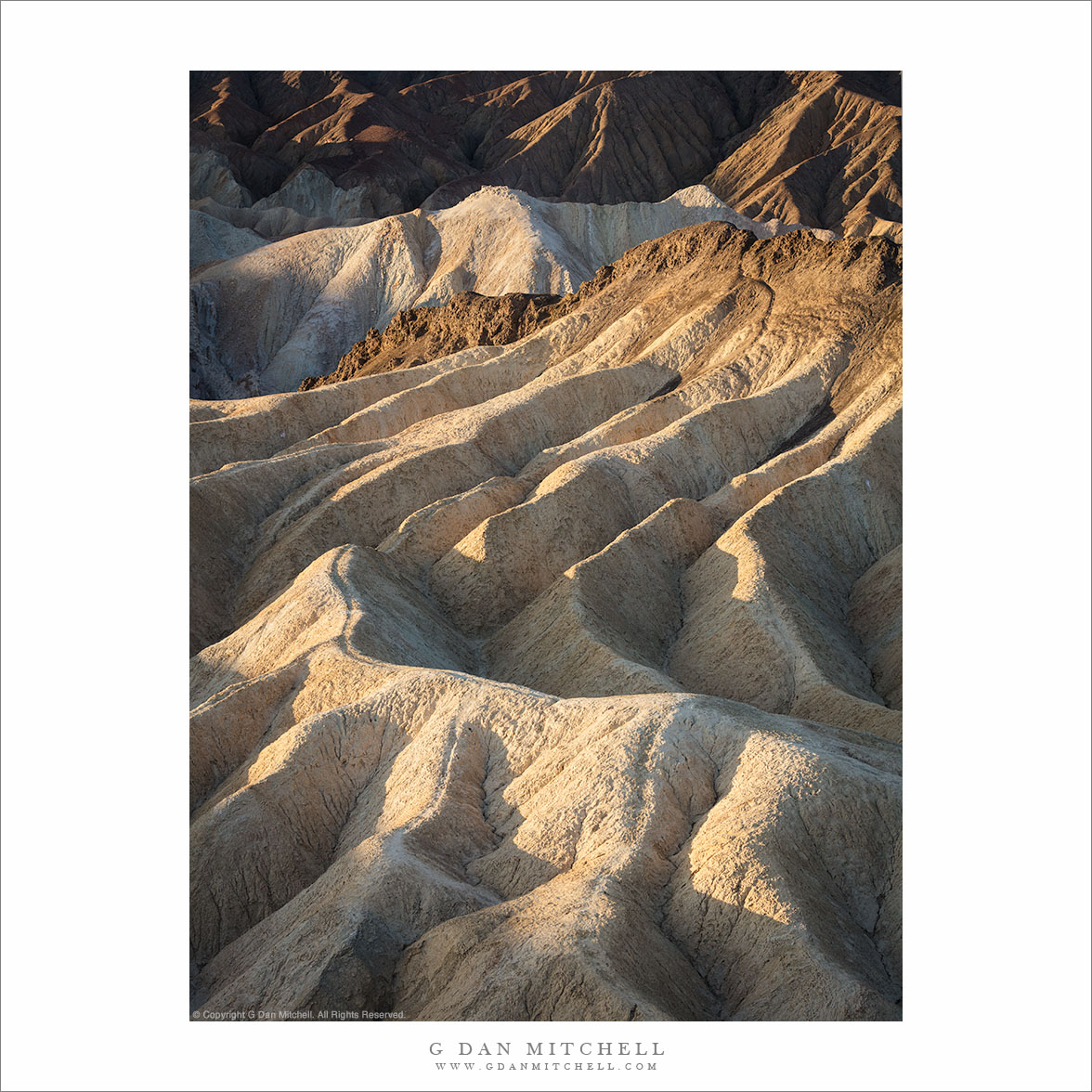
“Badlands Gullies, Morning” — The first direct sunlight sweeps across the curving shapes of badlands erosion gullies, Death Valley.

I have a rule about returning to photograph popular subjects that I first photographed years ago: Only stop if it looks like something unusual and very special might happen. The rule applies to Zabriskie Point in Death Valley, where scores of photographers (and others) gather before dawn to await the sunrise. During the last week of February I drove past on my way to a different subject. In the dim light I thought I saw developing clouds that might produce something special at sunrise. So I (literally) slammed on the brakes, turned around, parked, and joined the throng.


The special light I hoped for didn’t develop. Instead of turning colorful at sunrise, the colors just went flat. Ah, well. I can never be fully certain about what will happen in these situations, and my hunches merely improve the odds — sometimes things don’t work like I hope. But there I was, set up to make photograph s at this location. So, what else could I photograph there? I turned my attention to nearby badlands terrain and photographed it as the direct light arrived, softened a bit by high clouds.

G Dan Mitchell is a California photographer and visual opportunist. His book, “California’s Fall Color: A Photographer’s Guide to Autumn in the Sierra” (Heyday Books) is available directly from him.

G Dan Mitchell: Blog | Bluesky | Mastodon | Substack Notes | Flickr | Email


All media © Copyright G Dan Mitchell and others as indicated. Any use requires advance permission from G Dan Mitchell.
Desert Canyon, Cloud Shadows

Desert Canyon, Cloud Shadows
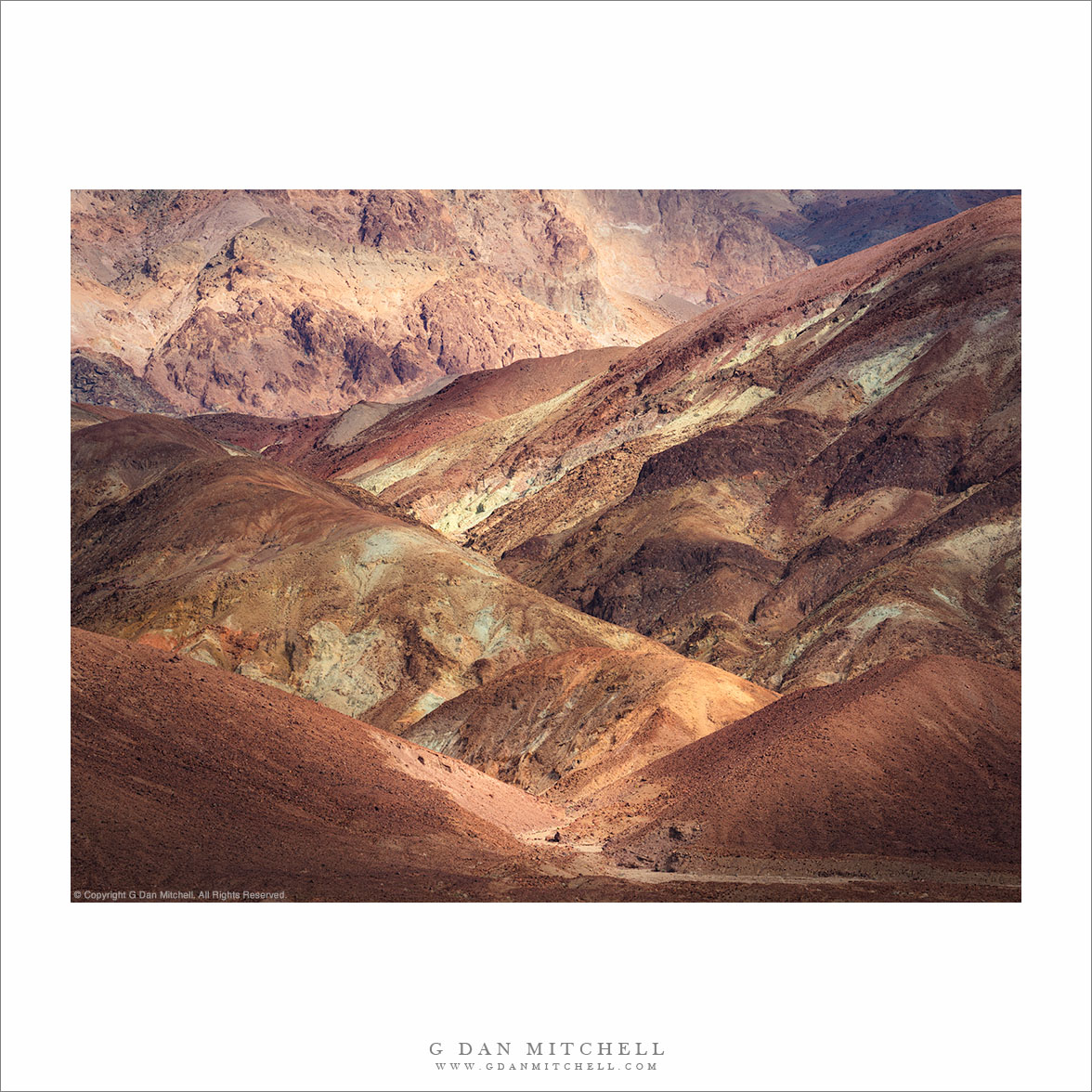
“Desert Canyon, Cloud Shadows” A twisting and colorful desert canyon empties in Death Valley under the shadows of passing clouds.

Light is everything when it comes to photographing the desert landscapes of Death Valley. The terrain is always impressive, but the midday light can be intense and harsh, washing out colors and muting details. But in the right light a feature that might look, well, “washed out” in that intense light can become beautiful. Add a few passing clouds to increase contrasts between light and shadow and things get even more interesting.

I don’t know the name of this little canyon or even if it has one. But I do know that there are canyons like it everywhere in this national park. Many are worth exploring, whether or not there is a trail. In many cases you can just walk carefully up the gravel fan to a canyon’s mouth and then follow a wash up among the quiet hills until you run out of time or the terrain becomes too difficult.


G Dan Mitchell is a California photographer and visual opportunist. His book, “California’s Fall Color: A Photographer’s Guide to Autumn in the Sierra” is available from Heyday Books, Amazon, and directly from G Dan Mitchell.

Blog | About | Instagram | Flickr | Facebook | Threads | PostEmail

Links: Articles, Sales and Licensing, my Sierra Nevada Fall Color book, Contact Info.

Scroll down to share comments or questions. (Click post title first if viewing on the home page.)


All media © Copyright G Dan Mitchell and others as indicated. Any use requires advance permission from G Dan Mitchell.