
Tag Archives: crack

Fractured Granite Ledges

Fractured Granite Ledges

Fractured Granite Ledges. Yosemite National Park, California. July 27, 2011. © Copyright 2011 G Dan Mitchell – all rights reserved.

Exfoliated and fractured granite ledges form patterns in late afternoon light, Yosemite National Park.

While this particular spot happens to be in the neighborhood of Tenaya Creek, similar features may be found throughout Yosemite and in many other parts of the Sierra. These rocks have probably been eroded in just about every way possible. They have been broken away from the underlying rock via exfoliation. The area was obviously glaciated. No doubt freezing water helped to widen the patterns of cracks and break up the rocks.

I made the photograph in late afternoon light when the sun was just barely above a low ridge beyond the upper edge of the photograph. The zoom was cranked out as wide as it goes in order to capture a good width and density of these wonderfully broken up rocks and the trees and other plants that somehow manage to live on and among them.

G Dan Mitchell Photography
About | Flickr | Twitter | FacebookGoogle+ | 500px.com | LinkedIn | Email

Text, photographs, and other media are © Copyright G Dan Mitchell (or others when indicated) and are not in the public domain and may not be used on websites, blogs, or in other media without advance permission from G Dan Mitchell.

(Basic EXIF data may be available by “mousing over” large images in posts. Leave a comment if you want to know more.)
Juniper Tree Trunk, Detail

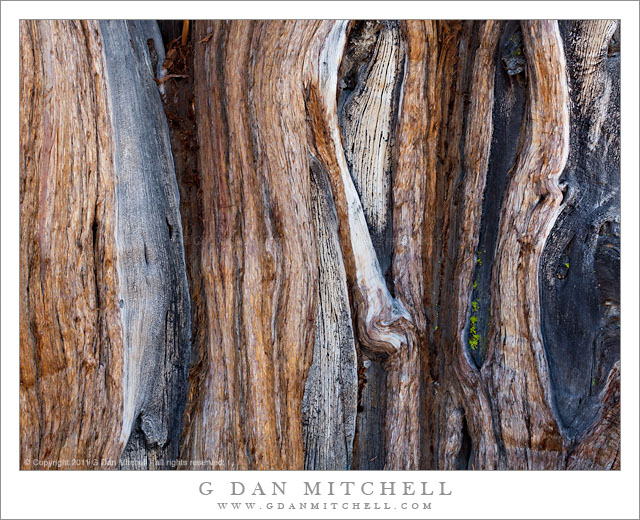
Juniper Tree Trunk, Detail

Juniper Tree Trunk, Detail. Yosemite National Park, California.August 12, 2011. © Copyright 2011 G Dan Mitchell – all rights reserved.

The heavily weathered and contorted trunk of juniper trees near Olmsted Point, Yosemite National Park.

These Sierra juniper trees grow in the most improbable places – on top of granite domes and slabs, with roots somehow finding sustenance in cracks and bits of gravel, and no doubt exposed to the full force of mountain storms. This is actually a group of trees that take advantage of the same crack in the otherwise solid granite, and which have grown together into what almost appears to be one very wide tree at first.

Because of their toughness, the way they grow almost into the rock, and the fact that the trees continue to live even when portions have died, it sometimes seems to me that these trees can have a character that is closer to that of the rock itself than just about any other living thing in the Sierra. The oldest branches and roots grow into the rock and have been shaped so much by their relationship to it that they can almost take on a rock-like character themselves.

These particular specimens happen to be growing part way up a dome-like granite slab above Tioga Pass Road as it passes through Yosemite’s high country. It appears that part of the treed may have been affected by fire, and dead sections have been worn and eroded by the tough sub-alpine environment. The only obvious signs of life in this close up image are the bits of moss or lichen growing in a few cracks in the wood.

G Dan Mitchell Photography
About | Flickr | Twitter | FacebookGoogle+ | 500px.com | LinkedIn | Email

Text, photographs, and other media are © Copyright G Dan Mitchell (or others when indicated) and are not in the public domain and may not be used on websites, blogs, or in other media without advance permission from G Dan Mitchell.

(Basic EXIF data may be available by “mousing over” large images in posts. Leave a comment if you want to know more.)
Tree and Granite, Pywiack Dome

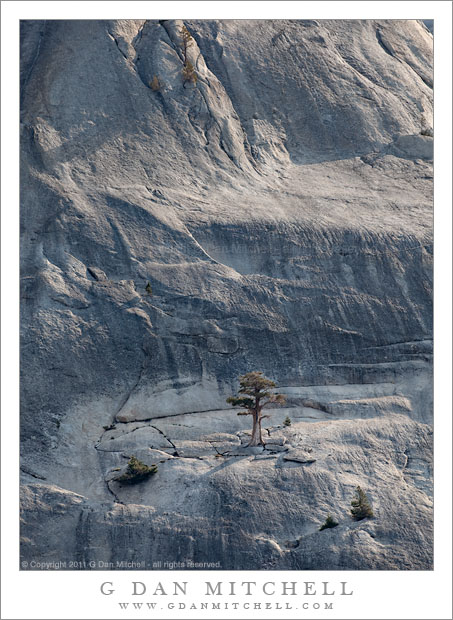
Tree and Granite, Pywiack Dome

Tree and Granite, Pywiack Dome. Yosemite National Park, California. July 27, 2011. © Copyright 2011 G Dan Mitchell – all rights reserved.

A weathered juniper tree grows high on the granite face of Pywiack Dome, Yosemite National Park.

This is another “take” on the same juniper tree high up on the slopes of Pywiack Dome that was seen in another photograph of this area that I posted earlier this week. I went through a process of “refining” the photograph that I described in the earlier post, and this was the interpretation that I came up with right before the landscape orientation version that I posted earlier. Unlike that photograph, this one frames the area of the dome containing the tree more tightly.

The color balance is a bit different in this one, also. I thought about that quite a bit, at first feeling that the coloration should be essentially identical since the images were made at about the same time and include some of the same subject matter. But the more I thought about it – and the more I experimented with the results of trying for uniformity – the more I felt that the two photographs are different images and that different interpretations make sense.

These trees never cease to amaze me. I often come across what are evidently very old trees that seem to grow almost straight out of solid rock, and only a closer inspection reveals that roots have grown tightly into small and unlikely cracks and weaknesses in the granite. That this tree should have managed to take root half way up the side of this large dome is even more amazing, much less that it managed to avoid growing into the stunted and twisted sort of shape that is so common among such trees.

G Dan Mitchell Photography
About | Flickr | Twitter | FacebookGoogle+ | 500px.com | LinkedIn | Email

Text, photographs, and other media are © Copyright G Dan Mitchell (or others when indicated) and are not in the public domain and may not be used on websites, blogs, or in other media without advance permission from G Dan Mitchell.

(Basic EXIF data may be available by “mousing over” large images in posts. Leave a comment if you want to know more.)

Spring Cascade, Polly Dome

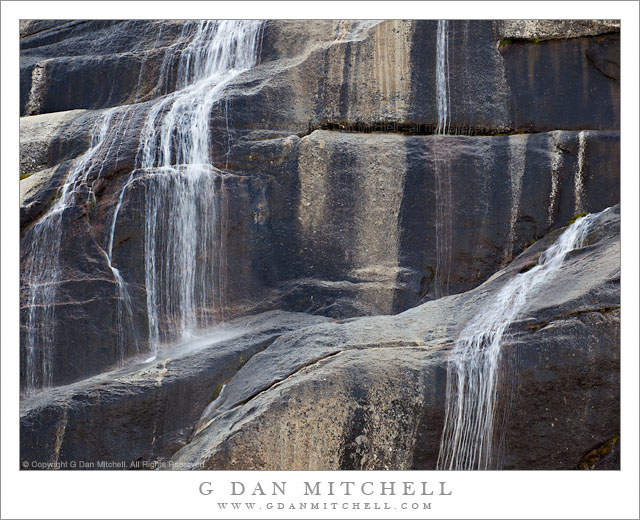
Spring Cascade, Polly Dome

Spring Cascade, Polly Dome. Yosemite National Park, California. June 18, 2011. © Copyright G Dan Mitchell – all rights reserved.

A seasonal spring cascade falls across the granite face of Polly Dome, Yosemite National Park.

I know that the chance to see the high country in winter-like conditions is part of what draws people to the opening of Tioga Pass Road, especially after a heavy snowfall season like this one. But for me the water is at least as much of a draw. The high country comes alive in ways that are not seen during the rest of the year. Because of the long and warmer days, the rate of snow melt accelerates, and when the snowpack is as deep as it is this year, that sets loose an amazing amount of meltwater.

I find full-flowing creeks in places where I didn’t even realize that water flowed. Creeks become raging torrents that threaten to jump their banks. In many places they do rise high enough to flood large expanses of meadow. Seasonal water falls and cascades appear almost everywhere you look.

I spotted this slender cascade high on the granite slopes of Polly Dome, above Tenaya Lake. My first idea was to make a photograph in which a longer stretch of the fall would appear, dropping perhaps several hundred feet. But as often happens, the more I worked this scene the more I wanted to eliminate extraneous material – and I ended up shooting at 400mm to edit out as much of the surround as I could.

G Dan Mitchell Photography | Flickr | Twitter (follow me) | Facebook (“Like” my page) | LinkedIn | Email
Text, photographs, and other media are © Copyright G Dan Mitchell (or others when indicated) and are not in the public domain and may not be used on websites, blogs, or in other media without advance permission from G Dan Mitchell.