Tag Archives: curves

Post-Processing: A Shadow Recovery Example

(In another forum someone asked a question – actually, more like posed a challenge – related to how much usable detail and quality could be extracted from a raw file that contained areas of very low luminosity, as could happen with a badly underexposed image or with an image of a scene with a very large dynamic range. Since I went to the work of responding and illustrating my response, I figured that I might as well share it here, too. With minor revisions, here it is.)

First, I actually have a “real” version of this photograph in which highlights were slightly blown, but which I preferred to use since I could bring them back in post and get a bit more shadow detail to start with. (It looks a bit bright to me as an on-screen jpg, but it makes a fine print.) That photograph ended up looking like this:
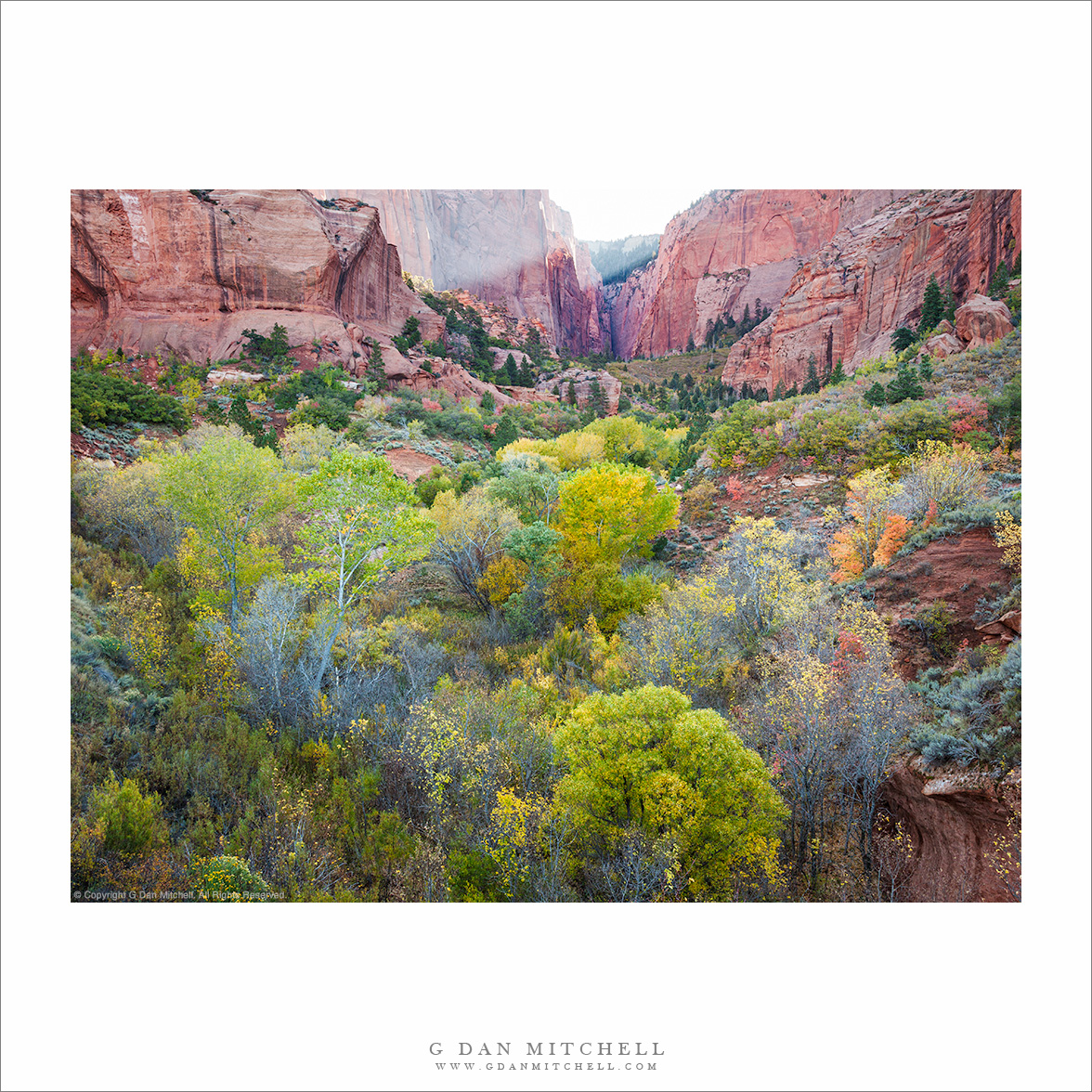
Morning light slants over the top of sandstone cliffs above early autumn foliage in Kolob Canyon, Zion National Park

This photograph and the other I’ll move to below were both shot from a tripod with a Canon EOS 5D Mark II at ISO 100 using the Canon EF 24-105mm f/4L IS at f/16. While the “keeper” used for the photograph above had a 1/4 second exposure, the example I’ll use below was shot at 1/30 second.

The exposure challenge in this scene was the very large dynamic range between the bright spot of sky at the head of the canyon and the much darker colorful foliage in relatively deep shadow in the foreground. Exposing for optimal quality in the foreground would completely blow out the sky, while exposing for the sky would necessarily grossly underexpose the foreground.

I originally thought that I might like to have four bracketed exposures in case that would let me produce a better final image via layer blending, but it turned out to be unnecessary and the final image (as shown above) has a single source file with no blending. However, this means that I still happen to have one very badly underexposed (by three stops) version at 1/30 second which I’ll use here as the starting point for what I plan to illustrate in this post. Follow along with me and see what I can do with the very underexposed version of the file…

Continue reading Post-Processing: A Shadow Recovery Example
Red Rock and Trees, Afternoon Light

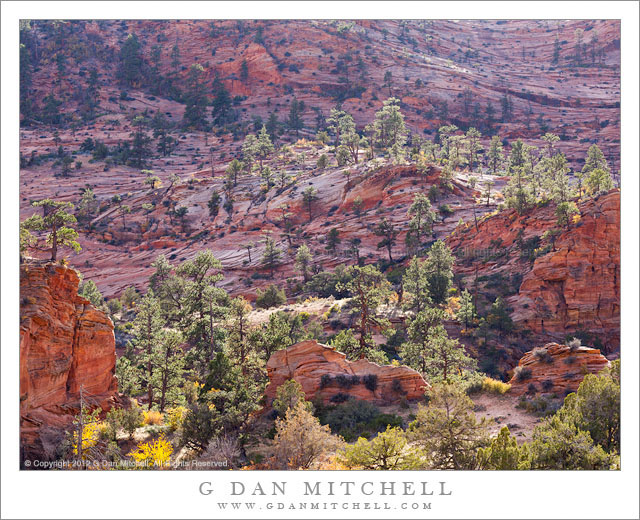
Red Rock and Trees, Afternoon Light - Back-lit trees in low afternoon sun light grow on rocky sandstone high country, Zion National Park
Back-lit trees in low afternoon sun light grow on rocky sandstone high country, Zion National Park

Red Rock and Trees, Afternoon Light. Zion National Park. October 22, 2012. © Copyright 2012 G Dan Mitchell – all rights reserved.

Back-lit trees in low afternoon sun light grow on rocky sandstone high country, Zion National Park

As much as I have come to love Zion Canyon itself, with its monumental cliffs, winding Virgin River, and cottonwood trees, something still draws me more strongly to the high country such as that found along the Mount Carmel Highway. (I’m sure that the “real” backcountry will eventually appeal to me just as much, but my “getting acquainted” process with Zion is still in its relatively early phase.) This higher elevation terrain, which can at first perhaps seem somewhat overly complex and even “disorganized – if that makes sense – has come to hold more interest for me photographically, though it has been a bit more difficult to figure out how and when and where to photograph it. I was intrigued by these wonderfully complex sandstone patterns of curves and lines when I first saw them, but initially had a hard time seeing coherent photographs among them.

Since my first visit – less than a year ago, believe it or not – I have now had the opportunity to revisit this area on quite a few days, and I feel like I’m starting to “get” its rhythms. Initially it was a matter of passing along the roadway through the park and catching glimpses of juxtapositions of features, bits of light or color, and various canyons and prominences and thinking “there must be a way to photograph that.” Return visits, in various types of light, during two seasons, and at all hours of the day have helped me figure it out. Among my favorite subjects here (and elsewhere!) are backlit trees, here combined with some low ridges and the swooping curves and textures of the wonderful red rock.

G Dan Mitchell is a California photographer whose subjects include the Pacific coast, redwood forests, central California oak/grasslands, the Sierra Nevada, California deserts, urban landscapes, night photography, and more.

Blog | About | Flickr | Twitter | FacebookGoogle+ | 500px.com | LinkedIn | Email

Text, photographs, and other media are © Copyright G Dan Mitchell (or others when indicated) and are not in the public domain and may not be used on websites, blogs, or in other media without advance permission from G Dan Mitchell.

Dunes, Eureka Valley, Morning

Dunes, Eureka Valley, Morning - Morning light and haze at the Eureka Valley Dunes, Death Valley National Park, California.
Morning light and haze at the Eureka Valley Dunes, Death Valley National Park, California.

Dunes, Eureka Valley, Morning. Death Valley National Park, California. January 6. 2012. © Copyright 2012 G Dan Mitchell – all rights reserved.

Morning light and haze at the Eureka Valley Dunes, Death Valley National Park, California.

This seems like a typical desert scene, right? Hot, arid, a bit of summer haze… It may look that way, but it was 28 degrees when I made this photograph!

At the tail end of my early January photography visit to Death Valley National Park I went north from the Ubehebe Crater area on the long gravel route up to the remote Eureka Valley Dunes, which are described as the tallest dunes in the United States, being nearly 700 feet tall. I decided to visit here at the end of my trip for several reasons – first, believe it or not, I had not been to this major feature in the park before. Second, because the trans-Sierra passes were still open in the strange weather year, by going out the north end of the park I figured I could shorten my drive back to the Bay Area a bit.

I arrived the night before, just in time to shoot a little bit as the last light came and went. Then I spent a very cold night “camping” in the back of my car. I was up reasonably early, but it was so cold that it was very hard to get out of the sleeping bag. Finally I did so, and I put on all my warm clothes and marched around the camping area trying to warm up a bit. Finally, after the morning sun topped the tall ridge to the east, the light arrived and my world began to warm up a bit. Eventually I packed up and started my trip back out to civilization. But first I wanted to stop a ways out in the valley and do some long shots back towards the dunes. This is one of those photographs, made from a ways down the road using a long lens.

Somewhat surprisingly, when I finally got back in my car a bit after 9:00 a.m. and long after the sun arrived, I finally thought to check the outside temperature on my car’s thermometer. At about 9:15, out in the valley, and in the sun… the temperature had finally risen… to 28 degrees!

G Dan Mitchell is a California photographer whose subjects include the Pacific coast, redwood forests, central California oak/grasslands, the Sierra Nevada, California deserts, urban landscapes, night photography, and more.
Blog | About | Flickr | Twitter | FacebookGoogle+ | 500px.com | LinkedIn | Email

Text, photographs, and other media are © Copyright G Dan Mitchell (or others when indicated) and are not in the public domain and may not be used on websites, blogs, or in other media without advance permission from G Dan Mitchell.

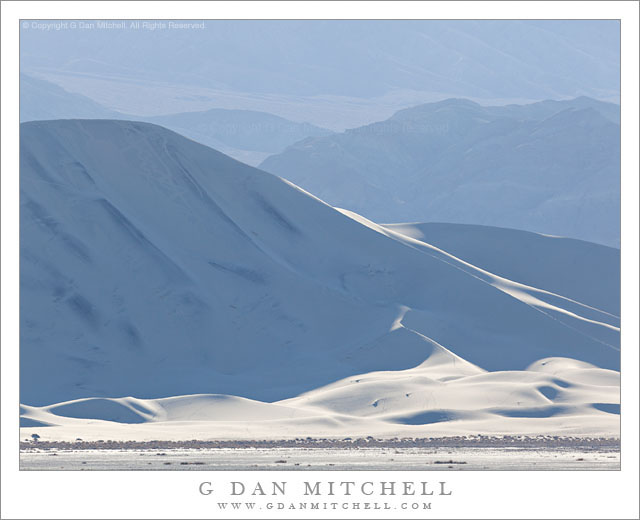
Mesquite Dunes and Cottonwood Mountains

Mesquite Dunes and Cottonwood Mountains

Mesquite Dunes and Cottonwood Mountains. Death Valley National Park, California. March 29, 2011. © Copyright G Dan Mitchell – all rights reserved.

Soft and hazy late-afternoon light on Mesquite Dunes and lower Cottonwood Mountains, Death Valley National Park.

The color of the sand dunes of Death Valley changes radically at different times of the day, in different weather conditions, and even seasonally. Many of the photographs of these dunes – the “Mesquite Dunes” in the middle Valley near Stovepipe Wells – are made in the early morning or in the evening. At those times the dunes take on the colors of sunrise/sunset light (generally very warm yellow to golden colors) or the pre-dawn or (better yet) post-sunset light of the sky, which can include a range of colors from blues to pinks to purples and so on. Judging by photographs you might think that the dunes are brightly and intensely colorful. (Or black and white, but that’s a different story.)

Most of the time the coloration is quite different from what we see at the early and late “edges” of the day. The less saturated colors at other times of day can be a bit more complicated to shoot, but they can also create some wonderful subtle effects if you happen to look in the right place at the right time. Late in the afternoon on this early spring day, there was some haze in the atmosphere – perhaps from some blowing dust and/or some clouds and moisture that had been around earlier. As the sun drops at Mesquite Dunes, it goes behind mountains to the west well before actual sunset. When this happens, the dunes are gently back-lit by soft light from the western sky, and the backlit haze mutes the colors of the dunes and, even more, the distant slopes of the rugged Cottonwood Mountains.

My idea here was to isolate the undulating shapes of the softly lit dunes in front of the background of the very, very muted colors and shapes of the lower Cottonwood Mountains, which are obscured by haze. There is some color in this scene, but it is subdued and edges quite a ways towards pastels.

G Dan Mitchell Photography | Flickr | Twitter | Facebook | Email
Text, photographs, and other media are © Copyright G Dan Mitchell (or others when indicated) and are not in the public domain and may not be used on websites, blogs, or in other media without advance permission from G Dan Mitchell.