Tag Archives: dead

Snag, Sky

Snag, Sky
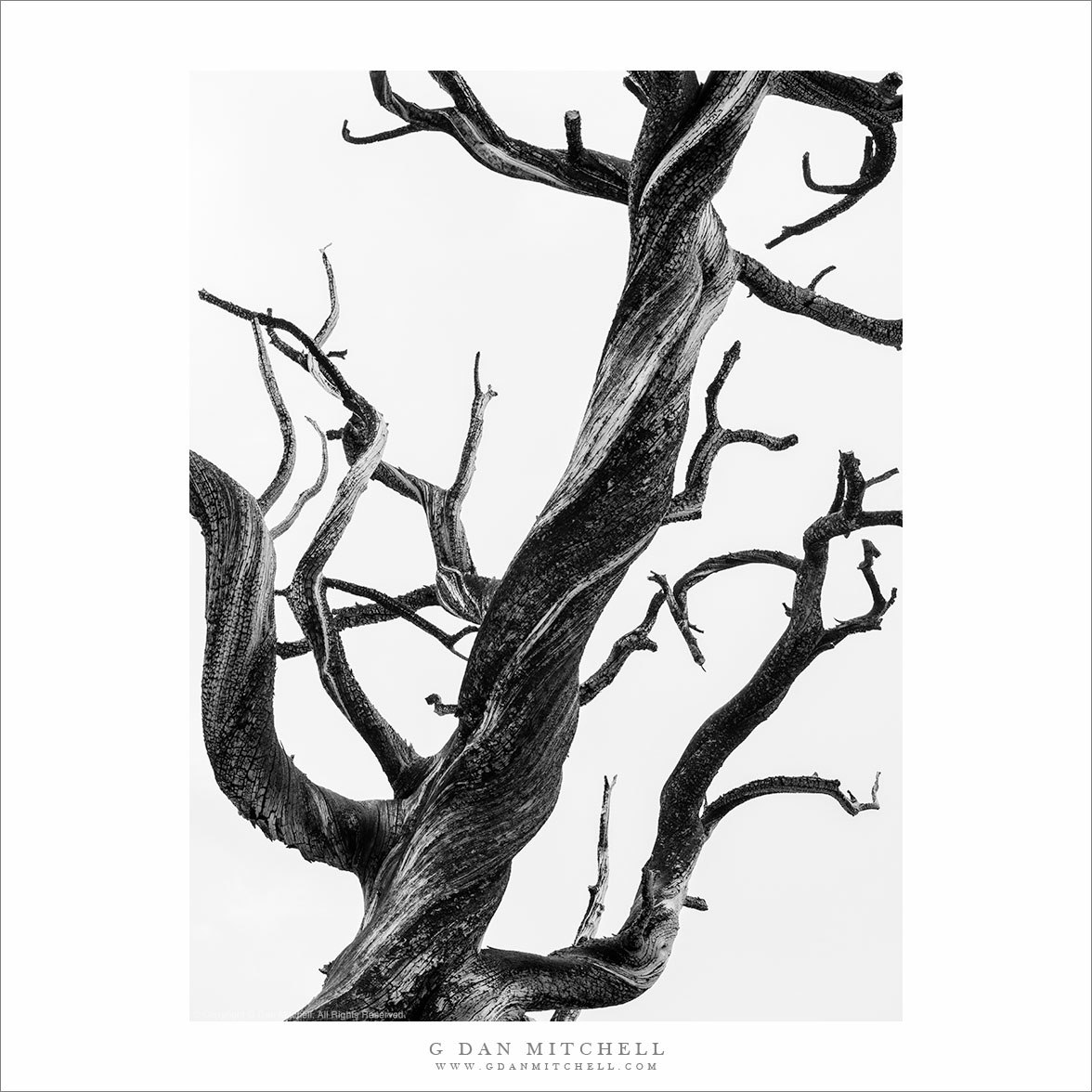
“Snag, Sky” — An old, twisted snag against a gray and cloudy Sierra Nevada sky

Old dead snags can be some of the most compelling sights in the High Sierra. They are everywhere —on the glaciated granite slabs, high atop ridges, within the first, lying in meadows. They are the other end of the life cycle begin by small trees at the edges of meadows. Sometimes to me they seem almost closer in spirit to rocks than to other living things, and some that die in dry rocky places continue to stand for a long time before finally decaying and fading away. Because they are stripped of small branches and needles, the reveal the complex and twisting shapes of the inner tree.

I came across this snag high in an area of granite slabs above a lake where we were camped. I visited it several times, intrigued by its shape and challenged to figure out a way to photograph it that did not include the surrounding living trees. Finally I found an angle that I could photograph with a long lens, tightly cropping a section of its form against the gray of a cloudy sky. In the end I decided on a monochrome rendition, feeling that it better captures the abstract from of the trunk and branches.


Leave a comment or question using the form. (Click the title to see the full article and to comment if you are viewing it on the home page.)

G Dan Mitchell is a California photographer and visual opportunist. His book, “California’s Fall Color: A Photographer’s Guide to Autumn in the Sierra” (Heyday Books) is available directly from him. Blog | Bluesky | Mastodon | Substack Notes | Flickr | Email

All media © Copyright G Dan Mitchell and others.
Fallen Tree, Lake Shore Autumn Grasses

Fallen Tree, Lake Shore Autumn Grasses
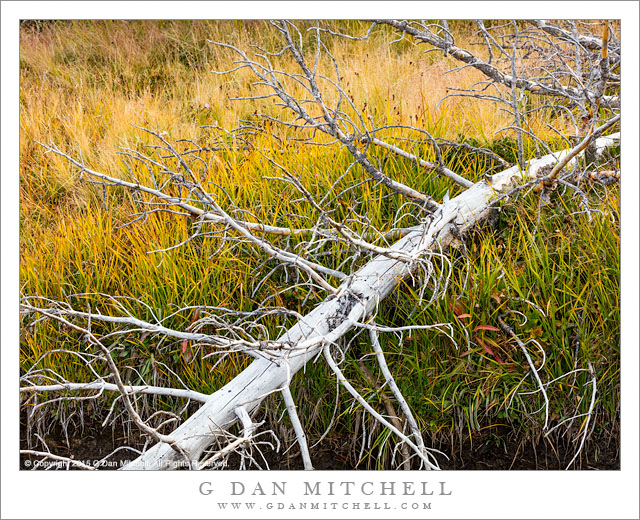
An old fallen tree and lakeshore autumn grasses at a Sierra Nevada lake.

Fallen Tree, Lake Shore Autumn Grasses. Yosemite National Park, California. September 12, 2015. © Copyright 2015 G Dan Mitchell – all rights reserved.

An old fallen tree and lakeshore autumn grasses at a Sierra Nevada lake.

During a week at this backcountry lake and the surrounding area I had plenty of time to wander about, work in varied conditions, and see beyond the obvious first impressions. After a few long stays in such places I have come to be familiar with a certain cycle. I arrive with a mixture of “how will I ever manage to find enough here for a week of work?” and “once I slow down I know there will be plenty to see.” After a day of settling in it begins to feel like there will be plenty to photograph, but that there is no real urgency to the work. I tend to wander, looking at whatever happens to catch my attention and not really working much from a plan. At some point near the middle of the stay there comes a time when I do a count of subjects remaining to photograph and number of mornings/evenings remaining… and I realize that I have to formulate a plan! And then, invariably, on the final day or two I realize that even with a week to work there will be subjects that I won’t get to.

I photographed this scene close to the midway point on the trip — when there still seemed to be plenty of time and just before I felt the need to begin planning more carefully. This is a wonderful time on such a trip, when there are opportunities to engage in “aimless” wandering — though there is very much an aim to that aimlessness! This subject is one that I could easily overlook early on during a trip or during the end-of-trip attention to specific remaining subjects. The skeletal gray of the fallen tree contrasts wonderfully with the rich coloration of the early fall meadow around the edges of this sub-alpine lake.


G Dan Mitchell is a California photographer and visual opportunist. His book, “California’s Fall Color: A Photographer’s Guide to Autumn in the Sierra” is available from Heyday Books and Amazon.
Blog | About | Flickr | Twitter | FacebookGoogle+ | 500px.com | LinkedIn | Email


All media © Copyright G Dan Mitchell and others as indicated. Any use requires advance permission from G Dan Mitchell.

Dead Trees, Sandstone Pothole

Dead Trees, Sandstone Pothole
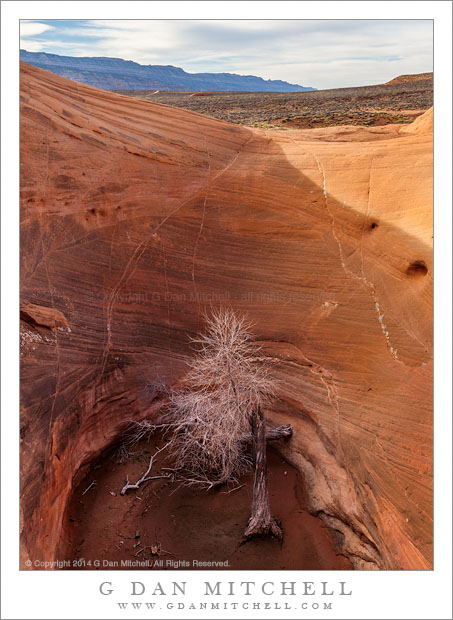
Dead trees lie at the bottom of a deep sandstone pothole, Grand Staircase-Escalante National Monument

Dead Trees, Sandstone Pothole. Grand Staircase-Escalante National Monument, Utah. October 23. 2014. © Copyright 2014 G Dan Mitchell – all rights reserved.

Dead trees lie at the bottom of a deep sandstone pothole, Grand Staircase-Escalante National Monument

There are multiple ways to react to the remarkable sandstone potholes from this terrain of rounded sandstone hills and gentle slabs. First of all, they are remarkable structures. They are simply “holes” in the sandstone — but surprisingly large holes. They are many feet across and perhaps 15-20 feet deep. They have no outlet, and you can imagine that with the right water source they would make rather gigantic swimming holes. Their source is not immediately apparent, though I understand that they are created over a long period of time by the forces of wind and water on the relatively soft sandstone.

They are beautiful, too. Their smooth, curving shapes have an almost sensuous quality, made stronger by the warm colors of the sandstone rock. Surprisingly, plants and even trees grow at the bottom of many of them. But these potholes may also be traps — there is no way out of their depths except for those creatures that can fly. In the middle or relatively smooth expanses of sandstone, these pits appear suddenly, and the angles at their edges quickly increase to vertical, making them potentially dangerous. The pothole in this photograph seems to me to have a bit less of the rock garden quality and a bit more of the ominous quality, with two dead cottonwood trees and broken branches littering the bottom of the pit.


G Dan Mitchell is a California photographer and visual opportunist. Blog | About | Flickr | Twitter | FacebookGoogle+ | 500px.com | LinkedIn | Email


All media © Copyright G Dan Mitchell and others as indicated. Any use requires advance permission from G Dan Mitchell.

Corn Field, Fog

Corn Field, Fog
Corn Field, Fog

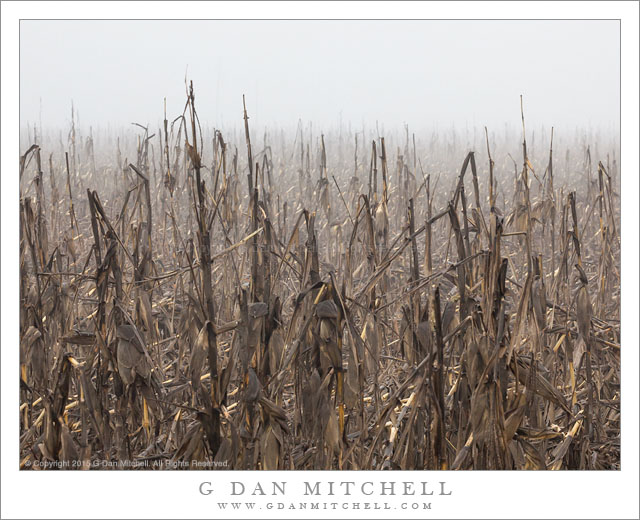
Corn Field, Fog. San Joaquin Valley, California. January 16, 2015. © Copyright 2015 G Dan Mitchell – all rights reserved.

The winter remains of a corn field in San Joaquin Valley

I used to imagine that wildlife refuges, those areas that are intended to provide habitat for wild critters, were something like parks of wilderness. Since I’ve been photographing winter birds in California I have learned that this presumption is usually dead wrong. There are a few such places that are left in their natural state, but many of them are distinctly non-natural locations. (Many are also there because hunters want to ensure that birds are there for them.) Quite a few of these places are agricultural, including some that I often visit.

I’ve seen some where the flooded winter fields were rice fields. This one is a corn field during much of the year and part of a very interesting and busy wildlife refuge in the winter. As I was there photographing birds recently, I looked across a field of dead corn plants fading into the distant fog and something about this desolate scene seemed worth a photograph, and I like the rather different mood that it evokes for me.


G Dan Mitchell is a California photographer and visual opportunist whose subjects include the Pacific coast, redwood forests, central California oak/grasslands, the Sierra Nevada, California deserts, urban landscapes, night photography, and more.
Blog | About | Flickr | Twitter | FacebookGoogle+ | 500px.com | LinkedIn | Email

Text, photographs, and other media are © Copyright G Dan Mitchell (or others when indicated) and are not in the public domain and may not be used on websites, blogs, or in other media without advance permission from G Dan Mitchell.