
Tag Archives: death valley

An Informal (and Surprising!) Death Valley Wildflower Report

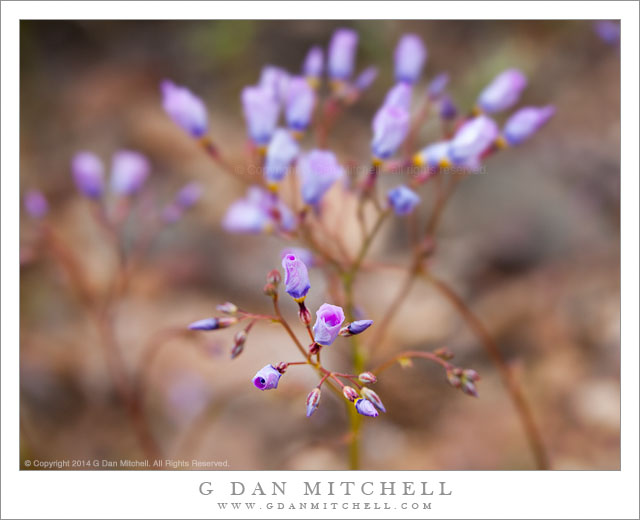
Gilia Buds
Gilia Buds

Gilia Buds. Death Valley National Park, California. April 2, 2014. © Copyright 2014 G Dan Mitchell – all rights reserved.

Gilia buds opening on a rainy day, Death Valley National Park

This is going to be a sort of hybrid post, covering two subjects and out of phase with my normal daily photograph posts. Think of it as a bonus post—a photograph and an informal report on Death Valley National Park wildflowers. The description of this photograph follows the report on Death Valley wildflower conditions.

Wildflower Conditions

By now it is no longer news that California and other parts of the west are in the throes of a very serious drought. The situation is especially serious in California, which is now experiencing the worst in a series of three below-normal precipitation years. Many parts of the state are experiencing what have been described as historic drought conditions. The situation remains critical—and many of us are worried about the upcoming wildfire season—though recent March and early April rains brought a bit of relief.

All spring I have been hearing that the drought would make this a poor year for desert wildflowers in Death Valley. However, I knew that Death Valley had experienced some rain events in the past few months and that desert plants are quite opportunistic, often quickly blooming in response to moisture. I know Death Valley fairly well, though I’m no expert on wildflowers. However, I had a hunch that we might be surprised by how the wildflower season would play out.

We visited the park for several days right around the beginning of April. Even before we arrived, we saw a decent number of wildflowers as we drove across other desert areas on the way to the park. It seemed like plants were acting in the opportunistic manner I describe above and quickly sprouting up and blooming in response to recent rains. As we entered the park and crossed Towne Pass we (especially my wife, who is passionate about photographing the “small things”) began to notice a lot of wildflowers in many places, including whole beds of colorful flowers in many places along this drive. While we did not see the tremendous blooms on the Valley floor that can occasionally occur, once we got up into higher country we saw flowers everywhere, at least when we slowed down and looked. There was more rain and snow during our visit, and the additional moisture is bound to encourage other plants and flowers to grow.

I just saw a report at the Desert USA website (which names the flowers in ways that I cannot hope to do) confirming what we saw—that there is actually a substantial bloom of desert wildflowers in many places. If you have the opportunity to head out that way soon, do so!

About the Photograph

Believe it or not, it was snowing lightly when I made this photograph! We began our day by driving on gravel roads before sunrise to reach a high location in the Panamint Range from which we planned to photograph at sunrise. The sunrise photography turned out to be a challenge, as it was cloudy at first light and the clouds only increased as the sunrise progressed. Soon we began to notice snow falling on nearby peaks, though it did not fall where we were until after we moved on. Later, in a less exposed location but with temperatures in the low thirties, we encountered our first very light snowfall, and we could see that it was snowing more heavily on the peaks and ridges around us.

We moved on, heading up into Wildrose Canyon. My original plan had been to drive to the end of the road, but by the time we reached the Charcoal Kilns it was snowing hard enough that this no longer seemed like a great idea. In fact, other drivers with two-wheel drive vehicles were having problems ascending the last section of the road to the kilns. We photographed the snowy conditions here and back in Wildrose Canyon, and then as the snow abated a bit we drove on, heading back in the direction of Emigrant Pass. Not far from the pass we found a hillside covered with a spectacular display of flowers. At first it was some cacti that caught our attention, but as we got out and looked around we saw many, many flowers all around. These gilia buds had not yet opened into their more showy display.

G Dan Mitchell is a California photographer and visual opportunist whose subjects include the Pacific coast, redwood forests, central California oak/grasslands, the Sierra Nevada, California deserts, urban landscapes, night photography, and more.
Blog | About | Flickr | Twitter | FacebookGoogle+ | 500px.com | LinkedIn | Email

Text, photographs, and other media are © Copyright G Dan Mitchell (or others when indicated) and are not in the public domain and may not be used on websites, blogs, or in other media without advance permission from G Dan Mitchell.
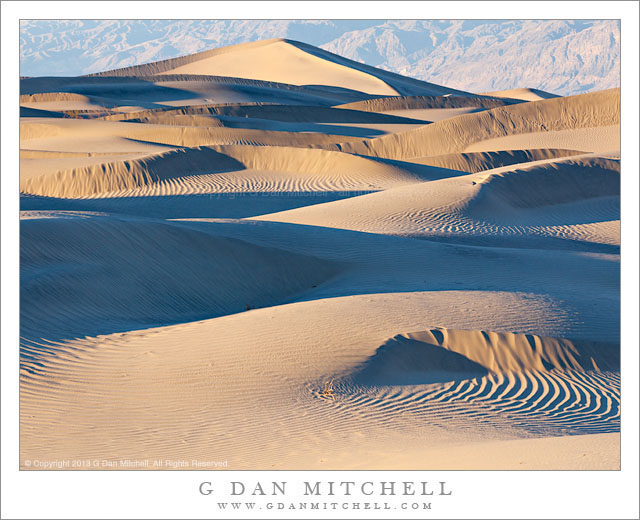
Dunes, Evening

Dunes, Evening
Dunes, Evening

Dunes, Evening. Death Valley National Park, California. December 11, 2013. © Copyright 2014 G Dan Mitchell – all rights reserved.

Receding layers of sand dunes in evening light, Death Valley National Park

After a very long day spent driving a lengthy backcountry gravel road through mountainous terrain, I headed back to my camp at Furnace Creek to take care of camp business and grab something to eat. As I usually do in Death Valley, I scheduled my day around a morning subject and an evening subject. Since the morning work had lasted so long, I was thinking of something closer for the evening and, besides, by the time I was ready to shoot it was probably too late to travel very far in the remaining light before the early sunset of this December day. So I decided to travel up the valley a bit to well-known dunes, where I can almost always find something interesting to photograph if I just go looking.

I stopped some distance from the “usual location,” loaded up some basic equipment, and wandered out into a likely looking section of the terrain that would probably not seem all that special to those seeing the area for the first time. (That’s easy to understand, when the impressive and large sand dunes tower above everything else not far from here!) But I know there is a wealth of interesting things to be found even in what appears to be the plainest of the dunes – conjunctions of light and shadow, textures of sand, tracks of small creatures, plants poking through the sand, and more. When I arrived the low sunlight was just about to leave this area, so I worked quickly, trying to take advantage of fleeting moments of shadow and light. As I came to the top of a low dune I saw this complex terrain of dunes and shadows stretching in front of me.

G Dan Mitchell is a California photographer and visual opportunist whose subjects include the Pacific coast, redwood forests, central California oak/grasslands, the Sierra Nevada, California deserts, urban landscapes, night photography, and more.
Blog | About | Flickr | Twitter | FacebookGoogle+ | 500px.com | LinkedIn | Email

Text, photographs, and other media are © Copyright G Dan Mitchell (or others when indicated) and are not in the public domain and may not be used on websites, blogs, or in other media without advance permission from G Dan Mitchell.
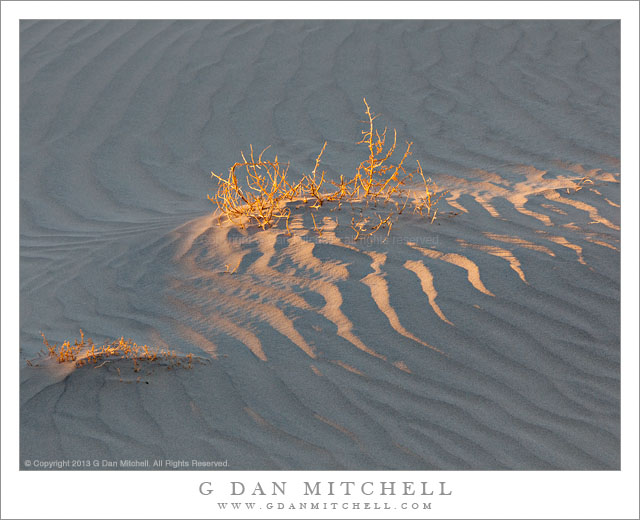
Dune Detail, Last Light

Dune Detail, Last Light

Dune Detail, Last Light. Death Valley National Park, California. December 11,2013. © Copyright 2014 G Dan Mitchell – all rights reserved.

A last beam of light slants across rippled sand dunes and a few desert plants, Death Valley National Park

After a long day of driving and photographing along a back-country road in Death Valley National Park, I finally made it back to my campground in the mid-afternoon. (You might wonder how I can claim a “long day” when I finished in the mid afternoon – something about starting a couple of hours before dawn in temperatures in the teens!) I took a short break and did a few camp chores, and then it was time to head out once again for an evening shoot. I decided to make it something fairly simple that wouldn’t require a lot of travel, so I ended up at some dunes just before sunset.

While I’m not unwilling to shoot big, long views of dunes – sometimes they are quite impressive! – more often I focus on some smaller aspect of them, and I really like looking very closely when I can. One of the great things about focusing on the small details is that once you start to see them you find them everywhere – even in places that you might not think are all that spectacular. As I walked out into the dunes, with only a general sense of where I wanted to go, it was not long at all before I started noticing all sorts of subjects in the long shadows and warm light of the oncoming evening. Many subjects, such as this one, are illuminated by extremely transient light – slanting at a low angle across the tops of dunes and momentarily catching a plant or a bit of dune texture. I probably had little more than a minute to work with this subject and then the light disappeared – and I quickly found another similar subject and then another and so on until the light finally was gone.

G Dan Mitchell is a California photographer and visual opportunist whose subjects include the Pacific coast, redwood forests, central California oak/grasslands, the Sierra Nevada, California deserts, urban landscapes, night photography, and more.
Blog | About | Flickr | Twitter | FacebookGoogle+ | 500px.com | LinkedIn | Email

Text, photographs, and other media are © Copyright G Dan Mitchell (or others when indicated) and are not in the public domain and may not be used on websites, blogs, or in other media without advance permission from G Dan Mitchell.

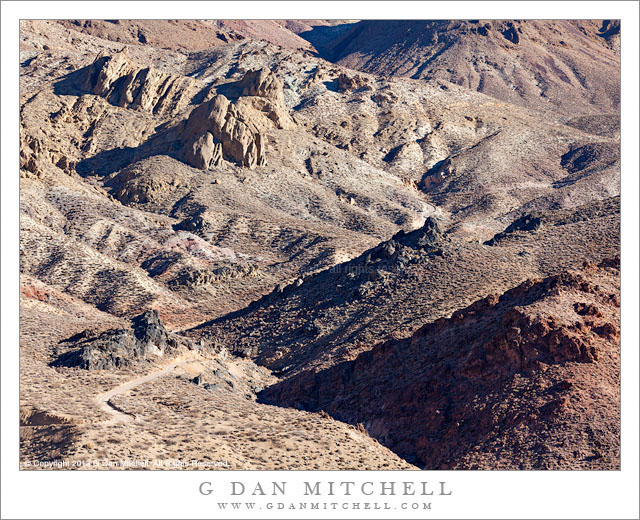
Titus Canyon Road

Titus Canyon Road
Titus Canyon Road

Titus Canyon Road. Death Valley National Park, California. December 11, 2013. © Copyright 2014 G Dan Mitchell – all rights reserved.

Titus Canyon Road descents into upper Titanothere Canyon before climbing to Red Pass

Early December is a fine time to be in Death Valley National Park, and I managed to spend five days there this past December. The weather is cooler this time of year – in fact, temperatures dropped into the upper twenties in the Valley during my visit and well down into the teens in some of the upper elevations that I visited during the pre-dawn hours. Although seasoned Death Valley visitors prefer to visit during the cooler months, things seem much quieter than a few months later in the spring. In fact, I almost had the entire Stovepipe Wells campground to myself on my first night!

The relative solitude extended to this day, on which I drove over the Amargosa Range via Titus Canyon Road, the rough back-country one-way route between the Amargosa Valley and Death Valley itself. I know this route fairly well, having been over it a number of times. I always start in the morning, and this trip was no exception – I was well out on to the route when the sun came up. Often I just take a few hours for the trip, stopping at a few key locations. But recently I have thought more about how I might photograph some of these places that I used to simply drive through, and on this visit I slowed way down and devoted almost the entire day to this area. The location in this photograph is an example of the sort of area that I might have just passed through in the past. Here the road traverses the upper reaches of a very large canyon that eventually spills out into Death Valley far below. The location from which I made the photograph marks the high point on the route, and I always stop there – but on some previous visits I have just regarded the terrain as being empty. It isn’t, and I’m learning to see it more clearly. Here the gravel road drops down from the previous ridge, winding through the rough and dry landscape to the bottom of the canyon and its dry stream bed before climbing steeply up to my camera position.

G Dan Mitchell is a California photographer and visual opportunist whose subjects include the Pacific coast, redwood forests, central California oak/grasslands, the Sierra Nevada, California deserts, urban landscapes, night photography, and more.
Blog | About | Flickr | Twitter | FacebookGoogle+ | 500px.com | LinkedIn | Email

Text, photographs, and other media are © Copyright G Dan Mitchell (or others when indicated) and are not in the public domain and may not be used on websites, blogs, or in other media without advance permission from G Dan Mitchell.